It is remarkably easy to deceive oneself regarding one’s own importance and popularity.
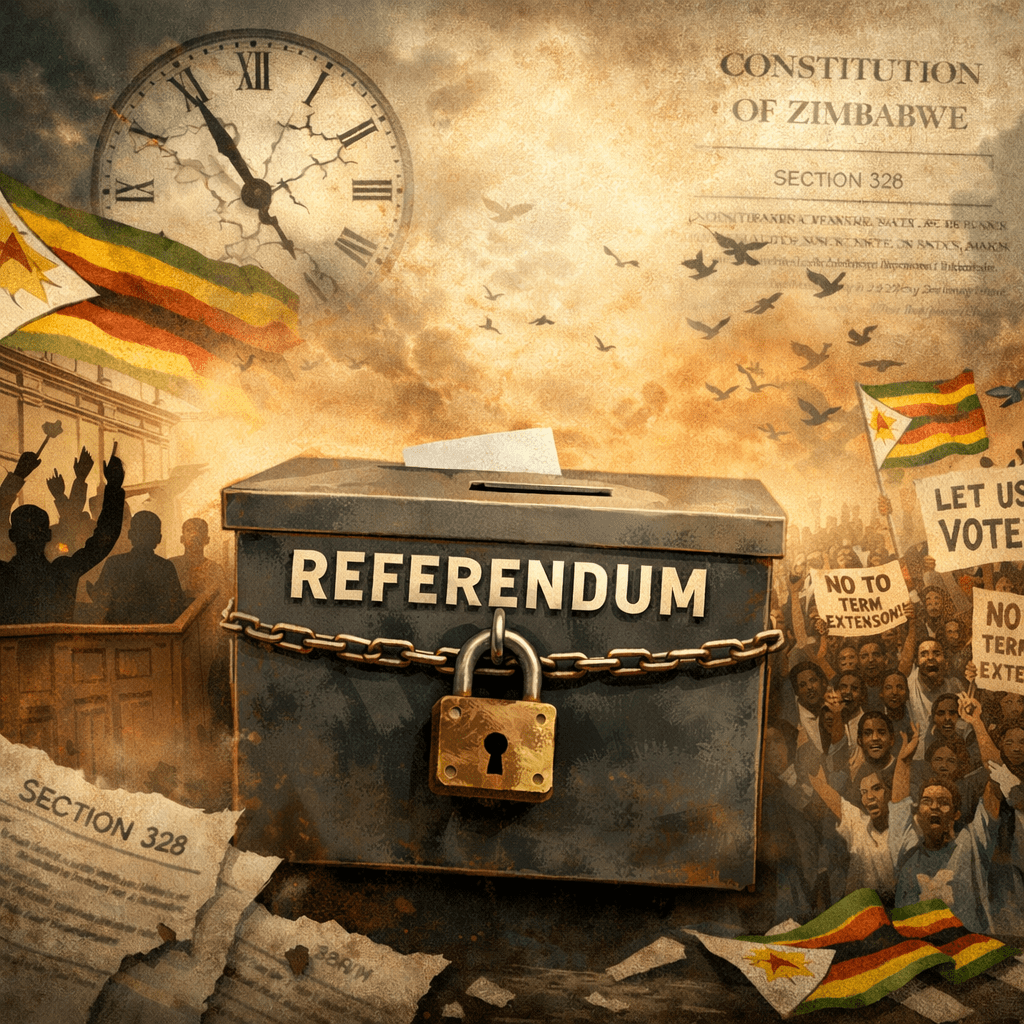
Ever since Cabinet approved proposals to amend the Constitution of Zimbabwe, the government has gone to extraordinary lengths to convince Zimbabweans that a national referendum is unnecessary.
If you value my social justice advocacy and writing, please consider a financial contribution to keep it going. Contact me on WhatsApp: +263 715 667 700 or Email: mbofana.tendairuben73@gmail.com
These proposals would, among other things, extend the president’s term in office from five to seven years and remove direct election by the citizens, replacing it with selection by Parliament.
Ironically, this same Cabinet is chaired by the president who stands to benefit directly from these changes.
Senior officials have consistently spun the narrative that citizens’ voices will be represented by members of Parliament, whom we elected to represent us.
In doing so, they have outright dismissed the need for a referendum.
Some have even cited examples of countries where constitutional amendments occur without a referendum, as if these examples alone could justify circumventing Zimbabwe’s supreme law.
President Mnangagwa’s own spokesperson, George Charamba, went further, taking to social media to claim that only six countries in the world hold national referendums for constitutional changes—including Ireland, Australia, and France—adding that “a few more require referenda for select chapters only.”
Curiously, he did not mention Zimbabwe among these “few more.”
This omission is telling.
It is a deliberate distortion designed to suggest that a referendum is unnecessary for extending the president’s term.
But the Constitution itself, drafted with foresight and clarity, directly contradicts this narrative.
No one denies that the proposed amendments are intended to extend the term of the current president, Emmerson Mnangagwa.
This has been consistently emphasized by his loyalists in government and in ZANU-PF, and it was reportedly the number one resolution at both the 2024 and 2025 ZANU-PF annual people’s conferences in Bulawayo and Mutare, respectively.
So what does the Constitution say about an incumbent benefiting from a term-limit extension?
Section 328(7) is unambiguous: an amendment to a term-limit, the effect of which is to extend the length of time that a person may hold or occupy any public office, does not apply to any person who held or occupied that office, or an equivalent office, at any time before the amendment.
No matter how some, including the flip-flopping Professor Jonathan Moyo, attempt to spin this—arguing that a “term limit” refers only to the number of terms, not the length of each term—this fact cannot be changed.
They may claim that Section 91(2) only limits the number of terms and not the five-year term stipulated in Section 95(1), and therefore Section 328(7) does not apply to President Mnangagwa.
But the Constitution itself dismisses this legal gymnastics.
Section 328(7) clearly defines a term-limit amendment as one “the effect of which is to extend the length of time that a person may hold or occupy any public office.”
To extend the length of time!
How much clearer can it be?
If the Constitution is amended to extend the presidential term, or even the tenure of Parliament in this office from five to seven years, this is a direct extension of the length of time the person may hold that public office.
The confusion being peddled is manufactured by loyalists seeking to circumvent and bastardize the supreme law of the land.
Section 328(7) makes it clear that someone like President Mnangagwa cannot benefit.
But that section can be amended, and if it is, Section 328(8) is explicit: subsections (6) and (7) must not both be amended in the same Constitutional Bill, nor may amendments to both be put to the people in the same referendum.
Any amendment to Section 328(7) is therefore expected to be subjected to a referendum.
Section 328(9) reinforces this, stating that the section may be amended only by following the procedures set out in subsections (3), (4), (5), and (6), as if it were contained in Chapter 4 of the Constitution—the Declaration of Rights.
Section 328(6) makes it crystal clear: where a Constitution Bill seeks to amend any provision of Chapter 4 or Chapter 16 (on land), within three months after it has been passed by the National Assembly and the Senate, it must be submitted to a national referendum.
In short, amendments to Section 328, which includes the provision barring an incumbent from benefiting, cannot bypass a national referendum.
Parliamentary approval alone is insufficient.
If the push to extend President Mnangagwa’s term is genuinely driven by the people—with some top officials and ZANU-PF social media operatives absurdly claiming over 80 percent endorsement—why then is there a fear of a national referendum?
Shouldn’t a referendum be an opportunity to prove once and for all that this is truly a popular demand, not an engineered political maneuver?
What is being hidden?
Are party officials worried that the charade of ZANU-PF resolutions—passed by a few provincial leaders claiming to speak for grassroots members—will be exposed as unrepresentative?
History provides clues.
In both the 2018 and 2023 elections, President Mnangagwa received far fewer votes than the party’s parliamentary candidates, scraping by with wafer-thin margins while ZANU-PF secured an overwhelming majority in Parliament.
If there were truly overwhelming support for his continued stay in power, this discrepancy would not exist.
Even for a party notorious for rigging elections, the regime cannot be confident that its machinery would secure a favorable outcome in a national referendum.
The “ED2030” agenda is not a people’s agenda.
It is a private project engineered by those who directly benefit from President Mnangagwa’s tenure—individuals who fear that a post-Mnangagwa dispensation will signal the closure of their feeding trough or require them to answer for past actions.
The people have nothing to gain.
On the contrary, this agenda perpetuates the Zvigananda looting spree, ensuring ordinary Zimbabweans grow poorer while the few around power grow richer.
A national referendum is not a threat; it is a democratic test.
If this campaign truly reflects popular will, the government should welcome the vote.
Avoiding it only reveals the fragility of the claim.
Zimbabweans deserve more than the spin of party loyalists; they deserve the final say in matters that directly affect their democratic rights.
● To directly receive his articles please join his WhatsApp Channel on: https://whatsapp.com/channel/0029VaqprWCIyPtRnKpkHe08
 TENDAI RUBEN MBOFANA - THE UN-OPPRESSED MIND!