It becomes problematic when the hunger to consolidate power become more powerful that the hunger to uplift citizens.
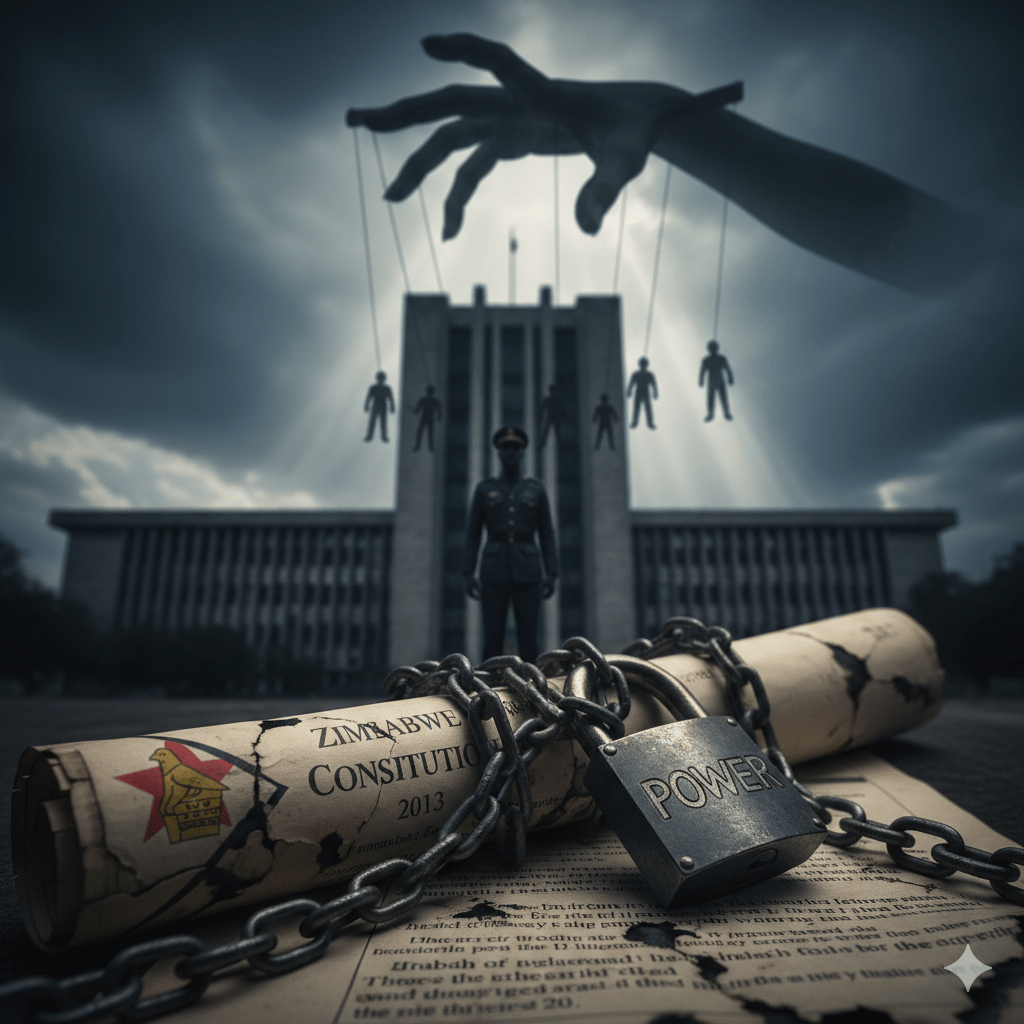
In the traditional evolution of a constitutional democracy, amendments are typically treated as an expansion of the light—a way to widen the franchise, deepen the pool of civil liberties, or tighten the leash on executive ambition.
If you value my social justice advocacy and writing, please consider a financial contribution to keep it going. Contact me on WhatsApp: +263 715 667 700 or Email: mbofana.tendairuben73@gmail.com
Yet, in Zimbabwe, we are witnessing a disturbing legal inversion.
Since the adoption of the 2013 Constitution, a document born of a rare national consensus and overwhelmingly endorsed by 94% of the population, not a single amendment has been crafted to make the life of the ordinary citizen easier, freer, or more secure.
Instead, the supreme law of the land is being systematically cannibalized.
It has been transformed from a shield for the people into a toolkit for the presidency, refined with surgical precision to ensure that power remains concentrated at the very top, far beyond the reach of those it is meant to serve.
One must critically interrogate the legacy of the “Second Republic” in this regard.
When this administration took the reins in 2017, the air was thick with the rhetoric of “reform” and “openness.”
Yet, the legislative reality has been a feverish race to undo the democratic safeguards of 2013.
A constitution is, by its very nature, supposed to tamper the power of those in office and make them directly accountable to the people.
In genuine democracies, we see this in practice.
Take, for example, the 22nd Amendment to the United States Constitution, which codified presidential term limits to prevent the emergence of a permanent executive.
Or consider Kenya’s 2010 Constitution, which radically devolved power to local counties and created a judiciary so independent it had the courage to nullify a flawed presidential election.
In Malawi, constitutional amendments and judicial independence combined to protect the integrity of the vote in 2020.
These are examples of nations using their supreme law to trim the hedges of power, allowing the rights of the citizen to breathe.
In Zimbabwe, however, the “Second Republic” has spent the last nine years doing the exact opposite.
The introduction of Constitutional Amendment No. 1 and No. 2 marked the beginning of this deconstruction.
By granting the President the unilateral power to appoint senior judges and extend their retirement ages, the state effectively neutered the judiciary’s role as an independent arbiter.
When the executive handpicks the umpires, the concept of the “separation of powers” becomes a polite fiction.
Furthermore, the removal of the “running mate” clause ensured that the Vice-Presidents remain appointees at the pleasure of the President, rather than elected officials with their own constitutional mandate.
These changes did nothing to fix the bread-and-butter issues of the Zimbabwean people; they were solely about the comfort and longevity of the man in the high office.
What makes this trend even more troubling is that while the government is eager to amend the constitution to consolidate power, it is equally enthusiastic about ignoring the rights already enshrined within it.
The 2013 Constitution clearly protects the right to peacefully demonstrate and petition.
Yet, under the “Second Republic,” the streets have become a silent monument to repression.
Not a single major anti-government demonstration has been sanctioned without a heavy-handed crackdown or a preemptive ban.
This is a direct violation of Section 59, rendering a fundamental democratic right dead on arrival.
The erosion extends to political rights in our rural heartlands, where the constitutional promise of a free and fair choice is often a myth.
Reports persist of citizens being coerced into supporting the ruling ZANU-PF through the weaponization of state resources and food aid, while opposition parties are frequently denied the right to conduct activities or access these areas freely.
When a significant portion of the population is bullied into political compliance, the constitution is not being upheld—it is being incinerated.
Even the Fourth Estate, the supposed watchdog of democracy, has been caught in the crosshairs.
Freedom of expression and of the media are guaranteed in Section 61, yet journalists like Blessed Mhlanga and Faith Zaba have faced arrest and harassment for merely doing their jobs.
The persistence of “insult laws,” which see citizens jailed for supposedly disparaging the dignity of the President, creates a chilling effect that makes a mockery of free speech.
It is a strange paradox: a presidency so fragile that it requires the protection of the police from the words of its citizens, yet so powerful that it can rewrite the national law at will.
The most visceral failure of the state’s constitutional obligation, however, is found in the right to health care.
Section 76 of our constitution is clear: every citizen has the right to basic healthcare services.
Yet, thousands of Zimbabweans needlessly lose their lives every year because our public health institutions are underfunded, unprofessionally run, and stripped of basic medicines.
When a mother dies in a ward for lack of a simple procedure, or a child succumbs to a preventable disease because a clinic has no medication , it is a criminal violation of the social contract.
The state’s “power greed” is evidently not matched by an enthusiasm for public service.
Perhaps the most glaring evidence of this anti-people trajectory is the refusal to facilitate the diaspora vote.
Zimbabweans living abroad are the lifeblood of our economy, contributing billions of dollars in remittances that surpass the output of most domestic industries.
These are people who have sacrificed much for the country, many having fled political or economic instability.
They have a “sacred right” to vote—a right bought by the blood of thousands during the liberation struggle.
Yet, there has been no amendment to include them.
Instead, as we sit in 2026, we are witnessing a move in the opposite direction.
The latest proposed constitutional amendments are the most troubling yet.
The suggestion that citizens should no longer directly vote for their president, moving instead to an indirect election through Parliament, is the ultimate admission of fear.
It is a move to insulate the executive from the popular will.
If the people can no longer choose their leader, then the leader is no longer accountable to the people; he is accountable only to the party machine.
Coupled with the push to extend presidential terms from five to seven years, it becomes clear that the “Second Republic” views the 2013 Constitution not as a guide for governance, but as a hurdle to be cleared on the path to life presidency.
The 94% who voted “Yes” in 2013 did not vote for a document that could be tailored like a suit for the incumbent.
They voted for a Zimbabwe where the law is king, not where the king is law.
To move forward, we must stop the “deconstruction” of our democracy.
We must demand that amendments focus on the diaspora vote, on the implementation of the Bill of Rights, and on the fixing of our health and education systems.
Anything less is a betrayal of the millions who stood in line a decade ago, hoping for a country that finally belonged to them.
The current trend is not just troubling; it is a direct assault on the soul of the nation.
It is time to return the constitution to the people before there is nothing left of it but the paper it was written on.
● To directly receive his articles please join his WhatsApp Channel on: https://whatsapp.com/channel/0029VaqprWCIyPtRnKpkHe08
 TENDAI RUBEN MBOFANA - THE UN-OPPRESSED MIND!