Truth has a stubborn way of outliving the excuses made to bury it.
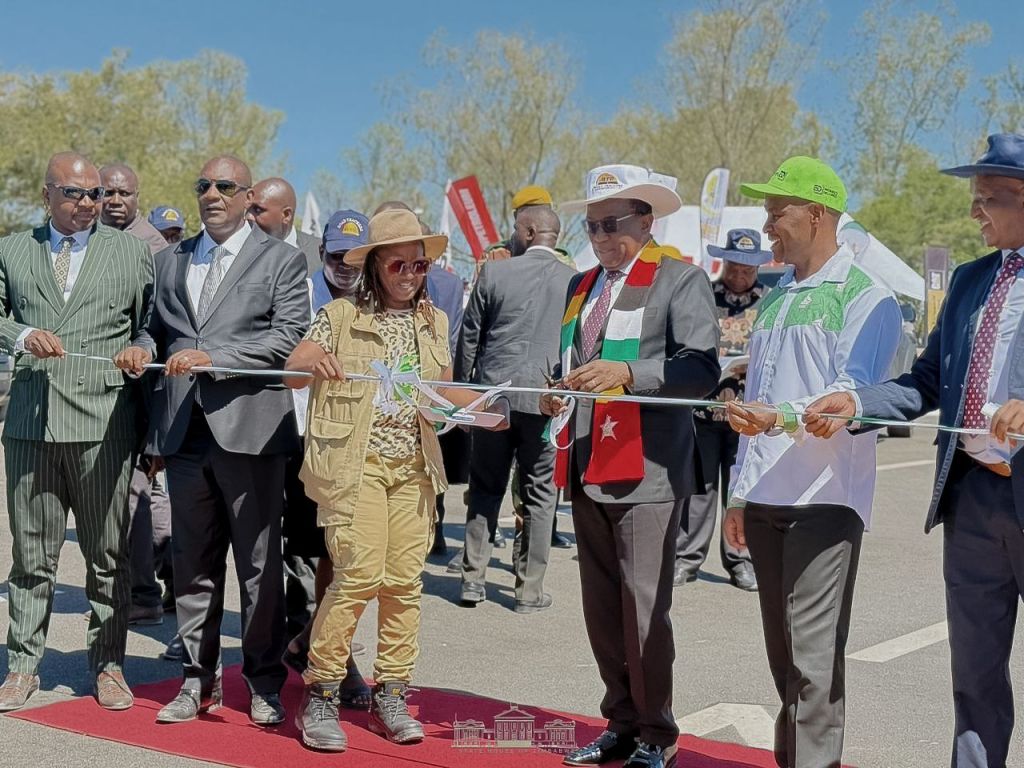
There is a peculiar brand of audacity required to stand before a nation, amidst the rubble of a disintegrating multi-million-dollar infrastructure project, and suggest that the primary culprit is not the hand that built it, but the wheels that drive upon it.
If you value my social justice advocacy and writing, please consider a financial contribution to keep it going. Contact me on WhatsApp: +263 715 667 700 or Email: mbofana.tendairuben73@gmail.com
Yet, this is precisely the theatre of the absurd we are currently witnessing in the wake of the “Urgent” alert issued by the Permanent Secretary for Information, Nick Mangwana, regarding the Shurugwi-Mhandamabwe Road.
To suggest that a road personally commissioned by the President less than two years ago, touted as a hallmark of the “Second Republic’s” developmental prowess, has begun to surrender its structural integrity so soon due merely to “overloading” is not just an insult to engineering; it is a profound insult to the intelligence of every Zimbabwean taxpayer.
It is a desperate, transparent attempt to drape the failures of a predatory patronage system in the flag of “national interest,” shifting the blame from the corridors of power to the dashboards of transport operators.
Let us be clear: roads do not simply “catch” distress like a common cold.
In the world of civil engineering, a road is a calculated response to a specific environment.
When the government commissioned the Shurugwi-Mhandamabwe Road, they were not building a bicycle path through a quiet suburb; they were rehabilitating a vital artery in the heart of Zimbabwe’s mining landscape.
This is a region defined by the heavy-haulage of chrome and platinum, a fact as permanent and predictable as the sun rising in the east.
Any contractor worth their salt, and any Ministry of Transport official with a shred of competence, knows exactly what the “axle-load” requirements for such a route entail.
If a road designed with a 20-year lifespan begins to buckle and show “alarming signs of distress” within months of its inauguration, it is not because the trucks are too heavy—it is because the road was built too thin.
Mangwana’s statement attempts to paint a picture of “irresponsible” truck drivers becoming “agents of destruction,” but this is a classic case of gaslighting.
If a bridge collapses under the weight of a crowd, we do not blame the people for being too numerous; we indict the engineer who failed to calculate the load.
By blaming overloading, the government is essentially admitting one of two things: either they were so incompetent that they designed a “light-duty” road for a heavy-industrial corridor, or they allowed a contractor to skimp on the essential sub-base materials required to withstand the very traffic the road was intended to serve.
In the context of Zimbabwe’s current political economy, the latter is far more likely.
We are living in an era of “tenderpreneurship,” where the proximity to power often dictates the awarding of contracts more than technical merit or a track record of excellence.
When billions are poured into infrastructure, and those funds are channeled toward companies whose primary qualification is their political alignment, the result is inevitable: shoddy workmanship that prioritizes the “ribbon-cutting” optics over the “twenty-year” reality.
The failure of the Shurugwi-Mhandamabwe link is merely the latest chapter in a long-running saga of infrastructure fraud.
We need only look at Seke Road, the strategic artery linking Harare to Chitungwiza, which has been reduced to a notorious obstacle course despite repeated official claims of rehabilitation.
As of early 2026, the road has deteriorated so severely that the Ministry of Transport has been forced into ‘emergency patching’—a desperate stopgap for a project that should have lasted decades.
This pattern of ‘disposable construction’ was mirrored in the billion-dollar rush for the 2024 SADC Summit, where roads like Nemakonde Way, Emmerson Dambudzo Mnangagwa Road, and Airport Road were given superficial, paper-thin facelifts.
Perhaps most telling is the case of Lorraine Drive and sections of Harare Drive, where the Ministry was forced to publicly order contractors like Fossil Contracting and Asphalt Products to redo the work at their own expense after the surfaces began disintegrating almost immediately.
This proves that even the authorities know the truth: it isn’t the trucks, it’s the shoddy workmanship.
Even the staggering $114 million Trabablas Interchange (Mbudzi) and Norton’s Shonhiwa and Koshen Drive have shown premature distress.
This is a visible indictment of a system that prioritizes patronage over engineering, forcing the taxpayer to fund the same kilometer of road multiple times over.
Therefore, there is a stinking hypocrisy in calling upon mining companies and transport operators to exercise “patriotic duty” while the state fails in its own regulatory obligations.
Mangwana speaks of weight limits being “there for a reason,” yet he remains silent on the state of our national weighbridges.
If overloading is truly a national siege, where are the enforcement mechanisms?
Why are these “irresponsible” vehicles allowed to traverse hundreds of kilometers of highway without being stopped, weighed, and fined?
The truth is that the “compliance” the Ministry calls for is often bypassed through the same system of patronage and bribery that defines the regime.
It is much easier for a government to release a flashy social media graphic blaming “unpatriotic” drivers than it is to address the systemic rot within the vehicle inspection departments and the weighbridge stations that are supposed to guard these “national assets.”
Furthermore, the rhetoric used in this statement is a masterclass in deflection.
By categorizing road failure as an “Economic Setback” and a “Squandering of National Resources,” Mangwana is attempting to preemptively absolve the state of the financial accountability that should follow such a failure.
If a road fails prematurely, the contractor should be liable.
The “millions in public funds” are being eroded not just by tires, but by a lack of transparent quality control and the absence of iron-clad performance guarantees.
In a functioning democracy, the “distress” shown by the Shurugwi-Mhandamabwe Road would lead to an independent audit, a suspension of the contractor, and a public inquiry into the procurement process.
Instead, we are given a lecture on “patriotism.”
It is a convenient shield; if you criticize the workmanship, the regime accuses you of supporting the “siege” against national development.
This is not just about potholes or asphalt; it is about the fundamental betrayal of the promise of independence.
My father, and the countless others who mobilized for a free Zimbabwe, did not envision a nation where the very infrastructure of progress would be treated as a disposable prop for political theater.
They envisioned a country built on the bedrock of excellence and integrity.
This is not just about potholes or asphalt; it is about the fundamental failure of public trust.
We are witnessing a era where the very infrastructure of progress is treated as a disposable prop for political theater, built not to last, but to survive just long enough for the cameras to stop rolling.
A nation is built on the bedrock of excellence and engineering integrity, not on the shifting sands of political expediency.
To see a brand-new road disintegrate is to see a physical manifestation of the regime’s governance style: all surface, no depth.
It is a “potemkin” development, where the top layer looks smooth enough for a presidential motorcade, but the foundation is a hollowed-out shell of mismanagement and greed.
The “alarming signs of distress” Mangwana mentions are not confined to the tarmac; they are reflected in the eyes of the 50% of Zimbabweans living in extreme poverty who watch as millions are “squandered” on projects that need “premature repairs” before the ink on the contract is even dry.
The irony of the Shurugwi-Mhandamabwe project is that it was touted as a “victory” for local capacity.
While empowering local contractors is a noble and necessary goal, it must not be used as a cover for substandard work.
True patriotism is not found in a truck driver obeying a weight limit that the road’s design should have already anticipated; true patriotism is found in a government official who ensures that every cent of taxpayer money buys a road that actually lasts twenty years.
True patriotism is refusing to award a tender to a crony who will use inferior bitumen or thin out the sub-base to line their own pockets.
By shifting the burden of “safeguarding investments” onto the public, the Ministry of Information is effectively admitting that the state has lost control—or perhaps, that it never had an interest in control to begin with, so long as the right people were getting paid.
As we move forward, we must refuse to accept these excuses.
We must reject the narrative that the destruction of our infrastructure is an act of God or a failure of the citizenry.
It is a failure of oversight, a failure of integrity, and a failure of leadership.
The “siege” on our roads is coming from inside the house.
It is the result of a system that rewards loyalty over competence and optics over substance.
Until there is real accountability for the contractors who deliver these “disposable” roads and the officials who sign off on them, we will continue to watch our national wealth crumble beneath our feet, one “premature repair” at a time.
Our fathers’ generation fought for a Zimbabwe that could stand the test of time; the current regime seems content to build a Zimbabwe that barely survives the rainy season.
The next time a government official warns of an infrastructure “siege,” we should look not at the trucks on the road, but at the signatures on the contracts.
We should ask why our “vital links” are so fragile and why our “patriotic duty” always seems to involve covering up for the regime’s incompetence.
The road to a prosperous Zimbabwe cannot be built on a foundation of lies and excuses.
It requires the hard, honest work of building things that last—and the courage to hold to account those who would rather see the nation’s dreams turn into dust.
● Tendai Ruben Mbofana is a social justice advocate and writer. To directly receive his articles please join his WhatsApp Channel on: https://whatsapp.com/channel/0029VaqprWCIyPtRnKpkHe08
 TENDAI RUBEN MBOFANA - THE UN-OPPRESSED MIND!