Self-delusion is a comfortable sedative, but it is a terminal cure for a nation in decay.
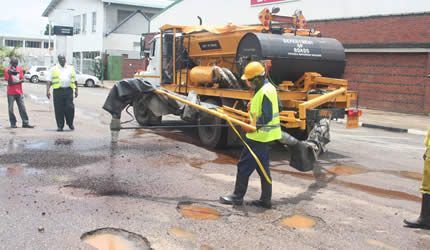
Last evening, as the flickering glow of the state-controlled broadcaster ZBC filled living rooms across the nation, viewers were treated to a familiar spectacle.
If you value my social justice advocacy and writing, please consider a financial contribution to keep it going. Contact me on WhatsApp: +263 715 667 700 or Email: mbofana.tendairuben73@gmail.com
An excitable news reporter, gesturing with rehearsed enthusiasm, stood on a freshly paved stretch of road in Harare, declaring the “mammoth” progress of the government’s rehabilitation program.
In a bid to frame this modest patch of bitumen as a monumental achievement, the reporter leaned on a tired, convenient cliché: “Rome was not built in a day.”
It is a phrase designed to induce a sedative patience in the populace, a linguistic sleight of hand intended to mask a reality that has not eluded a single Zimbabwean with eyes to see.
The reality is that while a few kilometers of suburban tarmac are celebrated with the pomp of a moon landing, the rest of the country’s road network lies in ruins, resembling war zones that pose a daily, lethal danger to vehicles and human life alike.
This rhetoric is not new.
President Emmerson Mnangagwa has long favored the mantra “Brick by brick,” a slogan that suggests a methodical, steady reconstruction of a nation.
On the surface, it sounds pragmatic and humble.
It suggests that the current administration is painstakingly laying the foundations of a new house after inheriting a wasteland.
But this is where the gaslighting begins.
To suggest that Zimbabwe is being built “one step at a time” as if we are a nascent state, barely out of its infancy, is a staggering insult to the collective intelligence of the nation.
Zimbabwe is not a new country being built from scratch.
We are a nation commemorating 46 years of ZANU-PF rule—a party that has held the levers of power since the Union Jack was lowered in 1980.
After nearly half a century in the cockpit, the “Rome wasn’t built in a day” defense is not just weak; it is a confession of failure.
When ZANU-PF took the reins at independence, they did not inherit a desert.
They inherited what Julius Nyerere famously described to Robert Mugabe as “the jewel of Africa.”
This was a country with a functional, diversified economy that was ranked among the best on the continent.
We inherited a road network so immaculate and a rail system so efficient that photographs from the 1980s are often mistaken by the younger generation for scenes from Europe.
We had a health system that was the envy of the region and schools that produced the most literate population in Africa.
We did not start with nothing.
We started with everything required to become a global titan.
Yet, 46 years later, the same party that presided over the “Jewel” asks for patience as they patch up the very potholes they allowed to form through decades of criminal neglect.
The irony of the Rome analogy is that while Rome was not built in a day, it was certainly burnt down in one.
In the context of Zimbabwe, the “fire” has been a slow, agonizing burn fueled by rampant corruption, systemic mismanagement, and the brazen looting of national resources.
Under the watch of this single party, a prosperous nation was converted into a basket case.
We are told to be grateful for a “brick” being laid today, while the government conveniently forgets that they are the ones who dismantled the entire wall over the last four decades.
Where did the “bricks” go that were already there in 1980?
They were liquidated into offshore accounts, converted into luxury villas in foreign lands, and vanished into the pockets of a well-connected elite who view the national treasury as a private ATM.
The “brick by brick” narrative falls apart completely when one looks at the resource-rich peripheries of the country.
If the government were truly building the nation one step at a time, places like Marange, Mutoko, Binga, Bikita, and Lupane should today be bustling, modern cities.
These areas sit atop vast wealth—diamonds, lithium, gold, and timber.
In any functioning democracy committed to development, the extraction of these minerals would have paved every road in the province with high-grade asphalt and built world-class hospitals in every district.
Instead, the people of Binga remain trapped in a time warp of underdevelopment, and the villagers in Marange walk on dusty tracks while billions of dollars in diamond revenue vanish into the “black hole” of state-sponsored opacity.
We should not be talking about the “rehabilitation” of Harare, Bulawayo, or Gweru as if it were an achievement.
By 2026, these cities should have evolved to compete with the likes of Brussels, Geneva, or the very Rome the state media loves to cite.
Zimbabwe is not a poor country; it is a rich country that has been poorly managed.
We boast minerals that the world is desperate for, yet we are told to celebrate a clinic being constructed here or a single school block there.
These are not signs of a developing nation; they are the crumbs falling from a table where the elite are feasting on the nation’s future.
The “Rome wasn’t built in a day” mantra is used to demand a level of patience that ZANU-PF has long since exhausted.
Forty-six years is more than enough time to have built three Romes.
In the same timeframe that ZANU-PF has governed Zimbabwe, nations like Singapore and South Korea rose from the ashes of war and absolute poverty to become first-world economic powerhouses.
They didn’t have the lithium, the gold, or the fertile soil that we possess.
What they had was leadership that understood that “building” requires more than slogans; it requires accountability, the rule of law, and an end to the culture of entitlement.
To accept the government’s plea for patience is to accept the premise that our current state of decay is a natural starting point.
It is not.
The ruins we see today are the result of a deliberate, sustained assault on the country’s infrastructure through the diversion of maintenance funds to political patronage.
When a reporter praises the patching of a road, they are essentially asking us to thank the person who broke our legs for handing us a pair of ill-fitting crutches.
The time for empty slogans is over.
As long as the primary drivers of our national collapse—corruption and the total lack of accountability—remain at the heart of the governance system, “brick by brick” will remain a hollow promise.
You cannot build a house on a foundation of rot.
We must stop allowing ourselves to be treated as fools who cannot count the years.
Forty-six years is not a “day.”
It is a lifetime.
It is a period longer than the entire lifespan of many of the citizens who are now forced to navigate the “war zone” roads of a country that was once the envy of the continent.
If ZANU-PF wants to use the Rome analogy, they should remember that Rome’s greatness was built on its infrastructure and its laws, but its fall was precipitated by the decadence and corruption of its leaders.
Zimbabweans don’t need metaphors; they need the functional, prosperous country that was promised to them 46 years ago—a country that was already largely built, before it was systematically dismantled.
● Tendai Ruben Mbofana is a social justice advocate and writer. To directly receive his articles please join his WhatsApp Channel on: https://whatsapp.com/channel/0029VaqprWCIyPtRnKpkHe08
 TENDAI RUBEN MBOFANA - THE UN-OPPRESSED MIND!