In the hands of those in power, history is often the first and greatest casualty.
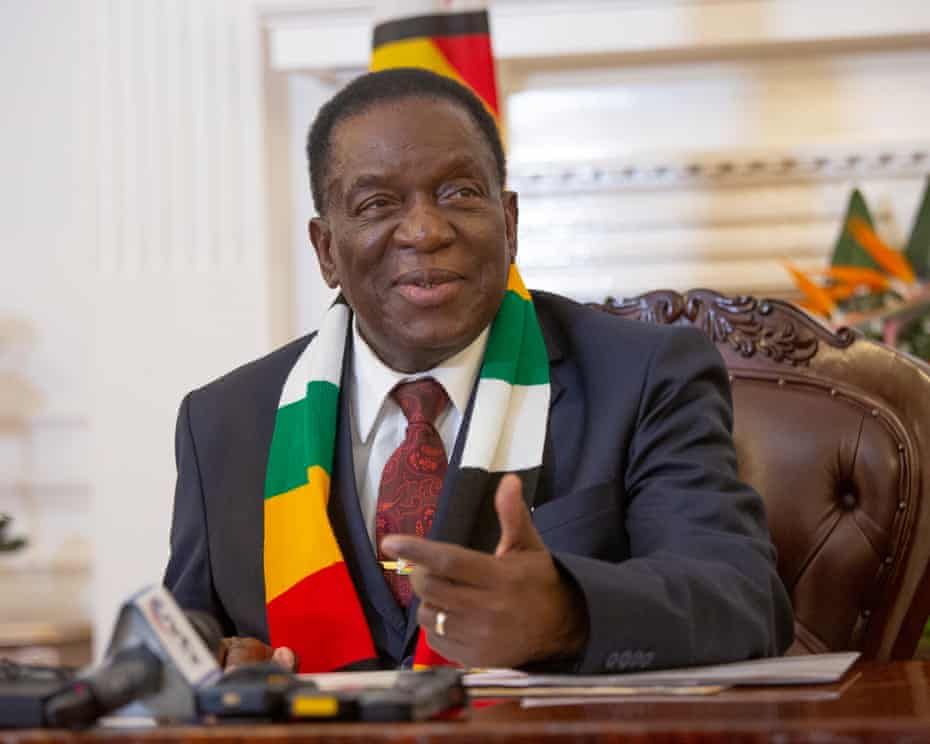
When President Emmerson Mnangagwa sat across from Tucker Carlson at the World Governments Summit in Dubai, he was not merely answering a journalist; he was performing a carefully choreographed act of historical revisionism.
If you value my social justice advocacy and writing, please consider a financial contribution to keep it going. Contact me on WhatsApp: +263 715 667 700 or Email: mbofana.tendairuben73@gmail.com
To the uninitiated international observer, his words painted a picture of a principled revolutionary correcting the deep-seated wounds of colonialism.
He spoke of land as a matter of sovereignty and suggested that those who fled Zimbabwe did so because they could not stomach the idea of equality.
However, for those who lived through the smoke and the chaos of the early 2000s, the President’s performance was nothing short of a stunning betrayal of the truth.
To claim that white farmers left because they felt “superior” is a grotesque distortion that ignores the state-sponsored terror, the collapse of the rule of law, and a political calculation that had everything to do with ZANU-PF’s survival and almost nothing to do with the landless poor.
Scrutiny of the President’s narrative reveals a series of convenient omissions.
The suggestion that farmers simply “decided to leave” masks the reality of a period defined by lawlessness and fear.
People did not leave because they felt superior; they left because they were hunted.
The land acquisitions were not a tidy legal transfer but a haphazard and violent campaign.
Farmers were given mere minutes to vacate properties they had called home for generations, often with nothing but the clothes on their backs.
They faced ambushes, beatings, and in several tragic cases, cold-blooded murder.
No rational person stays in a house that is being torched by mobs while the police stand by with folded arms.
To frame this flight as a choice based on racial pride, rather than a desperate attempt to preserve life and limb, is an insult to the victims of that era.
Security and the protection of the law are the basic prerequisites for any citizen to remain in their country, and in 2000, the Zimbabwean state deliberately withdrew those protections from a specific segment of its population.
The timing of this “correction of historical injustice” is perhaps the most damning evidence against the government’s narrative.
If ZANU-PF was so burdened by the weight of colonial land theft, why did it wait twenty years to act?
From 1980 to 1990, the government was bound by the “willing seller, willing buyer” clause of the Lancaster House Constitution, but that clause expired in 1990.
For the next ten years, the regime had the legal and constitutional power to embark on a structured, fair, and productive land reform program.
Instead, they dragged their feet for a decade.
It was only when the regime faced its first genuine existential threat—the defeat in the February 2000 constitutional referendum and the rapid rise of Morgan Tsvangirai’s Movement for Democratic Change—that the “land issue” was suddenly weaponized.
The Fast Track Land Reform Program was not a long-term developmental strategy; it was a knee-jerk, populist survival tactic designed to reclaim the support of war veterans and rural voters who were rightfully disgruntled by a failing economy and systemic corruption.
The common refrain that the British government “reneged” on its Lancaster House commitments is another pillar of the ZANU-PF myth that falls apart under historical inspection.
The British government did indeed pour millions of pounds into land acquisition and distribution in the first two decades of independence.
The shift in policy, famously punctuated by Claire Short’s 1997 letter, who stated the UK would not fund a program “plagued by corruption and elite capture”, was not a random act of colonial spite.
It was a reaction to the blatant misappropriation of funds and land by the Zimbabwean ruling elite.
While the British were willing to fund a program that targeted poverty eradication and benefited the landless, they were unwilling to bankroll a scheme where prime fertile land was being carved up among cabinet ministers and military generals.
The tragedy is that the “new masters” were standing in the way of genuine reform long before the first farm was invaded.
In 2001, Kumbirayi Kangai—who was then the Minister of Lands and Agriculture—was arrested on charges of embezzling approximately Z$228 million (then ~US$4.6 million).
These funds were part of the budget earmarked for land purchases under the reform program.
Although his legal case ultimately “fizzled out” and he was cleared of fraud in 2002, the incident was cited by critics as evidence of systemic corruption within the program.
A 1994 government audit revealed that approximately 5 million hectares of land purchased with British funds—intended for the landless poor—had instead been allocated to senior ZANU-PF politicians, military officers, and their families.
British Ambassador Deborah Bronnert noted that while the UK provided £44 million for land transfers in the 1980s, funding was halted in the 1990s because resources were being “stripped of value” and handed to the political elite rather than being used for productive resettlement.
Allegations surfaced that large portions of British contributions were diverted to “administrative costs” rather than reaching the intended beneficiaries of the “willing buyer, willing seller” model.
Funds provided through the Agricultural and Rural Development Authority (ARDA) and the Land Bank for resettlement projects were often diverted as non-performing loans to politically connected individuals who did not use them for farming.
The funds were being siphoned away, and the land that was acquired was going to top officials and military generals rather than the landless majority.
The ultimate irony of the fast-track land reform program is that it did not end the colonial-era injustice of land inequality; it simply changed the skin color of the perpetrators.
Today, the most productive and fertile land in Zimbabwe is held by a new landed gentry—the ZANU-PF elite and their families.
The divorce proceedings of Bona Mugabe, the daughter of the late Robert Mugabe, provided a sickening glimpse into this reality.
Court documents revealed a staggering portfolio of 21 commercial farms and vast tracts of urban land.
How does a single family come to possess 21 farms in a country where millions of citizens, including those who actually took up arms and fought in the bushes against colonial rule, remain landless and the “one man, one farm” policy is supposed to be the law of the land?
This is not the “correction of an injustice”; it is the institutionalization of greed.
The rural masses who were promised a stake in the breadbasket of Africa often found themselves relegated to marginal lands without the equipment, capital, or title deeds necessary to succeed, while the “new masters” sat on multiple properties they often lacked the skill or will to farm productively.
President Mnangagwa’s rhetoric in Dubai sought to frame Zimbabwe as a victim of Western imperialist whims, but the true victim has always been the Zimbabwean person—black and white—who believed in the promise of a fair and prosperous nation.
The violence of the 2000s was a choice made by a ruling party that preferred to burn the economy to the ground rather than lose an election.
By destroying the agricultural sector through chaos rather than reform, they catalyzed a multi-decade economic depression that has forced millions of our brightest minds into the diaspora.
Those who left were not fleeing equality; they were fleeing a state that had abandoned the very concept of the rule of law.
As we look at the ruins of what was once a continental leader in agriculture, we must reject the simplistic “us versus them” narrative that the President peddles on the global stage.
Colonial land injustices were real, and they demanded a solution, but the path taken by ZANU-PF was never about justice.
It was a populist distraction from their own failures, a shield against democratic opposition, and a massive land grab for a predatory elite.
To move forward, Zimbabwe needs an honest accounting of this history.
We must acknowledge that the greatest obstacles to land justice in our country were not the former colonial masters, but the post-independence leaders who allowed their own selfishness to eclipse the needs of the people.
Only when we stop lying to the world—and to ourselves—can we begin to build a country where land is a source of national prosperity rather than a tool of political survival.
● Tendai Ruben Mbofana is a social justice advocate and writer. To directly receive his articles please join his WhatsApp Channel on: https://whatsapp.com/channel/0029VaqprWCIyPtRnKpkHe08
 TENDAI RUBEN MBOFANA - THE UN-OPPRESSED MIND!