Lies have very short legs.
For more than two decades, the Zimbabwean narrative of economic despair has been meticulously curated by those in power.
If you value my social justice advocacy and writing, please consider a financial contribution to keep it going. Contact me on WhatsApp: +263 715 667 700 or Email: mbofana.tendairuben73@gmail.com
We have been told, with tireless repetition, that our woes—the staggering hyperinflation, the evaporated savings, and the graveyard of six defunct local currencies—were the consequences of external aggression.
“Sanctions,” we were informed, were the invisible hand strangling the life out of the Zimbabwean Dollar, the Bearer Cheque, the Bond Note, and the RTGS.
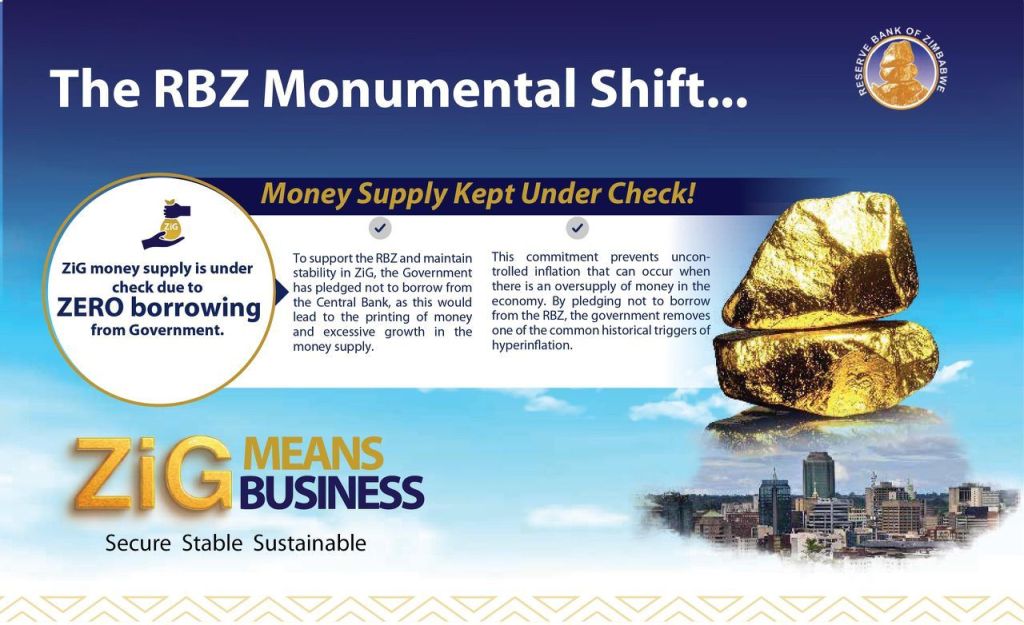
However, a recent and seemingly innocuous graphic released by the Reserve Bank of Zimbabwe (RBZ), titled “The RBZ Monumental Shift,” has done what twenty-five years of opposition politics and economic activism struggled to do: it has provided a smoking-gun confession from the very heart of the state.
By proudly proclaiming that the new currency, the ZiG, is stable because of “ZERO borrowing from Government,” the authorities have inadvertently admitted that the chaos of the past was not a foreign imposition, but a domestic choice.
It is a stunning, if unintended, acknowledgment that the hyperinflationary fires that consumed the nation’s wealth were fueled by a government that treated the central bank as its private, unrestrained ATM.
To understand the weight of this admission, one must look at the historical context the RBZ now admits to trying to “shift” away from.
Since the late 1990s, Zimbabwe has become a global case study in monetary failure.
We have seen the introduction and subsequent demise of six different iterations of local currency, each heralded with the same optimism and each ending in the same tragedy of worthlessness.
The RBZ’s new statement explains that pledging not to borrow from the central bank “removes one of the common historical triggers of hyperinflation.”
This is a profound sentence.
In the world of diplomacy and statecraft, this is what we call “saying the quiet part loud.”
If the removal of government borrowing is the “monumental shift” required for stability, then by logical extension, the presence of that borrowing was the monumental cause of our previous instability.
For years, the government insisted that the printing press was a necessary tool for survival against Western “economic warfare.”
Now, the RBZ admits that the printing press was the weapon used against the Zimbabwean people’s own pockets.
The “sanctions” excuse has served as a convenient veil for what can only be described as fiscal kleptocracy and institutionalized mismanagement.
While the government blamed Washington and Brussels for the currency’s collapse, they were busy engaging in opaque, quasi-fiscal activities that bypass Parliamentary oversight.
This is where the true story of Zimbabwe’s economic struggle lies.
Much of the borrowing the RBZ now pledges to stop was done in the shadows.
Under the guise of “Command Agriculture,” infrastructural development, or civil service stability, billions of dollars were funneled through the central bank.
Yet, as various Parliamentary Portfolio Committees have highlighted over the years, billions of these borrowed dollars remain unaccounted for.
We are a nation that borrows in the dark to spend on projects that never see the light of day.
When the Auditor General’s reports consistently point toward massive leakages, it becomes clear that the “unrestrained borrowing” mentioned by the RBZ was not just a policy error; it was a mechanism for looting.
Consider the sheer absurdity of the government needing to borrow so aggressively from its own central bank when the country sits upon some of the world’s most vast natural resources.
Zimbabwe is a land of gold, diamonds, platinum, and now, the “white gold” of lithium.
In a transparent and responsibly managed economy, these resources should provide a fiscal cushion that makes reckless money printing unnecessary.
Instead, we have seen a paradox where the more resources we discover, the more the government borrows.
This suggests that the borrowed money was never intended to bridge a genuine fiscal gap, but rather to compensate for the fact that resource revenues are often diverted away from the national fiscus and into the pockets of a politically connected elite.
The borrowing, and the subsequent printing of money to cover it, acted as a hidden tax on every Zimbabwean, eroding the value of their labor to fund the excesses of a few.
The RBZ’s “monumental shift” graphic effectively confirms that the currency failures were a result of government irresponsibility.
You do not need a degree in economics to understand that when you print money to pay for things you haven’t earned, the money you already have becomes worth less.
The government knew this in 2008, they knew it in 2019, and they knew it during the many “currency transitions” in between.
Yet, they continued the practice because it was the easiest way to fund their survival without having to answer to Parliament or the public.
By refusing to open the books to the people’s representatives, they turned the national economy into a black box.
This lack of transparency allowed for the misappropriation of funds on a scale that is difficult to fathom.
For example, the $3 billion missing from the Command Agriculture program—a figure that surfaced in Parliament—represents a staggering amount of “borrowed” wealth that simply vanished, while the resulting inflation punished the grandmother in Chipinge and the teacher in Bulawayo.
Therefore, we must reject the notion that targeted sanctions are the primary driver of our economic malaise.
If sanctions were the cause, then “ZERO borrowing from the Government” would not be the solution.
Sanctions do not force a government to print trillion-dollar bills; greed and a lack of accountability do.
Sanctions do not prevent a government from declaring its diamond revenues; opacity does.
The RBZ has handed us the truth on a glossy digital flyer: the “historical trigger” of our suffering was the government’s own hand on the lever of the printing press.
The targeted sanctions, while certainly a factor in the broader diplomatic landscape, have been used as a convenient “bogeyman” to distract from a systemic failure of governance.
They are a veil used to cover the tracks of those who have spent twenty-five years borrowing our future to pay for their present.
As we look at this new “pledge” of fiscal discipline, we must ask ourselves if a pledge is enough.
A government that admits it was the “trigger” of hyperinflation is a government that has lost its moral authority to lead the economy without radical, structural changes in transparency.
We don’t just need a “monumental shift” in borrowing habits; we need a monumental shift in accountability.
Every cent borrowed should be debated in Parliament.
Every resource revenue should be audited and published.
The era of blaming external phantoms for the ghosts in our own central bank must come to an end.
The RBZ has finally admitted that the calls were coming from inside the house.
Now, it is up to the people of Zimbabwe to demand that the arsonists who used the printing press as a torch are held accountable, and that the new “stability” is built on the bedrock of truth, not just another temporary promise to stop the looting.
The ZiG can only “mean business” if the government finally accepts that its business for the last quarter-century has been the primary cause of our ruin.
● Tendai Ruben Mbofana is a social justice advocate and writer. To directly receive his articles please join his WhatsApp Channel on: https://whatsapp.com/channel/0029VaqprWCIyPtRnKpkHe08
 TENDAI RUBEN MBOFANA - THE UN-OPPRESSED MIND!