There are some things that cannot be beautified, no matter how much spin is placed on them.
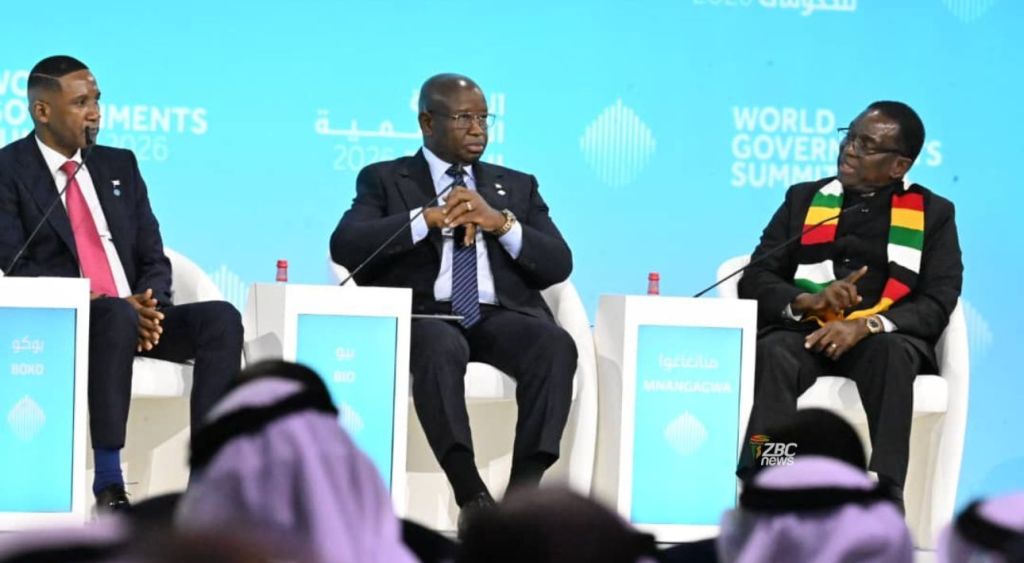
In the wake of President Emmerson Mnangagwa’s appearance at the World Governments Summit in Dubai, a curious narrative has taken hold among his more ardent supporters.
If you value independent, public-interest reporting and want to help keep it alive, please consider supporting my work financially — contact me via WhatsApp at +263 715 667 700 or email mbofana.tendairuben73@gmail.com
On social media and in state-aligned circles, his exchange with American journalist Tucker Carlson is being hailed as a “masterclass in diplomacy”—a cagey, brilliant maneuver to avoid entangling Zimbabwe in a geopolitical spat with the United States.
They argue that by refusing to be drawn into a discussion on the recent American intervention in Venezuela, Mnangagwa protected the national interest through strategic silence.
However, a closer look at that stage in Dubai reveals a far less flattering reality.
Far from a calculated move of statecraft, the President’s performance was an exercise in evasion that bordered on the embarrassing, exposing a leader who appeared caught off guard, ill-prepared, and fundamentally unable to think on his feet.
The moment in question—when Carlson asked for his perspective on the seismic shifts in Venezuela—was a chance for a veteran statesman to demonstrate gravity and global awareness.
Instead, we were treated to the jarring claim that Venezuela is simply “very far away from Zimbabwe.”
In a modern, hyper-connected world, this defense is not just weak; it is intellectually bankrupt.
We live in an era where global supply chains, international law, and the precedents of regime change affect every nation, regardless of geography.
For a leader who frequently decries “illegal sanctions” by linking Zimbabwe’s plight to that of Venezuela in international forums like the UN, to suddenly claim geographical distance as a shield of ignorance is a staggering contradiction.
It did not signal “strategic caution”; it signaled a fear of the moment.
The narrative of the “masterclass” rests on the assumption that Carlson was setting a trap, and that by saying nothing of substance, the President somehow won.
But this is a fundamental misunderstanding of what global leadership looks like.
When a head of state sits on a panel at a summit titled “World Governments,” the expectation is that they possess a worldview that extends beyond their own borders.
To claim that a fellow sanctioned nation—one that Zimbabwe has explicitly stood in solidarity with for decades—is “too far away” to have an opinion on is to admit a lack of strategic depth.
It suggests that our foreign policy is not based on consistent principles, but on whatever is convenient in the immediate seconds of an unscripted interview.
If Zimbabwe and Venezuela are brothers-in-arms against “imperialist” sanctions when the cameras are focused on the SADC Anti-Sanctions Day, they cannot suddenly become strangers when an American journalist asks a difficult question.
True diplomacy does not require hostility or the picking of unnecessary fights with superpowers.
One can be a statesman without being a provocateur.
A seasoned leader could have easily framed a response around enduring principles—respect for national sovereignty, the sanctity of international law, or a call for the peaceful, amicable resolution of disputes.
Even a neutral expression of hope for regional stability would have sufficed to maintain Zimbabwe’s dignity while avoiding a diplomatic landmine.
A leader could have said, “Zimbabwe stands for the principle that the people of any sovereign nation should determine their own destiny without external coercion.”
Such a statement is firm, principled, and avoids a direct confrontation with the US while still answering the question.
Instead, by acting as if he were unaware of the situation or that it held no relevance to his administration, the President made Zimbabwe look indifferent and uninformed on the world stage.
There is a profound difference between being a “silent operator” and being genuinely unprepared.
In high-stakes environments like the World Governments Summit, a leader’s ability to respond with clarity and composure is what separates a credible global player from a reactive politician.
When Carlson pushed for a deeper thought, the President’s struggle to articulate a coherent position beyond “I don’t know” was a missed opportunity of the highest order.
It suggested that without a scripted speech, the machinery of our leadership lacks the intellectual agility to navigate the complexities of 21st-century geopolitics.
Intellectual agility is not just about intelligence; it is about preparation.
It is about having a clear, internalised understanding of your nation’s values so that you do not have to “find” an answer when the spotlight hits you.
The inability to think on one’s feet in that moment revealed a hollow center where a robust foreign policy should be.
This performance also raises uncomfortable questions about the advice and briefing the President receives before such international engagements.
Carlson is not a standard journalist; he is a high-velocity interlocutor known for trying to unmask the talking points of global elites.
To walk into that arena without a pre-prepared “bridge” to answer geopolitical questions is a failure of statecraft.
It reinforces the damaging perception that African leaders are merely passive observers of history, waiting to see which way the wind blows before committing to a sentence.
If Zimbabwe truly wants to be a “friend to all and an enemy to none,” it must be able to speak to everyone with a sense of authority.
Silence, in this context, was not a shield; it was an admission of a lack of weight.
Furthermore, we must address the “distance” argument once more.
We are living in a multipolar world where the “Global South” is attempting to assert itself.
Zimbabwe often positions itself as a vocal member of this movement.
Yet, when asked about a fellow member of the Global South facing a crisis, the response was a shrug.
This sends a message to other potential allies that Zimbabwe’s solidarity is only as deep as its latest press release.
It tells the world that our commitment to international principles is skin-deep and easily discarded if the interviewer looks too intimidating.
This is not how you build a credible international reputation; it is how you remain a peripheral actor in global affairs.
The praise being heaped on this performance by domestic supporters is perhaps the most worrying part of this episode.
By calling this “masterful,” we are lowering the bar for what we expect from our leaders.
We are essentially saying that as long as a president doesn’t cause a diplomatic disaster, they have succeeded.
But “not causing a disaster” is the bare minimum requirement of the job.
Statesmanship is about more than just survival; it is about presence, influence, and the projection of national character.
When our leaders appear confused or evasive, it reflects on the entire nation.
It suggests a country that is not ready for the complexities of the global stage, despite the “Open for Business” slogans.
We must stop settling for the “bare minimum” and calling it brilliance.
Zimbabwe can be prudent without appearing small; we can be cautious without appearing confused.
If we are to be taken seriously as a nation that “is a friend to all and an enemy to none,” our leadership must be able to speak to the world with a sense of authority and awareness.
The Dubai panel was not a masterclass; it was a reminder of how much further we have to go before our performance on the global stage matches the lofty rhetoric we hear at home.
True statesmanship is earned through the quality of one’s presence, the clarity of one’s voice, and the courage to stand by one’s principles even when the questions are difficult.
In Dubai, the silence was not strategic—it was simply empty.
It was a performance that left the audience not with a sense of a cagey tactician at work, but with the uncomfortable realization that the emperor of our foreign policy has very few clothes when the teleprompter is turned off.
● Tendai Ruben Mbofana is a social justice advocate and writer. To directly receive his articles please join his WhatsApp Channel on: https://whatsapp.com/channel/0029VaqprWCIyPtRnKpkHe08
 TENDAI RUBEN MBOFANA - THE UN-OPPRESSED MIND!