There are times when it feels as though those in power operate with a split political personality.
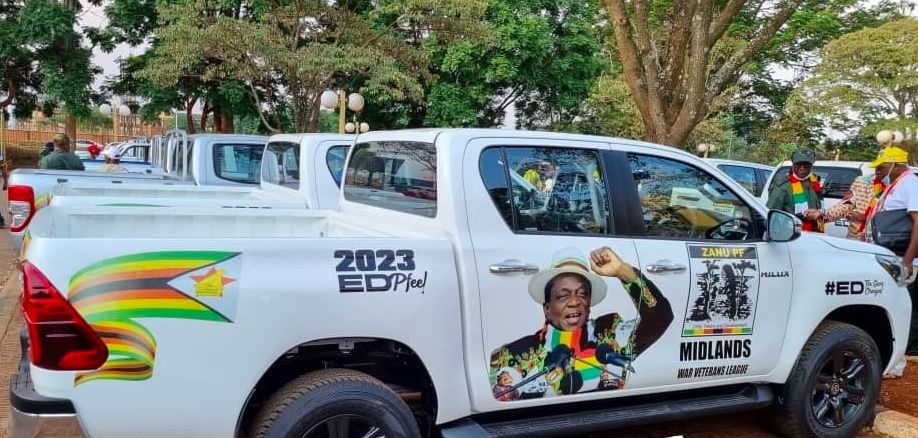
This afternoon, I came across a report carried by the state-controlled Zimbabwe Broadcasting Corporation (ZBC) in which the ZANU-PF Midlands provincial leadership called on party members to actively support the implementation of the National Development Strategy 2 (NDS2).
To directly receive articles from Tendai Ruben Mbofana, please join his WhatsApp Channel on: https://whatsapp.com/channel/0029VaqprWCIyPtRnKpkHe08
According to the report, the ruling party believes it has a “central role” to play in advancing Zimbabwe’s national development priorities.
I found this statement not only bizarre, but profoundly absurd and deeply insincere, given the ruling party’s long and well-documented record of undermining the very foundations upon which genuine economic development depends.
At the heart of any meaningful development agenda lies one basic principle: contribution to the national purse.
Development is not funded by slogans, party regalia, or endless political rallies.
It is funded through taxes, levies, fees, and the responsible stewardship of public resources.
Yet ZANU-PF’s senior leadership and its well-connected elites are notorious for doing the exact opposite—evading, undermining, or outright looting the fiscus, while preaching development to an already overburdened citizenry.
Who in Zimbabwe has not witnessed ZANU-PF-branded vehicles, or vehicles hastily adorned with party slogans or President Emmerson Mnangagwa’s stickers, sailing through toll gates without paying a cent?
How many of these vehicles even carry valid vehicle licence discs?
This is not an isolated phenomenon; it is a normalized culture of entitlement.
Yet toll fees and vehicle registration fees are not trivial amounts.
In 2024 alone, Zimbabwe reportedly collected ZWG 2.8 billion in toll fees—approximately USD 147.2 million—and ZWG 2.4 billion in vehicle registration fees, about USD 124.7 million.
These figures represent resources that could significantly improve road infrastructure, public transport safety, and basic service delivery.
When politically connected individuals exempt themselves from contributing to these funds, they are not being clever—they are actively sabotaging national development.
What makes the ruling party’s claims even more offensive is that tax and fee evasion is merely the most visible and mundane form of economic sabotage.
ZANU-PF has become synonymous with grand corruption, housing some of the most notorious economic predators in the country.
These individuals routinely exploit their proximity to political power to secure multi-million-dollar public tenders without due process, transparency, or competition.
In many cases, the promised services and products are never delivered, or are delivered at inflated costs and substandard quality.
The result is not development, but decay.
Zimbabwe is estimated to lose at least USD 4 billion annually through illicit financial flows, corruption, mineral smuggling, and outright theft of public resources.
This figure alone dwarfs many of the budgets allocated to critical social services.
Yet accountability remains virtually nonexistent.
Who has ever been held to account for the ill-fated Gwanda Solar Power Project, where millions of dollars disappeared without a single watt of electricity added to the national grid?
Who has been arrested, charged, or convicted over the Gairezi Power Project, another scandal marked by grand promises, massive expenditures, and zero delivery?
These projects are not accidents; they are symptoms of a system designed to enrich a politically connected few at the expense of national progress.
Even more damning were the Gold Mafia revelations, where individuals closely linked to political power were caught on camera openly boasting about gold smuggling and money laundering schemes.
These were not allegations whispered in dark corners; they were confessions recorded for the world to see.
Yet, years later, Zimbabweans are still waiting to hear who has been prosecuted, who has been jailed, or even who has been seriously questioned.
Silence and selective amnesia have become the state’s default response to grand corruption.
The consequences of this systemic looting and non-contribution are visible everywhere.
Zimbabwe’s public hospitals are in a perpetual state of collapse, where thousands of citizens die each year not because their conditions are untreatable, but because there are no painkillers, no diagnostic equipment, and no basic medical supplies.
Nurses and doctors are forced to work under inhumane conditions, while patients are asked to bring their own gloves, syringes, and medication.
This is not a mystery.
Hospitals are underfunded because the money meant for them has either been stolen or never collected in the first place.
The same story applies to public schools, where children learn under trees, teachers are demoralized by poverty-level wages, and infrastructure crumbles beyond repair.
It applies to roads that have become death traps, to water systems that no longer function, and to urban services that have all but collapsed.
Ordinary Zimbabweans are relentlessly taxed, levied, and fined to sustain a system that gives them nothing in return, while the political elite lives above the law.
Against this backdrop, the claim that ZANU-PF can play a “central role” in advancing national development priorities under NDS2 is not just laughable—it is insulting.
Development cannot be driven by a party that refuses to practice what it preaches.
One cannot sabotage the economy on one hand and claim to be its savior on the other.
One cannot loot the fiscus, evade basic civic obligations, and then lecture citizens about patriotism and sacrifice.
If ZANU-PF were serious about supporting economic development, the starting point would be painfully simple: its leaders must pay taxes, toll fees, and licence fees like every other citizen.
They must subject themselves to the same laws and accountability mechanisms imposed on ordinary Zimbabweans.
They must stop shielding corrupt individuals and start prosecuting them, regardless of political status or factional alignment.
Without this, NDS2 remains nothing more than a glossy document weaponized for propaganda, rather than a genuine roadmap for national transformation.
True development demands honesty, sacrifice, and accountability.
Until ZANU-PF demonstrates these qualities through action—not rhetoric—it has no moral authority to speak about economic development, let alone claim a central role in delivering it.
 TENDAI RUBEN MBOFANA - THE UN-OPPRESSED MIND!