It is frighteningly easy for professed believers to stand with the oppressors.
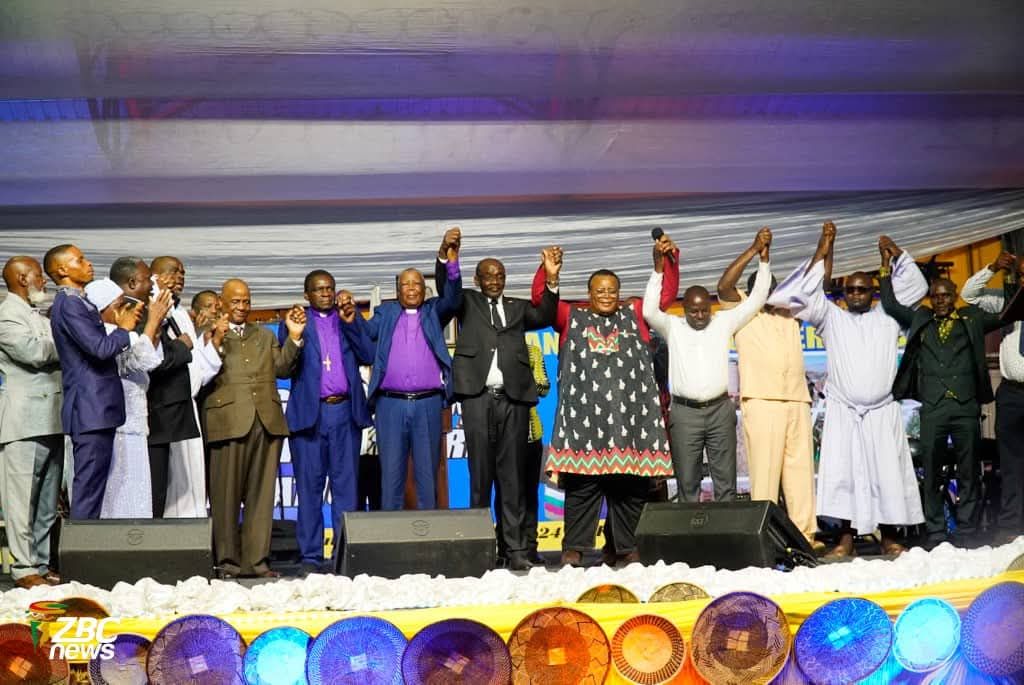
Today, a grouping of some church organisations converged in Bulawayo for a so-called “National Thanksgiving and Dedication Service.”
To directly receive articles from Tendai Ruben Mbofana, please join his WhatsApp Channel on: https://whatsapp.com/channel/0029VaqprWCIyPtRnKpkHe08
At this gathering, the same familiar pro-government church leaders once again issued their ritualistic endorsement of “the Second Republic under the able and visionary stewardship of President Emmerson Mnangagwa.”
Unsurprisingly, this posture was packaged as a “declaration by the church.”
Nothing about this spectacle is new, and nothing about it is innocent.
As a devout Christian, most readers know by now that I do not take kindly to the flagrant, unrepentant abuse of the name of our Lord Jesus Christ.
When the Gospel is weaponised to sanitise oppression, corruption, and mass suffering, silence becomes complicity.
That is why I speak out, as I am doing now.
Yet what I find most sickening is not merely the repeated public embrace of a regime that has presided over devastating poverty, state violence, and institutionalised corruption.
What is truly disturbing is the pretence — or deliberate misrepresentation — that these few compromised church leaders speak for “the Church” in its entirety.
They do not.
They never have.
The Church of Jesus Christ is not a political choir assembled for state ceremonies.
It is the body of believers bound by faith in Christ and obedience to God’s Word.
Zimbabwe’s Christians are not a monolith, and these leaders represent only a fraction of those who confess Jesus as Lord.
Thankfully, there remains a significant and courageous portion of the Church in Zimbabwe that has refused to bow to political pressure or financial inducements.
Church bodies such as the Zimbabwe Catholic Bishops’ Conference (ZCBC), the Zimbabwe Heads of Christian Denominations (ZHOCD), the Zimbabwe Council of Churches (ZCC), and the Evangelical Fellowship of Zimbabwe (EFZ) have consistently stood on the Word of God, speaking truth to power and condemning injustice, corruption, and the crushing of the poor.
In doing so, they have been beacons of hope in a darkened national landscape.
But even that distinction is not the real issue.
The argument should never be reduced to what “the church” says.
Frankly, I do not care what declaration is claimed to have been issued by any gathering of clerics, especially when that declaration blesses a kleptocratic and repressive regime.
History teaches us that churches — or rather church leaders — can be catastrophically wrong.
There are sobering precedents.
In Nazi Germany, large sections of the institutional church either supported Adolf Hitler or remained silent as Jews were exterminated, with some pastors openly preaching loyalty to the Führer.
In apartheid South Africa, the Dutch Reformed Church theologically justified racial segregation and oppression, citing Scripture to defend white supremacy while millions suffered under a brutal system.
During the transatlantic slave trade, many churches in Europe and America blessed slavery, arguing that it was divinely ordained, even as human beings were reduced to property and treated with unspeakable cruelty.
Closer to home, during the 1994 Rwandan genocide, some church leaders actively collaborated with killers, turning places of worship into slaughterhouses.
In all these cases, churches spoke — loudly — but God was not speaking through them.
This is why what matters is not what men and women say, no matter how ornate their robes or how impressive their titles.
What matters is what God Himself says.
Scripture is unambiguous in its condemnation of oppression, corruption, and abusive leadership.
“Woe to those who make unjust laws, to those who issue oppressive decrees,” declares Isaiah, “to deprive the poor of their rights and withhold justice from the oppressed of my people” (Isaiah 10:1–2).
Through the prophet Jeremiah, God rebukes leaders who enrich themselves while crushing the vulnerable: “Does it make you a king to have more and more cedar?… He defended the cause of the poor and needy, and so all went well. Is that not what it means to know me?” says the Lord (Jeremiah 22:15–16).
The prophet Amos delivers perhaps one of the most scathing indictments of religious hypocrisy aligned with injustice: “I hate, I despise your religious festivals… But let justice roll on like a river, righteousness like a never-failing stream” (Amos 5:21–24).
In the New Testament, James reminds us that God hears the cries of the exploited: “The wages you failed to pay the workers who mowed your fields are crying out against you” (James 5:4).
And Jesus Himself leaves no room for ambiguity when He identifies Himself with the suffering: “Whatever you did not do for one of the least of these, you did not do for me” (Matthew 25:45).
This is the God these church leaders claim to serve.
Yet how can one bless a system that impoverishes millions, presides over grand corruption, and crushes dissent, and still claim fidelity to Christ?
The apostolic response to such contradictions is clear.
When ordered by authorities to abandon truth, Peter and the apostles replied: “We must obey God rather than human beings” (Acts 5:29).
That principle remains the bedrock of authentic Christian witness.
Allegiance to God’s Word must always supersede allegiance to political power.
The Bible also warns us explicitly about “men of God” who distort Scripture for personal gain or political convenience.
Jesus cautioned, “Watch out for false prophets. They come to you in sheep’s clothing, but inwardly they are ferocious wolves” (Matthew 7:15).
The apostle Paul warned the Corinthians of those who “peddle the word of God for profit” (2 Corinthians 2:17), while Peter spoke of false teachers who “will exploit you with fabricated stories” (2 Peter 2:1–3).
These warnings are not abstract theology; they are practical safeguards for believers living under conditions of deception and manipulation.
That is why Christians must resist outsourcing their faith to compromised intermediaries.
We are called to read, study, and understand Scripture for ourselves, guided by the Holy Spirit.
As the apostle John urged, “Do not believe every spirit, but test the spirits to see whether they are from God” (1 John 4:1).
A faith that cannot question, discern, and challenge is a faith easily weaponised against the very people it should liberate.
When compromised church leaders choose to side with those who disobey God and oppress His people, it matters very little in the grand scheme of eternity.
God is not mocked, and history shows that He does not endorse injustice simply because it is wrapped in religious language.
For Christians who remain faithful, the task is clear: listen to God rather than men, stand with the oppressed rather than the powerful, and measure every declaration — whether from the pulpit or the State House — against the unchanging standard of God’s Word.
In the end, churches may speak, governments may applaud, and declarations may be issued.
But only one voice carries ultimate authority.
What the churches say does not matter.
What matters is what God says.
 TENDAI RUBEN MBOFANA - THE UN-OPPRESSED MIND!