There are moments when life in Zimbabwe feels unreal—like a dream, except it is a terrible nightmare.
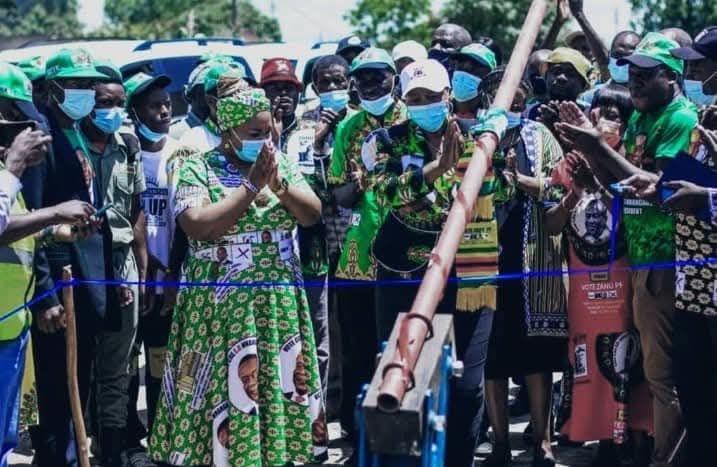
Today, the state-controlled broadcaster ZBC once again implored Zimbabweans to acknowledge and celebrate what it called “milestones made by the government” in developing the country.
To directly receive articles from Tendai Ruben Mbofana, please join his WhatsApp Channel on: https://whatsapp.com/channel/0029VaqprWCIyPtRnKpkHe08
To reinforce this message, the broadcaster replayed excerpts from President Emmerson Mnangagwa’s Unity Day speech delivered just days ago, in which he similarly urged citizens to recognise the “development achieved so far.”
But this raises a fundamental and unavoidable question: what exactly is this “development” we are expected to celebrate?
ZBC was very clear in its answer.
Viewers were taken to a short stretch of road being rehabilitated under the so-called Emergency Road Rehabilitation Programme (ERRP), presented as tangible proof that the country is making meaningful progress.
The report culminated in an almost triumphant declaration that development is happening “one kilometre at a time.”
This, we are told, is reason enough for national pride and celebration.
Alongside this, the same bulletin spoke of renewed efforts to industrialise Bulawayo, with promises of future employment creation and value addition to locally produced goods.
As usual, there were also familiar references to airport expansions, the upgrading of the Beitbridge Border Post, and various “empowerment funds.”
These empowerment funds, however, are little more than handouts and short-term loans designed to mask the reality of mass unemployment.
They attempt to cosmetically address an economy that has failed to create sustainable, formal jobs, pushing millions into a volatile and insecure informal sector devoid of basic labour protections or a dignified standard of living.
We were also reminded—yet again—of borehole drilling programmes, held up as evidence of a caring and developmental state.
On the surface, all these initiatives may sound positive.
Roads, water, industry, border posts, and airports are indeed important.
But the real issue lies not in whether these things are necessary, but in why they are being presented as extraordinary achievements deserving of applause nearly half a century after independence.
Why are we acting as though Zimbabwe is a newly established nation starting from scratch?
Why are we being asked to celebrate basic state functions as if they are historic breakthroughs?
Zimbabwe is not a country that emerged recently from an uninhabited wilderness.
We did not discover a virgin land that needed to be developed from nothing.
At independence in 1980, Zimbabwe inherited extensive infrastructure: well-built road networks, functioning rail systems, reliable power generation, efficient water and sanitation systems, hospitals, schools, and productive agricultural and industrial sectors.
The very use of the word “rehabilitation” is an admission that these things existed before.
Roads are being rehabilitated because they were once there—and because they were allowed to collapse.
What, then, happened over the past 45 years to bring the country to a point where patching up a few kilometres of road is framed as a milestone?
Why has the Bulawayo–Victoria Falls road deteriorated so badly that its rehabilitation is now treated as a major national achievement?
Why are bridges across rural Zimbabwe crumbling, collapsing, or turning into death traps every rainy season?
The answer is painfully obvious: decades of neglect, corruption, mismanagement, and the systematic hollowing out of public institutions.
The roads we are rushing to rehabilitate today were largely inherited at independence in pristine condition.
The bridges now washing away vehicles were built generations ago and maintained for years before being abandoned.
Schools, hospitals, power stations, and water systems have suffered the same fate.
Now that infrastructure resembles a war zone—pocked with craters, broken bridges, and collapsing public facilities—the government wants applause for emergency repairs that should never have been necessary in the first place.
For more than four decades, rural communities have borne the brunt of this failure.
Women have walked long distances to fetch water from unsafe sources.
Children have crossed flooded rivers to attend schools that are little more than trees or makeshift structures kilometres away from home.
Pregnant women have been forced to give birth in the bush while trekking to distant clinics that often lack basic medicines, equipment, or trained staff.
These are not new problems.
They are the accumulated consequences of 45 years of broken promises and abandoned responsibilities.
Now, when a borehole or two is drilled, when a single clinic or classroom block is constructed, or when a short stretch of road is repaired, we are told to celebrate “milestones.”
But milestones toward what, exactly?
Are we expected to be taken seriously as a nation when we applaud achievements that should have been accomplished decades ago?
After 45 years of independence, should we not expect four-lane highways crisscrossing the country?
Should modern, multi-layered traffic interchanges not be commonplace rather than headline-grabbing spectacles?
Should rural homes not be connected to the national power grid and piped water by now?
Should schools equipped with modern technology not be the norm, even in the most remote areas?
Should we not have well-equipped hospitals capable of handling most medical procedures without forcing citizens to seek care across borders or rely on fundraising campaigns?
Instead, towns and cities that once enjoyed reliable running water have gone for years without it.
Near-daily power outages lasting up to 16 hours have become normalised, crippling households, businesses, and industries alike.
This is happening in a country that has been independent long enough for someone born in 1980 to now have children attending university.
And yet, we are still expected to sing and dance over a newly resurfaced 10-kilometre road, the reconstruction of a bridge built in the 1960s, or the drilling of a borehole in a village that should have had piped water generations ago.
To then label this “development so far” is not just misleading—it is insulting.
“So far” since when?
Since 1980?
If so, then this is an indictment, not an achievement.
It is an admission that after nearly half a century in power, the ruling party has little to show beyond repairing what it allowed to decay.
Zimbabweans cannot be expected to celebrate failure masquerading as progress.
We cannot allow mediocrity to be rebranded as development simply because it is accompanied by slogans, jingles, and state media fanfare.
ZANU-PF has governed this country continuously since independence.
The responsibility for where Zimbabwe stands today lies squarely at its feet.
Let us, as a nation, be honest with ourselves.
Zimbabwe is not five years old.
It is 45 years into independence.
The standards by which we measure progress must reflect that reality.
To pretend otherwise is to insult the intelligence, resilience, and lived experience of Zimbabweans.
We deserve better than recycled infrastructure, recycled promises, and recycled propaganda.
We deserve real development—measured not in kilometres repaired, but in decades of sustained progress that should have already been achieved.
 TENDAI RUBEN MBOFANA - THE UN-OPPRESSED MIND!