Let’s confront an issue that threatens to become a pandemic in Zimbabwe.
This morning, I was watching the television program ‘Economic Forum’, hosted by legendary journalist John Masuku.
To directly receive articles from Tendai Ruben Mbofana, please join his WhatsApp Channel on: https://whatsapp.com/channel/0029VaqprWCIyPtRnKpkHe08
What unfolded on that show confirmed something many of us have long argued but struggled to get across.
The Zimbabwe Council for Higher Education (ZIMCHE) chairman, Professor Mandivamba Rukuni, was being interviewed on the state of higher education in Zimbabwe.
At some point, Masuku raised a question that hits at the heart of a growing obsession in our society: the proliferation of PhDs.
Professor Rukuni’s response was strikingly candid and enlightening.
He confirmed a truth that many Zimbabweans find inconvenient: those who receive honorary PhDs cannot—and should not—use the title of “Dr.” outside the academic institution that awarded the honor.
An honorary degree, as Rukuni and academic practice globally clarify, is a symbolic recognition given to individuals for notable achievements or contributions in a particular field.
It is a commendation, not a formal academic qualification earned through research, study, and rigorous examination.
Its value lies in acknowledgment, not in granting authority to claim expertise in the same way an earned PhD does.
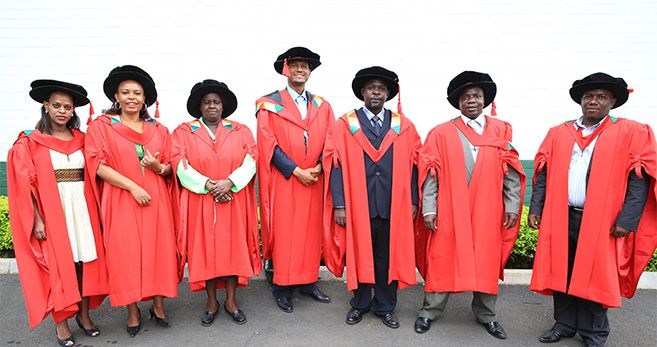
Yet, in Zimbabwe over the past several years, we have witnessed a troubling trend: an obsession with PhDs, whether earned through years of study or awarded as honorary recognitions.
As Masuku remarked during the program, “If you throw a stone in Zimbabwe, you’ll hit a Doctor.”
This is not a sign of intellectual flourishing, nor does it reflect a genuine love for knowledge.
On the contrary, it is evidence of a culture enthralled by titles.
Zimbabweans, it seems, love titles—Doctor, Professor, Engineer, Apostle, Bishop, Prophet.
Titles have become currency, a symbol of status and validation rather than merit or accomplishment.
This obsession with titles, I believe, reflects a deeper emptiness within us.
It is a craving for recognition, for validation, for a sense of worth that many feel is lacking in their lives.
Whether consciously or subconsciously, we seek to compensate for perceived inadequacies or unfulfilled ambitions with symbols of prestige.
Titles, in this context, become substitutes for substance.
They are not celebrated for what they signify in terms of learning, contribution, or insight, but for the social cachet they confer.
Professor Rukuni did not mince his words when addressing the matter of legitimate PhDs and professorships.
Holding a PhD or being elevated to the rank of professor should be far more than a ceremonial gesture.
It should reflect a tangible impact on society.
It is not enough to have spent years writing academic papers or navigating university bureaucracy if your work has no discernible effect on the lives of those around you.
A PhD, in essence, should serve as a bridge between knowledge and action.
What is the value of holding a PhD if your research remains hidden in archives or libraries, with no contribution to solving real problems within communities?
Zimbabweans should not accept mere titles as evidence of achievement; impact and application of knowledge must be the measure of worth.
When it comes to honorary PhDs, Rukuni was uncompromising.
Those awarded such honors are strictly prohibited from using the title of “Dr.” outside the institution that conferred the degree.
This rule is not a matter of pedantry; it is about preserving the integrity and meaning of academic qualifications.
In Zimbabwe, however, it is common to encounter businesspeople, politicians, media personalities, and even musicians flaunting the title “Dr.” based on honorary degrees.
This practice is a direct violation of established norms and contributes to confusion, misrepresentation, and potential abuse.
When someone with an honorary degree claims to be a doctor, they risk misleading others into believing they possess formal academic expertise they do not have.
At a minimum, ethical practice demands that such individuals clearly indicate that their PhD is honorary whenever the title is mentioned in writing or speech.
Globally, this is a standard practice—yet in Zimbabwe, adherence remains weak.
But beyond the rules and regulations lies a deeper societal question: why are we so obsessed with titles in the first place?
Why do we elevate symbols over substance?
Why does a simple academic credential, an honorary or otherwise, carry more weight in public imagination than genuine impact or contribution?
Even well-known figures, from business leaders to politicians, have been exposed for forging PhDs or earning them through questionable and unrigorous means.
These questions point to a broader, more troubling condition: a culture increasingly driven by appearances rather than essence, by validation rather than achievement.
In a society where unemployment, economic instability, and social challenges are rampant, titles become a refuge—a way to signal success, competence, and influence without necessarily earning them.
This preoccupation with titles is mirrored in other areas as well.
The hunger for recognition, whether through religious, social, or political labels, indicates a pervasive insecurity.
Titles are used to create distinction, elevate status, and assert relevance in a context where individuals may feel powerless or inadequate otherwise.
But the danger is clear: when titles are divorced from real ability, contribution, and knowledge, they become hollow signifiers.
They risk creating a class of “decorated” individuals whose public persona is disconnected from tangible achievement.
It is also a reflection of our collective failure to cultivate a society where merit, competence, and service are celebrated above superficial markers.
A nation that confuses titles with accomplishment is a nation at risk of undermining its own intellectual and moral capital.
We should interrogate why so many seek external validation rather than internal fulfillment, why the honorific carries more meaning than the substance it is meant to signify.
There is a pressing need for Zimbabweans to confront this emptiness, to shift the focus from personal glorification to meaningful contribution.
The lesson from Professor Rukuni is clear and non-negotiable: honorary PhDs are honors, not qualifications, and those who receive them must exercise ethical restraint in using the title “Dr.” beyond the institution that bestowed it.
Simultaneously, all Zimbabweans—students, academics, and society at large—must reflect on the broader obsession with titles.
We need to cultivate a culture where the worth of an individual is measured not by the letters after their name, but by the impact of their ideas, the integrity of their actions, and the tangible benefits they bring to their communities.
It is time for Zimbabweans to reclaim the meaning of achievement, to separate substance from symbol, and to recognize that a title, without action and contribution, is an empty vessel.
Until we confront this deeper societal emptiness, we risk perpetuating a cycle where appearance trumps essence, and where recognition is sought not for what we do, but for what we can claim.
Titles should be a reflection of accomplishment, not a refuge from inadequacy.
In the end, it is not just about the PhD or the Dr.
It is about the values we uphold, the culture we nurture, and the example we set for future generations.
Zimbabweans need to ask themselves: what truly matters—letters on a name, or the real difference we make in the lives of others?
The answer, if we are honest with ourselves, will require us to confront uncomfortable truths about who we are and what we value as a people.
Until then, honorary PhDs cannot claim the title “Dr.”—and neither should the obsession with titles blind us to the substance we so desperately need.
 TENDAI RUBEN MBOFANA - THE UN-OPPRESSED MIND!