Some awards are not badges of honour, but quiet indictments of how low the bar has fallen.
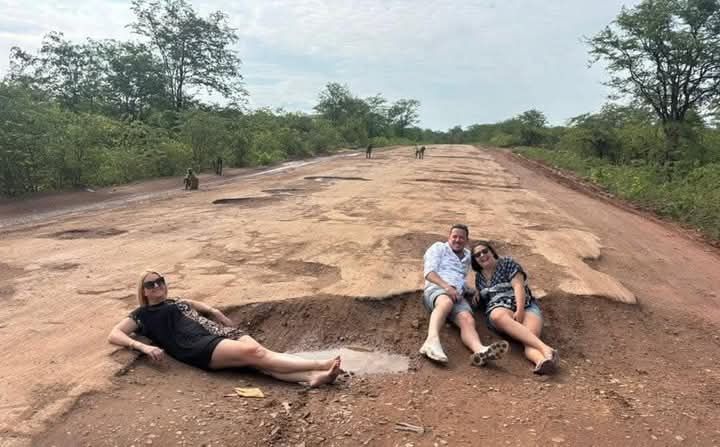
When a Nigerian publication like Vanguard recently listed Zimbabwe among the top ten African countries with the “best” road networks, many Zimbabweans laughed in disbelief.
To directly receive articles from Tendai Ruben Mbofana, please join his WhatsApp Channel on: https://whatsapp.com/channel/0029VaqprWCIyPtRnKpkHe08
Others felt anger.
Some simply shook their heads.
The pothole-riddled reality that motorists experience daily makes such a ranking seem almost insulting.
But what if, in a strange and deeply depressing way, the list is not entirely wrong?
What if Zimbabwe’s roads really are “among the best” on a continent where the overall standard of road infrastructure has collapsed so badly that being the best simply means being the least disastrous?
This uncomfortable possibility reminds me of an experience from school in the 1980s.
At prize-giving ceremonies, known as Speech Night, awards were given to the top three pupils in each class.
Our classes were grouped by performance: the high performers were placed in one stream, the average performers in another, and the weakest performers in yet another.
In the lowest-performing class, the “best” pupil might proudly receive a trophy with an average score of 35%.
There was no doubt that this child was the top of their class, but there was also no doubt that their actual performance was poor.
In fact, their marks were often lower than those of the weakest child in the top-performing class, who received no award because someone else scored 97%.
The awards were real, but the achievement was relative and deeply misleading if viewed without context.
This is exactly the danger with continental rankings that lack serious context.
It may indeed be possible that Zimbabwe’s road network ranks within the top ten in Africa — not because it is good, but because so many other countries are in a far more catastrophic state.
Years of underfunding, corruption, weak maintenance cultures, and political mismanagement across the continent have left many African roads resembling post-conflict zones.
Bridges collapse without warning.
Major highways disappear under mud during rainy seasons.
Entire rural regions become inaccessible for months at a time.
In that bleak landscape, being “less terrible” can deceptively appear as being “good”.
But this is not a compliment.
It is an indictment.
Zimbabwe’s roads are in a shocking condition.
Urban streets look like bombed landscapes, with crater-sized potholes capable of destroying suspensions and claiming lives.
Key highways are scarred with broken surfaces, unmarked hazards, collapsed shoulders, and drainage systems that have long stopped functioning.
Images of vehicles stuck in giant potholes are not rare spectacles; they are routine scenes of daily life. Commuters plan journeys around road damage rather than distance or time.
Mechanics thrive not because the economy is healthy, but because roads are destroying vehicles at an industrial scale.
Yet, if Zimbabwe enjoys any relative regional advantage, it is not because of recent excellence, but because of inherited strength.
At independence in 1980, Zimbabwe possessed one of the most sophisticated and extensive road networks on the continent.
The engineering standards were high.
Maintenance regimes were systematic.
The network was designed with industrial, agricultural, and tourism needs in mind.
That legacy created resilience: even decades of neglect could not erase it overnight.
What we are driving on today is not the product of post-independence innovation, but the stubborn remnants of a once world-class system.
This is why the celebration of basic infrastructure today feels so hollow.
Forty-five years after independence, Zimbabwe is celebrating its first major traffic interchange as if it were a revolutionary achievement.
In many parts of the world, even in developing economies, interchanges are unremarkable features of functional road systems.
They are taken for granted.
In Zimbabwe, we are encouraged to stand in awe of something that should have been commonplace decades ago.
When a nation with a single major interchange is ranked among the “best” in Africa, it speaks volumes — not of excellence, but of how low the bar has fallen across the continent.
The situation becomes even more absurd when one considers major strategic routes.
The highway linking Bulawayo, Zimbabwe’s second-largest city, to Victoria Falls — one of the Seven Natural Wonders of the World — has deteriorated so badly that it had to be hurriedly rehabilitated because it was no longer safely navigable.
A road connecting an industrial hub to one of Africa’s premier tourist destinations became so dangerous that emergency intervention was required.
And yet, in the same breath, the country is praised as having one of Africa’s best road networks.
The contradiction is staggering.
If Zimbabwe truly is in Africa’s “top ten” for road networks, then this is not a reason to celebrate Zimbabwe.
It is a reason to mourn Africa.
It means the continent has lowered its expectations so dramatically that pothole-ravaged highways now qualify as excellence.
It means decades of promised development, infrastructure masterplans, and glowing political speeches have translated into little more than patched-up decay.
It means citizens across Africa are being conditioned to confuse survival with success.
Being the “best among the worst” is not an achievement.
It is a warning siren.
It tells us that we have normalised failure on a continental scale.
It tells us we have become comfortable with mediocrity, and worse, comfortable with collapse as long as someone else has collapsed more.
That is not progress.
That is managed decline.
There is nothing to celebrate in such a ranking.
Zimbabwe’s roads are not world-class.
They are not even regionally impressive by global standards.
They are a shadow of what they once were, crumbling under the weight of corruption, looting of public funds, and a political culture that rewards propaganda over performance.
We have moved from inheritance to negligence, from excellence to excuses.
Perhaps the cruelest truth is this: Zimbabwe does not need to be the best in Africa.
It does not need to compete with failure elsewhere.
It simply needs to be good enough for its own people — safe, reliable, and fit for purpose.
Until that happens, any “top ten” label is not a honour.
It is a tragic joke.
And if Africa’s standards have fallen so low that Zimbabwe’s broken roads can be described as “among the best”, then the real story is not about Zimbabwe at all.
It is about a continent that has learned to rank decay, reward deterioration, and clap for survival instead of demanding excellence.
 TENDAI RUBEN MBOFANA - THE UN-OPPRESSED MIND!