Those who fail to learn from history are bound to repeat its mistakes.
Yesterday’s foiled attempted military coup in Benin, aimed at removing President Patrice Talon, should not be viewed as an isolated act of rogue adventurism.
To directly receive articles from Tendai Ruben Mbofana, please join his WhatsApp Channel on: https://whatsapp.com/channel/0029VaqprWCIyPtRnKpkHe08
It is a warning flare.
It is a symptom of a deeper disease that has been spreading across parts of Africa — a dangerous mix of economic despair, political exclusion, corruption and the slow suffocation of democratic hope.
Benin, once regarded as one of West Africa’s more stable democracies, now finds itself brushing against the same dark current that has swept through countries such as Guinea, Burkina Faso, Niger, Gabon, Chad and, more recently, Madagascar.
The pattern is no longer coincidental.
It is structural.
Military coups do not occur in a vacuum.
They are not random storms.
They are pressure valves.
They emerge when societies have been squeezed so tightly by poverty, corruption and governance failure that the constitutional order itself begins to look like a prison rather than a protection.
While soldiers may pull the trigger on coups, it is political failure that loads the weapon.
The most potent driver behind this new wave of coups is economic mismanagement that translates into real, everyday suffering for ordinary people.
When citizens work harder and get poorer, when market prices rise but wages stagnate, when young people see no future beyond unemployment and migration, loyalty to constitutional order becomes abstract.
Democracy, to a hungry stomach, sounds like a luxury.
It is difficult to preach patience and institutionalism to people who are choosing daily between transport money and food, between school fees and survival.
Poverty does not just weaken the economy — it erodes belief in the system itself.
Corruption acts as a corrosive accelerant.
It deepens poverty and adds insult to injury.
What enrages citizens is not merely being poor, but watching leaders grow obscenely rich while hospitals lack medicine and schools crumble.
When political office becomes the fastest route to wealth, when public funds are looted with impunity, and when anti-corruption institutions exist only on paper, the social contract breaks down.
In that environment, the uniform begins to look more honest than the suit, and the rifle more trustworthy than the ballot box.
This is a tragic illusion, but a powerful one.
Equally dangerous is the systematic weakening or suffocation of political opposition.
A functioning democracy requires not only elections, but genuine competition and credible alternatives.
In many of the countries now experiencing coups, opposition parties were either fragmented, infiltrated, intimidated, financially strangled or legally barred from meaningful participation.
Their leaders arrested, disqualified or driven into exile.
Voters were left with ballots that changed nothing, parliaments that checked nothing, and courts that protected no one but the powerful.
When peaceful change is blocked, unconstitutional change begins to look like the only remaining door.
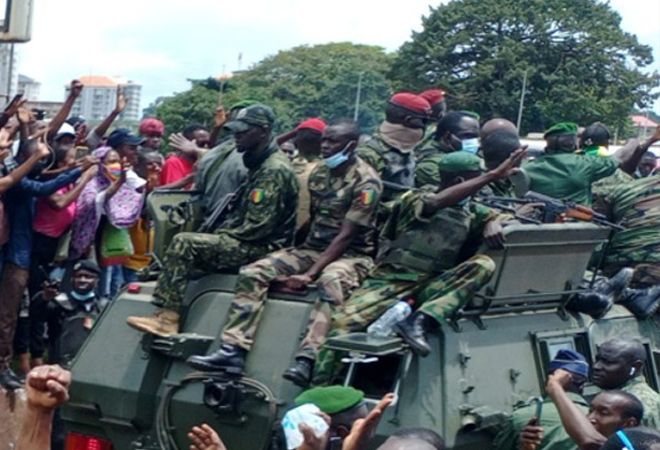
This is precisely why many recent coups have been greeted not with resistance, but with celebration.
Crowds have poured into the streets waving national flags, embracing soldiers, chanting against former presidents.
Is this not precisely what Zimbabwe witnessed in November 2017, when Robert Mugabe was removed from power through military intervention?
This is not because people suddenly fell in love with military rule.
It is because they had already fallen out of love with a civilian order that had stopped serving them.
For citizens trapped in misery, the overthrow of a hated elite feels less like a crime and more like deliverance.
There is also a critical but often ignored pattern in these coups.
They are rarely led by the most senior generals.
Instead, the faces of this new coup wave are captains, lieutenant colonels and colonels — men closer to the rank-and-file, closer to the barracks reality, and closer to the lived suffering of ordinary citizens.
Figures such as Burkina Faso’s Captain Ibrahim Traoré, Niger’s Colonel Amadou Abdramane, and Guinea’s Colonel Mamady Doumbouya illustrate this pattern, rising not from the distant comfort of generalship but from the more grounded, frontline strata of their militaries.
Many of them come from the same neighbourhoods, the same struggling families, and the same broken schools as the people cheering them.
They feel the same inflation in their salaries, the same shortages, the same frustrations.
They are not insulated by luxury residences and diplomatic privileges.
They do not live in the fantasy bubble of presidential palaces.
This is why the idea of “coup-proofing” through the appointment of loyal generals is a dangerous delusion.
Leaders often believe they can survive by surrounding themselves with handpicked military chiefs, rotating commanders, or creating parallel security units.
But loyalty at the top does not compensate for rage at the base.
Generals do not carry out coups alone.
Tanks are not driven by generals.
Radios are operated by junior officers.
Checkpoints are controlled by lieutenants and captains.
When the lower and middle ranks lose faith in a system, no amount of palace reshuffling can save it.
There are lessons here not only for West Africa, but for the rest of the continent.
Countries with widespread poverty, entrenched corruption, hollow institutions and weakened opposition are sitting on dangerous political fault lines.
It is a myth that coups only happen where soldiers are naturally ambitious.
In reality, coups happen where hope has died and where the military becomes the last institution that appears capable of imposing change.
This is why, in such countries, the sight of military vehicles or tanks rolling into capital cities so often ignites excitement and expectation among desperate populations rather than fear.
In environments where leaders have destroyed hope, emptied state institutions of meaning and converted democracy into theatre, military intervention begins to feel less like a crime and more like a rescue mission.
People do not welcome coups because they love soldiers; they welcome them because the civilian political order has collapsed so completely that anything else seems preferable.
The true antidote to military takeovers is not more soldiers guarding presidential palaces.
It is leadership rooted in legitimacy.
It is economic policies that reduce suffering rather than multiply it.
It is visible, fearless action against corruption regardless of rank or political affiliation.
It is governance that restores dignity rather than demands submission.
Above all, it is a strong, vibrant opposition — not one that is tolerated reluctantly, but one that is protected deliberately.
An opposition that gives people hope; that shows citizens that change can come through peaceful, constitutional means; that makes elections meaningful and not ceremonial.
When citizens believe in the ballot box, they do not clap for the bullet.
The attempted coup in Benin should not be dismissed as a failed plot.
It should be understood as a message.
Africa stands at a crossroads.
Leaders must choose whether they want to rule over populations or serve citizens.
If they choose control over accountability, luxury over service, and repression over reform, they may soon discover that no number of loyal generals can save them.
A hungry, humiliated and hopeless population will always look elsewhere for salvation — and too often, they will find it in the barrel of a gun.
 TENDAI RUBEN MBOFANA - THE UN-OPPRESSED MIND!