Can it get any weirder?
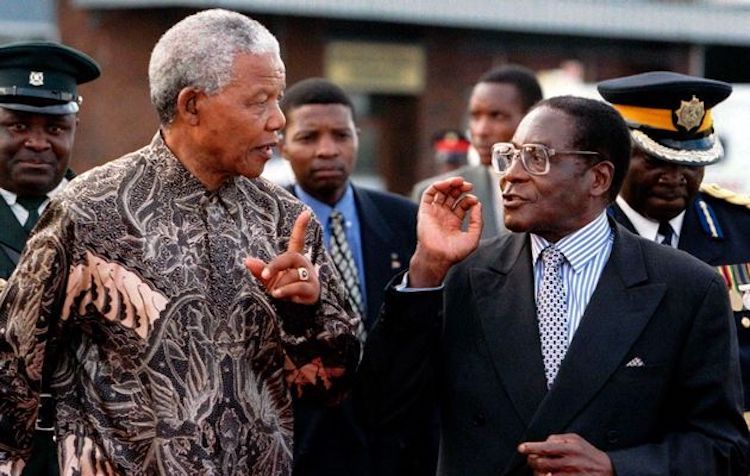
I honestly did not know whether to laugh or cry when I read today’s Nehanda Radio op-ed accusing Nelson Mandela of “selling out” South Africa’s black majority.
To directly receive articles from Tendai Ruben Mbofana, please join his WhatsApp Channel on: https://whatsapp.com/channel/0029VaqprWCIyPtRnKpkHe08
The writer’s argument—essentially that Mandela betrayed the revolution by agreeing to compromises during the transition from apartheid—was so amateurish, so historically shallow, and so selectively reasoned that it bordered on the absurd.
Yet such narratives have become fashionable among those eager to blame colonial-era negotiations for post-independence failures while conveniently absolving the leaders who actually governed after liberation.
But history is far more complex than that—and certainly far less flattering to those now weaponising it.
To begin with, which liberation movement in Africa achieved independence without compromise?
Which one picked up a gun, marched onto the battlefield, and defeated the colonial powers militarily?
Not a single one.
Independence across the continent—from Kenya, to Zimbabwe, to Namibia, to South Africa—was secured through negotiation.
And negotiation, by definition, requires compromise.
These new African governments were under immense pressure to accept certain guarantees demanded by the departing colonial administrations—chief among them protections for property, land, and white commercial interests.
To condemn Mandela for doing what every other liberation movement had to do is to reveal not deep political understanding, but glaring historical ignorance.
Zimbabwe provides an even clearer example—ironically, one that the writer of the op-ed fails to apply consistently.
When Robert Mugabe and ZANU-PF signed the Lancaster House Agreement in 1979, they willingly accepted a ten-year moratorium preventing compulsory land acquisition.
They agreed to the “willing seller, willing buyer” arrangement, under which Britain would provide funds for land redistribution.
If Mandela “sold out” by accepting compromises, then Mugabe must top the list, because for ten full years after independence he did not touch white land.
In fact, he did not touch it even after the ten-year constitutional clause expired in 1990.
Zimbabwe’s leadership continued to protect white commercial farming interests well into the late 1990s.
If we apply the writer’s own standards, Mugabe’s government looks far worse—not because it compromised in 1979, but because even after it no longer had to compromise, it still did nothing.
The truth is that ZANU-PF only moved to violently seize land a full twenty years after independence, and not out of some sudden patriotic awakening.
It was a panicked response to political survival.
After losing the February 2000 constitutional referendum—its first major defeat since independence—and with the June elections looming, ZANU-PF saw its grip on power slipping.
The MDC had been formed only nine months earlier, yet already posed a real electoral threat.
The ruling party needed a dramatic, populist manoeuvre to reassert control, rally rural voters, intimidate opposition supporters, and shift national conversation away from governance failures.
Land became the perfect political tool.
To claim this was motivated by historical justice, or that Britain had somehow “reneged” on its commitments, is to repeat a myth that has been thoroughly debunked.
Claire Short’s famous letter to Agriculture Minister Kumbirai Kangai made one thing unmistakably clear: the UK stopped funding Zimbabwe’s land reform programme because of the rampant corruption, misappropriation of funds, and elite capture of redistributed land.
By then, millions of pounds intended for land acquisition had been diverted to senior ZANU-PF officials, military commanders, and loyalists.
This was not a British betrayal; it was a Zimbabwean betrayal—of its own people.
Even more damning is the historical record showing that after Britain withdrew from the programme, Zimbabwe did not actually run out of support.
In 1998, during the Land Donor Conference, the United States, the Netherlands, Norway, and Sweden collectively pledged significant resources—about US$1 million—to help finance the Inception Phase of Land Reform and Resettlement Programme II.
In other words, alternative funding was available.
The programme could have continued peacefully, lawfully, and effectively.
There was absolutely no economic or political justification for unleashing violent land grabs.
A senior insider involved in land reform at the time recently confirmed this to me after reading one of my articles.
He even shared documentation showing the extent of international support on the table at the time.
The evidence is overwhelming: the land seizures of the 2000s were not caused by British duplicity or colonial conditions—they were a deliberate political strategy by ZANU-PF to prevent electoral defeat.
If there had been no threat of losing the 2000 election, there would have been no “fast-track” land reform.
Zimbabwe would have continued on the same path it had followed for twenty years—protecting white commercial farms while the ruling elite quietly looted whatever land funding became available.
Which brings us to the final, glaring flaw in the “sell-out” narrative: who actually benefited from the land reform programme?
If the argument is that Mandela betrayed the masses while Mugabe championed them, then the evidence tells a different story entirely.
The vast majority of Zimbabweans today still live on the same overcrowded communal lands their ancestors were confined to under colonial rule.
Meanwhile, the ruling elite—politicians, military commanders, judges, and their families—took over the bulk of the prime farmland.
Some ended up with multiple farms.
The Mugabes alone reportedly possessed several.
So who, exactly, was liberated?
Which “black masses” benefited from this revolutionary act?
For most Zimbabweans, life after the land seizures only grew harder: food insecurity, job losses, hyperinflation, international isolation, disappearing public services, and economic collapse.
If Mandela is accused of selling out because of negotiated compromises that prevented civil war and laid the foundation for a stable economy, how then do we classify leaders who wrecked their countries through elite looting masked as revolution?
At the end of the day, blaming Mandela for South Africa’s current economic structure is an intellectually lazy way of avoiding responsibility.
Post-independence leaders across Africa have had more than enough time—and far more power than colonial negotiators ever wielded—to reshape their countries.
If Zimbabwe, South Africa, or any other nation continues to struggle with inequality, corruption, and economic stagnation, that is not the fault of Lancaster House, CODESA, or Mandela.
It is the fault of those who governed long after the ink dried on those agreements.
Mandela did not sell out.
The real betrayal is committed by leaders who hide their failures behind the ghosts of negotiations they themselves would never have survived without.
 TENDAI RUBEN MBOFANA - THE UN-OPPRESSED MIND!