A most worrying trend has gripped Zimbabwe.
When I was growing up, particularly in the 1980s, I learned a term that became deeply embedded in our national vocabulary: dependency syndrome.
To directly receive articles from Tendai Ruben Mbofana, please join his WhatsApp Channel on: https://whatsapp.com/channel/0029VaqprWCIyPtRnKpkHe08
It was one of the most favoured buzzwords of the new government of a recently independent Zimbabwe.
At the time, it was a warning—a philosophy—meant to guide a nation emerging from a colonial system that had pushed the majority to the margins of society.
The leaders of the young nation wanted to build a people who stood on their own two feet.
They wanted to cultivate citizens who earned their living through honest hard work, who had self-respect, and who saw begging not as a normal state of existence but as something shameful and alien to our culture.
They dreamed of a Zimbabwe where the dignity of work uplifted the people, and where reliance on handouts was looked upon as an indignity.
And for a while, they succeeded.
The early post-independence period created one of the most empowered black populations on the African continent.
Zimbabweans from all walks of life—from bus drivers and teachers, to nurses, factory workers, musicians, and semi-skilled artisans—were able to buy houses, own cars, send their children to school, and maintain a relatively decent standard of living.
Ordinary people could build lives of dignity because the economy worked, industries were functional, and wages meant something.
The government made it its mission to eliminate any form of institutional begging.
Social welfare existed to help people back on their feet, not to chain them to permanent reliance.
People with disabilities were equally part of this vision of empowerment.
Long before independence, trailblazers like Jairos Jiri—himself a man without formal education—had established centres to teach life skills and promote self-reliance among persons with disabilities.
After independence, government strengthened and expanded these efforts.
Schools for disabled children were set up or supported, teacher training colleges introduced specialised programmes—like United College of Education’s special education course in 1983—and the University of Zimbabwe followed with a Bachelor of Education in Special Needs by 1994.
Legislation such as the 1987 Education Act advanced inclusive education.
Everything pointed towards a future in which every citizen, regardless of physical ability, could work, contribute, and live with dignity.
And woven through all this was a constant reminder: We do not want a dependency syndrome in Zimbabwe.
This principle was not merely political; it was cultural.
In our homes, begging was frowned upon.
Mothers would scold children for eating at neighbours’ homes—a practice known as kukwata—because it was seen as a sign of poverty and a lack of self-respect.
I remember the stern reprimands from my own mother when she discovered I had asked others for things.
These lessons stayed with many of us into adulthood.
Even today, no matter how dire my circumstances become, I still find it incredibly difficult — even embarrassing — to ask for help.
That reluctance comes from a place of dignity—a belief that a person must strive to make their own way.
Yet somehow, and tragically, this value system has been systematically eroded by the current Zimbabwean regime.
Begging has not only become acceptable—it has become fashionable, normalised, and in many cases, incentivised.
It is shocking to see grown men, women, and even children publicly posting videos begging complete strangers for everything from basic survival items to luxuries such as phones, cash, and even cars.
How did a once proud people, known across Africa for industriousness, education, and self-reliance, become a nation of beggars?
I believe the answer lies in two intertwined forces: poverty and corruption.
Both are state-authored, systemic, and inseparable.
According to credible institutions, nearly 80 percent of Zimbabweans now live below the poverty line.
Millions of people cannot afford food, shelter, healthcare, or transport.
Why?
Because the state—through massive, well-documented high-level corruption—has allowed billions of dollars in national resources to be looted every year by protected elites.
The same systems that once enabled Zimbabweans to stand on their own feet have been hollowed out.
The economy has collapsed.
Formal unemployment sits above 90 percent when measured realistically.
Even those still employed—teachers, nurses, civil servants—earn wages far below the poverty threshold.
Institutions that once supported vulnerable populations, including those with disabilities, are severely underfunded.
Social welfare exists in name only.
And yet poverty alone does not explain the widespread acceptance of begging.
Even in hardship, Zimbabweans have historically held fast to their dignity.
So why are people now willing to publicly plead for help—sometimes for basics, sometimes for luxuries?
This is no longer just poverty.
It is a deliberate political weapon.
Unable or unwilling to build a functioning economy, the regime has discovered that people who are impoverished, desperate, and dependent are easier to control.
Instead of citizens holding the government accountable for the economic ruin it has caused, the very individuals who have benefitted from looting billions of dollars in national wealth have reinvented themselves as philanthropists.
They hand out food hampers to a few hungry elderly women.
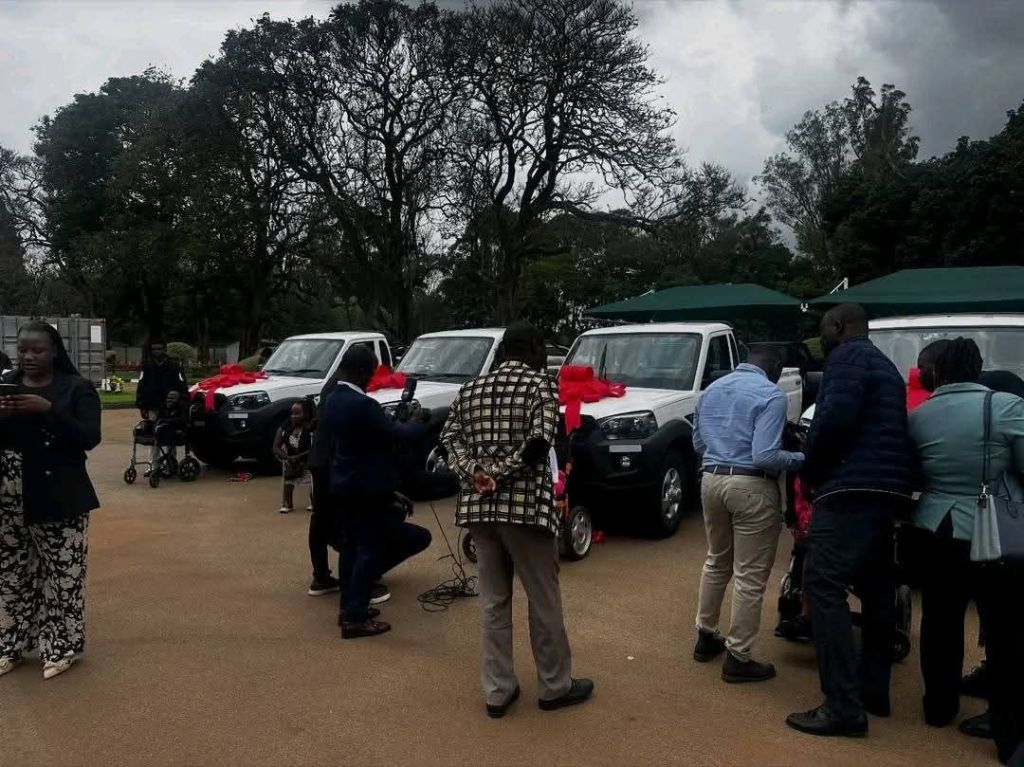
They donate cars to a handful of people with disabilities.
They gift vehicles and cash to celebrities.
And they do so with cameras rolling, social media accounts buzzing, and political banners fluttering in the background.
This is not charity.
It is political manipulation.
And it is sickening.
By turning themselves into benevolent benefactors, these elites have mastered the art of quietening Zimbabweans.
Who can question the corruption of the ruling class when they hope to be chosen for a handout?
Who can demand national accountability when they fear losing the chance for a grocery hamper, a wheelchair, or a car giveaway?
Even those with the loudest voices—the artists, influencers, and public personalities—now sing the praises of the looters because they hope to be the next beneficiaries.
Instead of demanding that government properly fund rehabilitation centres, special needs schools, and social welfare programmes, individuals chant slogans for a donation.
But let us ask the hard questions: Why should a whole musician have to beg for a wheelchair?
Why is the system so broken that an artist cannot earn enough from his craft to afford essential medical equipment?
In the 1980s, did we not watch visually impaired musicians like Paul Matavire build respectable livelihoods through their work?
That was Jairos Jiri’s dream.
What does it say about a nation when even its talented, once self-sufficient people must now depend on politically connected benefactors?
This is the tragedy of today’s Zimbabwe.
Our people do not lack wheelchairs, groceries, or cars.
They lack a functional country.
They lack institutions that work, industries that employ, wages that sustain families, and a government that values their dignity.
The rise of handouts is not a sign of generosity.
It is a sign of national decay.
A nation cannot progress when its citizens are groomed into dependency.
Handouts do not uplift society; they uplift only a select few while eroding the collective backbone of a people.
They pacify rather than empower.
They weaken rather than strengthen.
They turn proud citizens into grateful subjects.
Zimbabwe must rediscover the values that once defined us: hard work, self-reliance, and dignity.
We need systems—not handouts.
We need functioning institutions—not photo-op philanthropy.
We need leaders who build a country, not a political base of dependents.
Until then, we will remain a nation sinking ever deeper into poverty, not because poverty is inevitable, but because dependency has been turned into a political strategy.
And it is destroying us.
 TENDAI RUBEN MBOFANA - THE UN-OPPRESSED MIND!