For the ordinary Zimbabwean, the only development that counts is the kind that lifts them out of poverty.
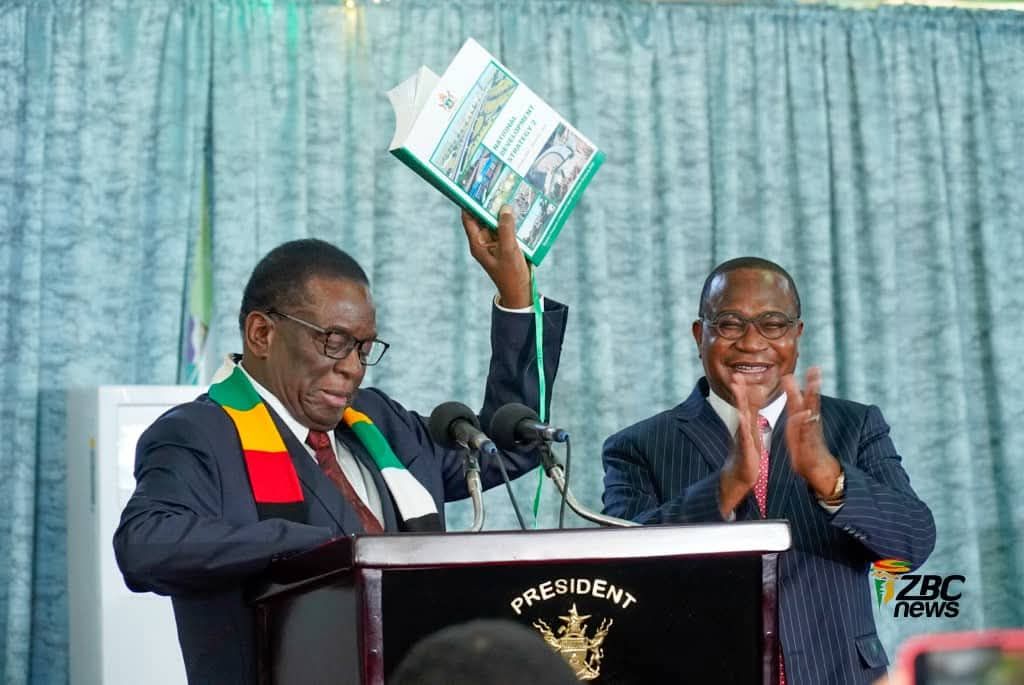
Yesterday, President Emmerson Mnangagwa launched the second phase of the National Development Strategy, known as NDS2, in a ceremony filled with excitement, glowing speeches, and a great deal of self-congratulation.
To directly receive articles from Tendai Ruben Mbofana, please join his WhatsApp Channel on: https://whatsapp.com/channel/0029VaqprWCIyPtRnKpkHe08
Judging from the tone of government officials and the state-controlled media, one would think Zimbabwe had just completed a historic developmental leap.
During a television interview on ZBC, as Finance Minister Mthuli Ncube prepared to present the 2026 National Budget, he too proudly celebrated what he called the “successes” of NDS1, confidently asserting that the government had managed to lift Zimbabweans out of poverty.
Yet, in typical fashion, he never bothered to provide the details or evidence to support these extraordinary claims.
That omission was not a mistake.
It is simply how the Mnangagwa administration operates: bold claims of success, rarely backed by verifiable facts, repeated so often that they begin to sound true—until one examines the lived reality of ordinary Zimbabweans.
The truth, which no amount of propaganda can conceal, is that poverty in Zimbabwe has actually increased under NDS1.
More Zimbabweans are poorer today than they were at the beginning of the programme in 2020.
That is not the opinion of Tendai Ruben Mbofana, nor the allegation of someone determined to “always criticise the government”, as some would like to claim.
These are facts rooted in empirical evidence, collected by the same institutions that the government itself routinely cites—ZIMSTAT, the World Bank, UNICEF, and various reputable research bodies.
Facts are stubborn.
They do not disappear simply because the powerful prefer a different story.
In 2020, at the very start of NDS1, Zimbabwe was already a country in distress.
According to the Rapid PICES Survey—a joint initiative by ZIMSTAT, the World Bank, and UNICEF—extreme poverty stood at an alarming 49 percent.
Nearly half of all Zimbabweans could not meet even their minimum food needs.
Before that, in 2019, extreme poverty was already high at about 38 percent.
So even before the supposed implementation of a grand development blueprint, poverty was on the rise.
NDS1 was meant to reverse this.
Instead, what happened over the next five years was a worsening of the very crisis it claimed it would solve.
By 2025, far from lifting people out of poverty, most Zimbabweans remained trapped in it—and many had fallen deeper into deprivation.
Independent assessments showed that approximately 60 percent of Zimbabweans were living below the US$3.65 per day global poverty threshold.
Other poverty benchmarks create an even more sobering picture.
Under the lower-middle-income poverty line—set at US$5.50 per day—more than 80 percent of Zimbabweans fall below the threshold.
This means that even if someone is technically employed, runs a vending stall, or engages in small informal activities, they remain poor in real terms.
Poverty is not defined by possessing a job title or having something to do during the day; it is defined by one’s ability to meet basic living standards.
And by this measure, the vast majority of Zimbabweans remain poor.
What makes the government’s claim of success even more astounding is the nature of the “evidence” it provides.
ZBC proudly highlighted infrastructural developments—some disputed, some incomplete, and many financed through opaque arrangements.
The broadcaster listed road rehabilitation, the Mbudzi (referred to as “Trabablas”) Interchange, the refurbished Robert Gabriel Mugabe International Airport, and an increase in grain production.
These isolated projects are no doubt intended to create the appearance of progress.
But development cannot be cherry-picked.
A nation is not transformed because a few kilometres of road are resurfaced or an airport terminal is expanded.
Development is measured by the quality of life of ordinary citizens—their income, housing, healthcare, food security, opportunities, and dignity.
If millions remain poor, then development has not taken place.
This is precisely where NDS1 collapsed.
Instead of real, broad-based economic transformation, the Mnangagwa administration relied on optics and handouts.
The past five years have been characterised by a culture of patronage—cars, cash donations, food hampers, agricultural inputs, and other temporary relief items, usually handed out during rallies and high-profile visits.
While such gifts may temporarily alleviate hunger or bring momentary excitement, they are not, and have never been, a pathway out of poverty.
Handouts can feed someone for a day.
Sustainable economic empowerment is what changes a life.
Yet the government has repeatedly mistaken the former for the latter.
During his ZBC interview, Mthuli Ncube even claimed that the Pfumvudza programme had lifted Zimbabweans out of poverty.
But this is an absurd assertion.
Yes, Pfumvudza may provide households with food in a good rainfall season.
But having food today does not transform someone’s economic status.
Poverty is not merely about whether one goes to bed hungry on a particular day; it is defined by whether one has a stable, reliable, and dignified means of sustaining oneself.
A person can be food-secure for a month but still live in deep poverty.
Likewise, the mere existence of a job does not automatically lift someone out of poverty, especially when wages are insufficient to meet the basic cost of living.
The government loves to boast that the few companies that have opened in Zimbabwe have created thousands of jobs.
Yet most of these jobs are low-paying, unstable, and do not meet the US$5.50 per day lower-middle-income poverty threshold.
Even professionals such as teachers, nurses, and other civil servants fall below this line, with the lowest paid taking home (net salary) less than US$170 a month — effectively earning under US$5.50 a day.
Zimbabweans working in retail, security, construction, agriculture, domestic work, and manufacturing are frequently earning well below the level needed to live decently.
To claim that these jobs have transformed poverty levels is nothing more than political theatre.
This is why NDS2 begins on a foundation of failure.
For Mnangagwa and Mthuli Ncube to celebrate the “successes” of NDS1 without addressing the growth of poverty is not just misleading—it is deeply insulting to the millions of Zimbabweans who continue to struggle daily.
One cannot plan for an “upper middle-income economy” when 80 percent of the population lives below the poverty line.
Development strategies must be grounded in truth.
They must respond to real human conditions, not imagined progress.
What Zimbabweans need is not propaganda, not slogans, and not carefully edited television interviews.
They need genuine economic development—industrial revival, meaningful job creation, a stable currency, fair wages, reliable public services, investment in innovation, and policies that allow citizens to build sustainable livelihoods.
A country cannot be lifted out of poverty by distributing maize seed, handing out cash to a handful of loyalists, or funding one or two poultry projects.
True empowerment requires an economy that works for all, not just for the politically connected.
As we enter NDS2, Zimbabweans must resist the temptation to take government rhetoric at face value.
The truth is clear: NDS1 was an unmitigated failure.
Poverty has increased, livelihoods have worsened, and the gap between the ruling elite and the ordinary citizen has widened.
Pretending otherwise will not create development.
Only an honest reckoning with these facts—and a complete shift in economic governance—will.
 TENDAI RUBEN MBOFANA - THE UN-OPPRESSED MIND!