So the debate keeps getting weirder and more desperate.
Of late, especially after the renewal of the so-called Resolution No. 1 at the recent ZANU-PF Annual People’s Conference in Mutare, loyalists of President Emmerson Mnangagwa have intensified their campaign to extend his stay in office beyond the current constitutional limit.
To directly receive articles from Tendai Ruben Mbofana, please join his WhatsApp Channel on: https://whatsapp.com/channel/0029VaqprWCIyPtRnKpkHe08
The refrain is predictable: Mnangagwa is allegedly doing such an exceptional job that Zimbabwe cannot afford to “interrupt” his progress before he sees through his promised Vision 2030.
What has caught my curiosity — and frankly, my bemusement — is an analogy that Mnangagwa loyalists are increasingly relying on to support this argument.
They compare the presidency to a soccer match and boldly ask: “How do you substitute a player who is scoring goals?”
It is quite the colourful example — but unfortunately for them, it is also fraught with glaring flaws.
To begin with, no one is substituting President Mnangagwa.
Substitution in football occurs while the match is still in progress, and the player is removed before the final whistle.
This analogy would have made perfect sense only if Zimbabweans were clamouring for Mnangagwa to step down before 2028.
But that is not the case.
He is being allowed to finish the match — right up to the 90th minute.
He is playing the full game, uninterrupted, exactly as provided for in the Constitution.
So this whole talk of “substitution” is deliberately misleading.
Come 2028, the match will simply reach full time.
The referee — in this case, the Constitution of Zimbabwe — will blow the whistle as it was designed to do.
The game ends.
The player walks off the pitch, no matter how many goals he might have scored.
Not because he has been substituted, but because the time allocated for the match has expired.
In fact, it would be the height of absurdity to demand that a referee add an extra 30 minutes to a match simply because one player was scoring too many goals.
That is how football works.
That is how constitutions work.
It is as simple as that.
This takes us directly to the wise words of renowned constitutional lawyer Professor Lovemore Madhuku, who once made an extremely important point that Mnangagwa’s supporters seem determined to misunderstand.
Term limits, he argued, are designed precisely for presidents who are performing well.
Those who are unpopular or failing do not need term limits — because in functional democracies they are voted out long before they reach the end of two terms.
In countries where elections are truly free, fair, and credible, poor-performing presidents rarely survive one full term, let alone two.
They are swiftly removed by voters, without the need for any constitutional restrictions.
That, in fact, would be the true equivalent of a substitution.
Term limits exist for the opposite scenario — for leaders who are doing a good job, delivering progress, and therefore likely to keep winning elections again and again.
In such cases, a country may inadvertently slide into a benevolent dictatorship simply because the electorate keeps choosing the same leader.
To avoid that democratic stagnation, constitutions impose a maximum number of terms, ensuring that no matter how good a president may be, a healthy cycle of leadership renewal remains guaranteed.
This is the very essence of term limits — and it is the very reason they were written into Zimbabwe’s Constitution.
They are a safeguard against overconcentration of power, the corrosion of institutions, the rise of personality cults, and the temptation of leaders to see themselves as indispensable.
They prevent the presidency from turning into a permanent occupation.
They ensure accountability, encourage generational leadership, curb the abuse of incumbency, and give the nation periodic breathing space for new ideas, new energy, and new direction.
Term limits protect democracy from the most seductive danger of all: the idea that the future of an entire nation should rest in the hands of a single man.
And so it makes absolutely no sense for President Mnangagwa to extend his stay in office beyond the expiry of his constitutionally mandated two five-year terms in 2028.
The fact that he has already been elected twice — regardless of the contested nature of Zimbabwe’s elections — means he was endorsed by the people.
They entrusted him with a full decade of leadership.
For any leader, that is a profound honour.
The question then becomes: should he not be satisfied with that?
Should he not walk away in 2028 with his head held high, proud of having completed the maximum term allowed by law — a privilege denied many presidents in other countries?
Yet the push for an extension risks permanently staining his legacy.
Instead of being remembered as a president who respected the Constitution and embraced the democratic evolution Zimbabwe desperately needs, he risks joining the long list of African leaders whose insatiable hunger for power drove them to twist, amend, or mutilate their constitutions to prolong their rule.
For a man who has spoken often of reform, nation-building, and constitutionalism, that would be an indelible mark of dishonour — the opposite of the legacy he presumably desires.
But all is not lost.
President Mnangagwa still has a rare and historic opportunity to choose greatness.
Zimbabwe has never witnessed a smooth, democratic transfer of power since independence in 1980.
Not once.
Every transition has been born out of conflict, internal party coups, mass protests, or political crisis.
This is Mnangagwa’s chance to break that tragic pattern and become the first leader in Zimbabwe to peacefully hand over power to a successor.
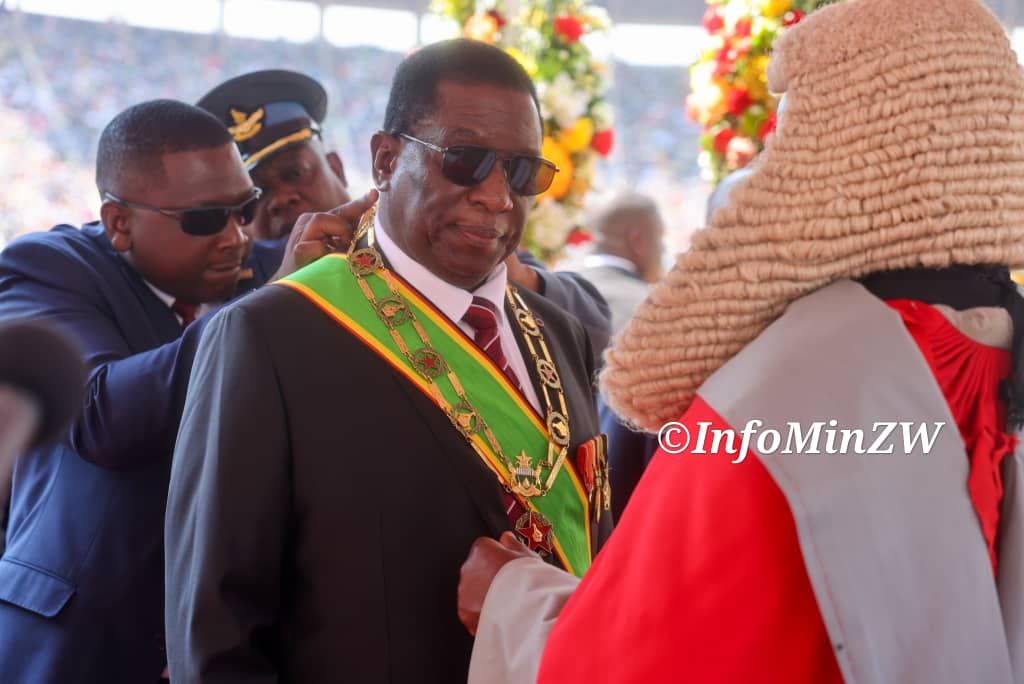
One can already imagine the scene: a packed National Sports Stadium in 2028, thousands of Zimbabweans gathered in unity and hope, as President Mnangagwa walks up to the podium to formally hand over the reins of office.
The Chief Justice administers the oath of office to the new president.
The nation witnesses — for the first time since the night of 17 April 1980 — a peaceful and dignified transfer of power.
That single moment would eclipse every controversy of his tenure.
It would be a rebirth of Zimbabwe’s democratic spirit.
If that happened, history would not remember Mnangagwa as the man who tried to cling to power.
It would remember him as the leader who broke the cycle of political stagnation, who honoured the Constitution, and who ushered Zimbabwe into a new era of democratic maturity.
He would become a hero and a legend — not for how long he stayed in office, but for how honourably he chose to leave.
And I, for one, would be there in the stadium, applauding loudly, celebrating a president who finally made democracy real for Zimbabwe.
 TENDAI RUBEN MBOFANA - THE UN-OPPRESSED MIND!