Sometimes, the loudest message comes not from what is said, but from what is deliberately left unsaid.
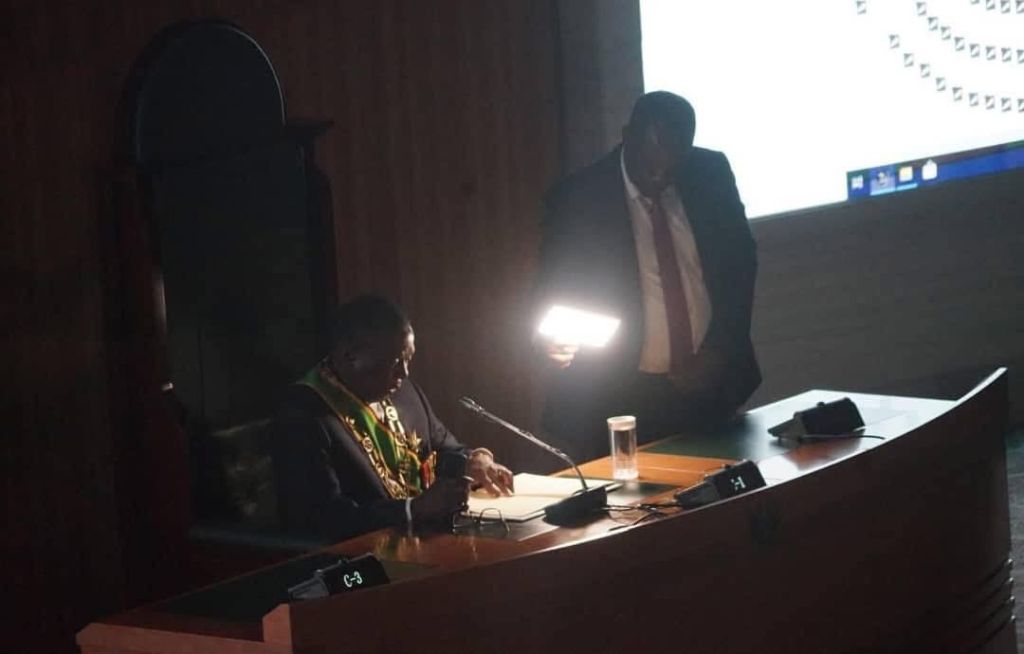
President Emmerson Mnangagwa’s State of the Nation Address (SONA), delivered in Parliament yesterday, once again exposed the hollowness and detachment of the so-called “Second Republic” from the everyday struggles of ordinary Zimbabweans.
To directly receive articles from Tendai Ruben Mbofana, please join his WhatsApp Channel on: https://whatsapp.com/channel/0029VaqprWCIyPtRnKpkHe08
As with all the SONAs we have heard over the years, this one was filled with carefully curated economic jargon, selective achievements, and grand projections meant to paint an image of progress.
Yet, beneath the polished rhetoric lies a deafening silence on the single most destructive force behind Zimbabwe’s unending misery — corruption.
It is staggering that a president who claims to preside over a reform-driven and “open for business” administration would completely ignore the cancer of corruption in a country currently ranked the most corrupt in southern Africa by Transparency International, with a dismal 2024 Corruption Perception Index score of just 21 out of 100.
This shameful ranking places Zimbabwe among the worst globally, yet Mnangagwa’s SONA barely whispered a word about fighting graft — not even the usual empty promises or tokenistic declarations.
Why such silence on an issue so central to our national collapse?
Is this not the same corruption that robs our nation of at least US$4 billion every year through tender fraud, procurement irregularities, minerals smuggling, and other illicit financial flows?
Four billion dollars annually — stolen or misused — while our hospitals lack basic medications and functional equipment, while our schools decay without resources, and while millions of our fellow citizens go hungry or live in darkness for 16 hours a day.
That figure represents not just money lost, but lives lost — mothers who die giving birth due to shortages of oxygen, children who perish from treatable diseases, and young people whose dreams vanish in the thick fog of hopelessness.
And yet, despite this catastrophic plunder, Mnangagwa’s speech focused on the illusion of “economic growth,” boasting of a 6.6% projected GDP increase for 2025.
But growth for whom?
What use is a growing GDP in a country where over 80% of the population lives below the poverty datum line, and over 90% are unemployed or trapped in precarious informal work?
What comfort is a rising GDP when ordinary Zimbabweans are living in destitution, unable to afford decent meals, pay school fees, or access clean water?
An economy that grows while its people starve is a mockery of development.
It is akin to a father earning a high salary but squandering it on personal pleasures while his children go hungry and uneducated.
On paper, the family looks comfortable, but in reality, the children are just as poor as those from a truly impoverished household.
This is the Zimbabwe we live in — a state that parades impressive-sounding statistics while its citizens wallow in despair.
If GDP growth is not reflected in the quality of life of ordinary citizens — in affordable healthcare, clean water, decent jobs, and reliable electricity — then it is meaningless.
What good is a GDP of US$46 billion when millions cannot afford bread, when hospitals have no syringes or gloves, and when students are dropping out of school because their parents can’t pay the fees?
Real progress is not measured by economic graphs but by the smiles of citizens who can afford dignity.
What makes this all the more tragic is that other countries with smaller economies have managed to deliver far better standards of living to their citizens.
Take Lesotho, with a GDP of around US$3 billion — roughly fifteen times smaller than Zimbabwe’s — yet its poverty rate, though still high, is falling faster than ours, and its governance indicators are considerably better.
Or consider Eswatini, with a GDP under US$6 billion, but where basic public services such as electricity and clean water are far more accessible.
Even Malawi, whose GDP barely reaches US$15 billion, is slowly making tangible improvements in healthcare and education through targeted anti-corruption reforms.
These examples expose a painful truth: Zimbabwe’s crisis is not primarily about a lack of resources, but about their theft and mismanagement.
The real tragedy of Mnangagwa’s administration is not that it lacks plans or programs — it’s that those programs are systematically sabotaged by corruption.
Every major project is turned into a feeding trough for political elites and their cronies.
Those closest to power have become overnight millionaires, flaunting obscene wealth while ordinary people live like refugees in their own land.
Who can forget the scandalous US$5 million advance payment given to tenderpreneur Wicknell Chivayo for the Gwanda solar power project?
Ten years later, the site remains a barren piece of land — no panels, no electricity, no accountability.
The supposed 100 MW plant that could have powered thousands of homes is now a national embarrassment, symbolizing the state’s complicity in grand corruption.
And yet, instead of demanding accountability, the same individuals implicated in such scandals are celebrated, honored, and given more contracts.
This is precisely why Mnangagwa could not afford to address corruption in his SONA.
To do so honestly would have meant confronting the very system that sustains his rule — a patronage network built on looted wealth, rigged tenders, and captured institutions.
It would have meant naming and prosecuting those within his inner circle who have turned public office into private business.
That, he cannot do.
So he opts for silence — a silence that protects the corrupt while betraying the suffering masses.
If Zimbabwe is ever to rise again, this culture of impunity must end.
Economic growth figures and infrastructure projects mean nothing if they are built on stolen foundations.
No road or bridge will lift the people out of poverty if the contracts are inflated tenfold to enrich the connected few.
No agricultural program will succeed if inputs meant for farmers are diverted to the black market by corrupt officials.
And no national budget will ever benefit the people as long as billions are siphoned off to offshore accounts.
Zimbabweans are not asking for miracles.
We are simply demanding honesty, integrity, and accountability from our leaders.
We are tired of empty statistics and slogans — of “Vision 2030” promises that sound grand but deliver nothing.
What the people want are results they can feel in their homes, see in their neighborhoods, and count in their bank accounts.
We want hospitals that save lives, schools that shape futures, and jobs that restore dignity.
For that to happen, corruption must be confronted head-on — not through cosmetic anti-corruption commissions that serve as political tools, but through genuine, fearless prosecutions that reach the highest levels of power.
Until Mnangagwa’s government tackles corruption decisively and transparently, every SONA he delivers will remain just another empty ritual — a speech filled with promises but devoid of moral substance.
The true state of our nation cannot be measured by GDP figures or infrastructural blueprints, but by the condition of our people.
And right now, the state of the nation is one of poverty, suffering, and betrayal — the direct consequence of corruption that has gone unchecked for far too long.
Unless that rot is addressed, Zimbabwe’s future will remain stolen, and the president’s grand speeches will continue to ring hollow in the ears of a hungry and hopeless people.
 TENDAI RUBEN MBOFANA - THE UN-OPPRESSED MIND!