A lie, as the saying goes, has short legs — it can only run so far before it is finally exposed.
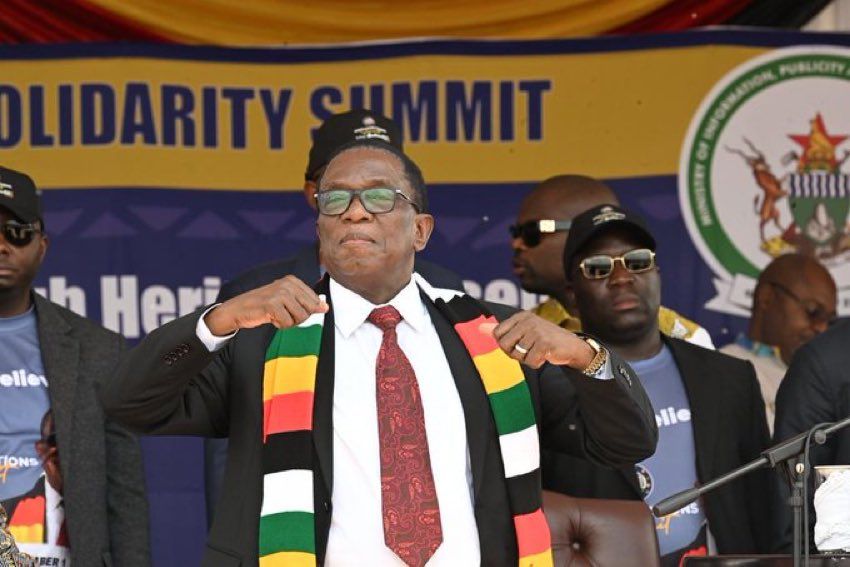
Once again, on this 25th of October, President Emmerson Mnangagwa took to the podium during the so-called SADC Anti-Sanctions Solidarity Summit, to repeat a tired old refrain — that “illegal Western sanctions” are to blame for Zimbabwe’s economic collapse.
To directly receive articles from Tendai Ruben Mbofana, please join his WhatsApp Channel on: https://whatsapp.com/channel/0029VaqprWCIyPtRnKpkHe08
He praised the “resilience of Zimbabweans under siege,” portraying the nation as a victim of foreign hostility and economic strangulation.
Yet, after nearly two decades of this narrative, the question every Zimbabwean must ask is simple: if sanctions have crippled the nation, how has the government somehow managed to find billions of U.S. dollars to fund its own corruption, patronage networks, and lavish lifestyles?
The reality is that what Mnangagwa calls “economic sanctions” are not blanket restrictions on the country.
The United States, the European Union, and the United Kingdom have all repeatedly clarified that their measures are targeted — aimed only at specific individuals, companies, and entities accused of corruption, human rights abuses, and state capture.
In fact, the U.S. terminated its entire Zimbabwe-specific sanctions program in March 2024, replacing it with the Global Magnitsky framework — which sanctions only 11 individuals, including Mnangagwa himself, and three companies such as Sakunda Holdings and Fossil Contracting.
The European Union, for its part, no longer has a single Zimbabwean individual under sanction, maintaining only an arms embargo.
The UK, too, has delisted most of its earlier targets.
Even vocal anti-sanctions activist Rutendo Matinyarare has openly acknowledged that sanctions on Zimbabwe have been removed — in fact, he has gone so far as to boast that he singlehandedly achieved this supposed diplomatic victory.
So where are these so-called “crippling sanctions” the regime laments every October 25th?
There are none.
Even Zimbabwe’s inability to access international lines of credit has nothing to do with sanctions, but everything to do with the country’s own failure to service its foreign debt — which now stands at over US$18 billion.
This reality has already been openly acknowledged by the Mnangagwa administration itself through the establishment of the Arrears Clearance and Debt Resolution Process, mediated by the African Development Bank (AfDB) and former Mozambican President Joaquim Chissano.
The process was meant to rebuild trust with international creditors by demonstrating a commitment to fiscal discipline, transparency, and governance reforms — yet little progress has been made, largely because the government continues to resist the very reforms needed to unlock credit and debt relief.
However, Zimbabwe is free to trade, borrow, invest, and receive aid from any country in the world — provided it follows basic international financial norms and laws against money laundering.
But the real problem is that investors, banks, and multilateral institutions have lost confidence in Zimbabwe, not because of sanctions, but because of the government’s own chronic corruption, political repression, and policy inconsistency.
No investor will risk money in a country where powerful individuals grab mines, farms, or contracts without due process; where the rule of law is a suggestion, not a principle; where court judgments are ignored if they displease the powerful; and where state institutions serve political elites, not the public.
That is not a sanctions problem — it is a governance problem.
If sanctions truly crippled Zimbabwe’s economy, how does the government continue to find vast sums of U.S. dollars to hand to politically connected tenderpreneurs?
Wicknell Chivayo, for example, was advanced over US$5 million by ZESA for the 100 MW Gwanda Solar Project, which never materialized.
After failing to deliver any progress on the project, ZESA cancelled the contract — yet, instead of being held accountable, Chivayo was astonishingly rewarded when the courts ordered ZESA to pay him a further US$22 million in compensation for “breach of contract.”
More recently, Chivayo reportedly pocketed about R800 million (roughly US$40 million) from a staggering R1.1 billion payment by Treasury to South African company Ren-Form CC, supposedly for election materials.
This is the same individual who flaunts luxury cars and gifts them to musicians, church leaders, and pro-Mnangagwa praise-singers as if distributing wedding confetti — while public hospitals lack basic medicines and ambulances.
If the state can find tens of millions of U.S. dollars for corrupt deals, how does it fail to equip hospitals, repair roads, or ensure clean water?
How can the same government that claims sanctions block development spend millions rehabilitating a handful of roads and building airport terminals, while schools crumble, water supplies run dry, and electricity remains a luxury?
It is convenient for Mnangagwa’s administration to point fingers at Washington or Brussels for the country’s hardships.
But the real sanctions — the ones truly destroying Zimbabwe — are self-imposed, through corruption, looting, and economic mismanagement.
The Auditor-General’s reports reveal billions lost annually to tender fraud, procurement irregularities, and missing funds across ministries and parastatals.
The Zimbabwe Anti-Corruption Commission admits that the country loses more than US$2 billion every year to corruption and illicit financial flows — an amount far greater than any possible impact from sanctions.
Ordinary Zimbabweans have been made to endure the consequences.
Over 80 percent of the population now lives below the poverty datum line.
Unemployment exceeds 90 percent, forcing millions into informal street vending or exile.
Hospitals are death traps.
Schools are underfunded.
Roads resemble war zones.
Electricity blackouts last up to 16 hours a day, while water taps run dry for years.
Yet amid this national suffering, the politically connected elite wallow in obscene wealth — luxury mansions, imported cars, and foreign bank accounts.
If these are the fruits of “sanctions,” they are clearly not hurting those in power.
Instead, they are weaponized as a propaganda shield — a convenient scapegoat for the regime’s failures.
Under Robert Mugabe, sanctions became a slogan to mask the destruction wrought by violent land seizures and policy chaos.
Under Mnangagwa, they remain a smokescreen to hide grand theft and incompetence.
Let us be clear: targeted sanctions do have some impact. T
hey create a perception of risk that discourages some foreign banks and investors from engaging with Zimbabwe, fearing inadvertent violation of U.S. or EU rules.
This “perception effect” may cost the country one or two percentage points in GDP growth each year.
But that pales in comparison to the 10 or 15 percentage points lost through corruption, poor governance, and capital flight.
The government itself admits that mining, agriculture, and manufacturing are losing billions annually to leakages, smuggling, and tax evasion.
Instead of blaming foreign powers, Mnangagwa should confront the real saboteurs of Zimbabwe’s economy — the corrupt officials and business cronies bleeding the country dry.
A nation that cannot account for billions in public contracts, that fails to prosecute looters, and that shields thieves under political protection does not need sanctions to fail.
It is already sanctioning itself through greed.
Even now, with most sanctions already lifted or reduced to a handful of targeted measures, have our hospitals suddenly been stocked with medicines?
Have power stations started functioning efficiently, or have teachers’ and nurses’ salaries improved?
Of course not.
Nothing will change unless the looting stops, accountability is restored, and public funds are used for the public good.
Zimbabwe’s suffering is not the result of “external enemies,” but of internal betrayal.
The ruling elite have turned corruption into a governing philosophy and made poverty their political weapon.
They thrive in crisis, because chaos sustains control.
So as President Mnangagwa again mourns the “albatross of sanctions” before the cameras of state television, the people of Zimbabwe must see through the charade.
The true albatross around our nation’s neck is not Western pressure — it is the corruption, impunity, and hypocrisy of those who claim to be our liberators while feeding off our misery.
Until that changes, no summit, slogan, or scapegoat will ever bring Zimbabwe’s recovery.
 TENDAI RUBEN MBOFANA - THE UN-OPPRESSED MIND!