They say power corrupts — and absolute power corrupts absolutely.
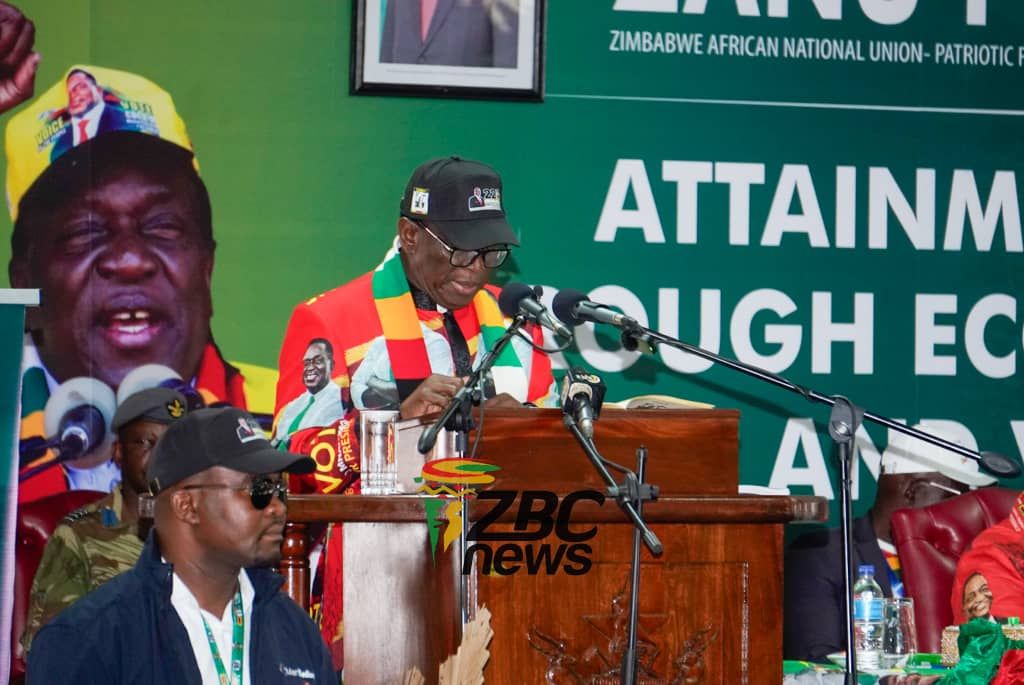
The just-ended ZANU-PF National People’s Conference in Mutare has once again laid bare the tragic reality of Zimbabwe’s ruling party — that it has been reduced to nothing more than a cult built around one man.
To directly receive articles from Tendai Ruben Mbofana, please join his WhatsApp Channel on: https://whatsapp.com/channel/0029VaqprWCIyPtRnKpkHe08
The Conference’s so-called “Resolution No. 1”, which instructs Justice Minister Ziyambi Ziyambi to begin the legal processes of extending President Emmerson Mnangagwa’s term by two years — from 2028 to 2030 — is nothing short of an admission that ZANU-PF believes there is no one else among its ranks capable of steering the country forward.
The resolution, which was ironically a reaffirmation of a similar one passed at last year’s conference but never implemented, is as desperate as it is dangerous.
It directs that by October 2026, Ziyambi must ensure the legal framework is in place to allow Mnangagwa to continue leading beyond his constitutionally mandated two five-year terms.
The party claims this is necessary to allow him to “continue his visionary leadership marked by stability, economic recovery, and transformative national development.”
But if ZANU-PF truly believes that the entire fate of Zimbabwe’s so-called Vision 2030 — the dream of an “empowered upper middle-income economy” — rests solely on one individual, then the party has no business governing this nation.
A political party that cannot produce capable successors, that cannot cultivate leadership beyond one man, is a political disaster waiting to happen.
Section 91 of the Constitution of Zimbabwe clearly stipulates that no one may serve as President for more than two terms, while Section 95 limits each term to five years.
Section 328 makes it even clearer that these limits can only be changed through a national referendum and that even then, the incumbent cannot benefit from such an extension.
These provisions were not inserted by accident; they were meant to prevent precisely the kind of power entrenchment that ZANU-PF is now attempting.
If Mnangagwa’s loyalists were truly concerned about stability and continuity, they would be working to strengthen the institutions of state and governance, not the position of one man.
They would be ensuring that Vision 2030 — if it truly exists beyond slogans — is institutionalized, not personalized.
A national vision that depends entirely on one person’s continued presence is not a vision at all; it is a cult of personality.
And yet, this push for term extension is not truly about “economic recovery” or “transformative development.”
It is about fear — fear of losing power, fear of accountability, and fear of change.
The so-called “Zvigananda” — the powerful clique of politically connected businesspeople and tenderpreneurs — know that their fortunes are tied to Mnangagwa’s stay in power.
Figures like Kudakwashe Tagwirei, whose business empire has grown fat on state contracts awarded without tender, are reportedly being positioned as potential successors.
It is no secret that Tagwirei’s closeness to Mnangagwa and his family has made him one of the most powerful and untouchable men in the country.
There are even suggestions that this entire succession plan is tribal — meant to keep power within the Karanga faction and out of reach of Vice President Constantino Chiwenga, who is Zezuru, and his supposed military backers.
The resistance from Chiwenga’s camp is not trivial.
It represents a deeper fracture within the ruling elite — between those who believe Mnangagwa should retire in 2028 as the Constitution demands, and those who want to keep him in office for their own protection.
The latter camp is driven not by national interest, but by self-preservation.
They know that a new administration, particularly one led by Chiwenga, could expose the grand corruption networks that have drained Zimbabwe’s coffers.
When Mnangagwa’s supporters talk about “stability,” what they really mean is the stability of their own positions and privileges.
When they talk about “economic recovery,” they are referring to their own personal enrichment.
For the rest of the country, the so-called stability has meant persistent power cuts, crumbling hospitals, failing schools, and unbearable poverty.
As I write this piece, I am sitting in the dark due to yet another round of load-shedding.
It is almost poetic — symbolic of the darkness into which this country has been plunged by years of mismanagement and corruption.
Millions of dollars have been poured into phantom projects such as the Gwanda solar plant, for which tenderpreneur Wicknell Chivayo received over US$6 million in advance, yet not a single watt of electricity has been generated.
That money could have equipped hospitals, bought ambulances, or built classrooms — but instead it lined the pockets of politically connected individuals who continue to flaunt their wealth on social media, giving away cars and cash as though poverty were a spectacle.
If ZANU-PF believes that Mnangagwa alone can fix this — when he has presided over it for nearly eight years with little to show — then it is delusional.
If the party truly has no other leaders who can carry the Vision 2030 torch, then it has failed in its most basic political duty: to nurture leadership.
What happens if Mnangagwa were to die today or tomorrow?
Would that mark the end of Vision 2030?
Would the entire state machinery grind to a halt?
This possibility alone should terrify any sensible person.
A political party that has no contingency, no bench of capable leaders, no mechanisms for continuity, is a threat to national stability, not a guarantor of it.
The truth is simple and brutal: this resolution is not about vision — it is about greed.
It is not about progress — it is about protection.
Protection for the corrupt, for the tenderpreneurs, for those who have plundered the nation’s wealth and now fear the day of reckoning.
Mnangagwa’s continued rule is their insurance policy.
So when ZANU-PF delegates cheer and chant for the extension of his term, they are not celebrating “visionary leadership”; they are celebrating their own continued access to looting opportunities.
Meanwhile, the ordinary Zimbabwean — the teacher earning less than US$300 a month, the nurse watching patients die due to lack of medicine, the vendor chased from the streets — remains trapped in a cycle of hopelessness.
If the ruling party cannot imagine a future without Mnangagwa, then it has no business imagining a future for Zimbabwe.
For a party that prides itself on being “colossal,” this dependence on one man exposes a frightening hollowness.
Real political maturity lies in building institutions, not idols; in developing leadership, not lifelines.
The tragedy of Zimbabwe today is not just that our leaders are corrupt — it is that they no longer even bother to hide their greed.
They now dress it up as “visionary leadership,” pass it as “resolutions,” and sell it as “stability.”
But beneath the grand speeches and party slogans lies a naked truth: this is a political elite clinging to power not for the good of the nation, but for the preservation of privilege.
If ZANU-PF cannot find within its ranks a single leader capable of taking Zimbabwe to 2030, then the party itself does not deserve to make it there.
 TENDAI RUBEN MBOFANA - THE UN-OPPRESSED MIND!