History is full of plunderers who disguised themselves as investors.
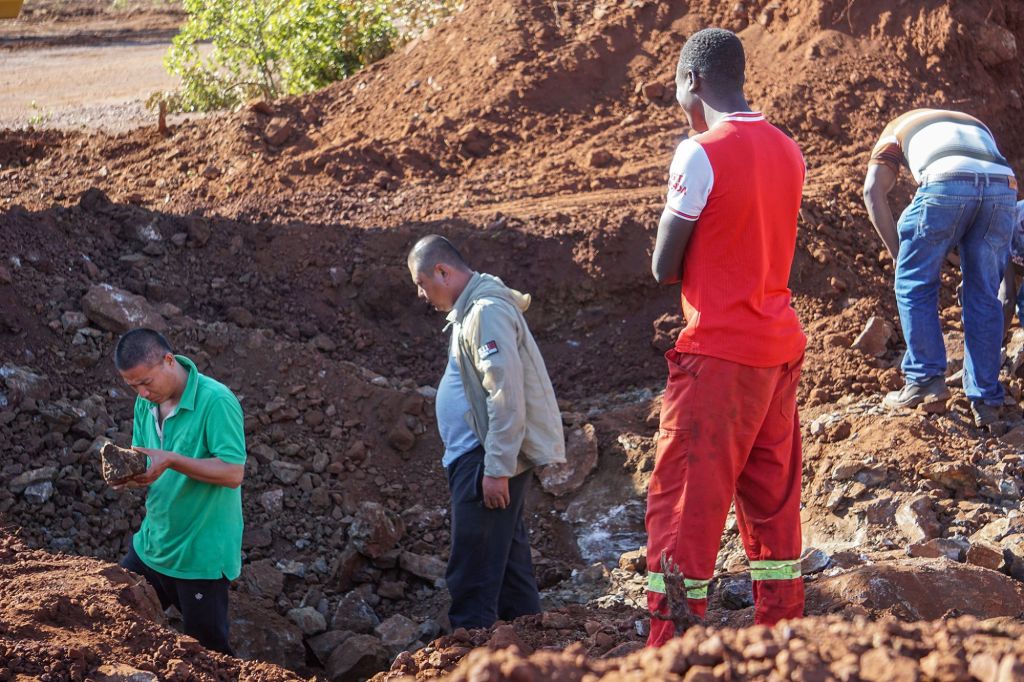
The recent report by Xinhua, boldly claiming that China is supporting Zimbabwe’s “industrialisation and modernisation,” might sound reassuring to anyone unfamiliar with the lived realities of ordinary Zimbabweans.
To directly receive articles from Tendai Ruben Mbofana, please join his WhatsApp Channel on: https://whatsapp.com/channel/0029VaqprWCIyPtRnKpkHe08
The Chinese ambassador to Zimbabwe, Zhou Ding, spoke proudly about his country’s contribution to our so-called industrial growth, citing investments, infrastructure development, and job creation.
Yet, these carefully chosen words conceal a darker, more uncomfortable truth.
The reality on the ground is far removed from the polished diplomatic statements.
What China has been advancing in Zimbabwe is not genuine development—it is a ruthless extraction of resources, carried out at the expense of workers, communities, and our environment.
As much as China claims to be driving Zimbabwe’s march towards industrialisation, this claim is meaningless if it comes bundled with gross violations of people’s rights, rampant environmental destruction, and exploitative labour practices.
Reports from the Centre for Natural Resource Governance (CNRG), labour unions, and even our own police files paint a harrowing picture of Chinese operations in Zimbabwe.
Workers are grossly underpaid—sometimes unpaid altogether—and subjected to physical and even sexual abuse at the hands of their Chinese employers.
In 2020, for instance, two employees at Reden Mine in Gweru were shot and injured by their Chinese manager during a wage dispute.
In 2021, a CNRG report documented the case of River Valley Mine in Mutoko where women reported sexual harassment by Chinese bosses, while men were forced to work without safety gear.
Others are exposed to deadly risks: in Hwange’s Collum Coal Mine, seven workers died in 2021 due to negligence, with survivors alleging that management ignored repeated warnings about unsafe shafts.
Entire communities are not only displaced from their ancestral lands but are also robbed of their heritage, dignity, and future.
The forced removals often happen without free, prior, and informed consent, a principle enshrined in international law, nor do they come with fair compensation.
Instead, families who have lived on their land for generations—depending on it for farming, grazing, and cultural practices—are suddenly uprooted to make way for mining concessions or industrial projects.
In Uzumba, for instance, villagers were ordered to vacate their land to pave way for Heijin, a Chinese black granite mining company.
According to the CNRG, these families were neither properly consulted nor adequately compensated, yet their livelihoods have been irreparably disrupted.
Similarly, in Hwange, the expansion of coal mining projects by Chinese firms has pushed villagers off their land, with promises of relocation and development that have largely gone unfulfilled.
The most heartbreaking aspect is that these displacements tear people away from sacred sites, graves of their ancestors, and rivers that sustain their daily survival.
In Chiadzwa (Marange), thousands were forcibly moved to Arda Transau to make way for diamond mining operations dominated by Chinese firms.
More than a decade later, those communities still live in dilapidated housing without running water, proper sanitation, or access to fertile land.
Schools and clinics promised at the time of relocation either do not exist or are poorly resourced, while the wealth from diamonds is siphoned away.
What this means is that displacement is not just about loss of land—it is about the destruction of entire ways of life, leaving communities poorer, more vulnerable, and permanently dependent.
This pattern is disturbingly consistent across Zimbabwe.
Whether it is black granite in Mutoko, coal in Hwange, or diamonds in Marange, Chinese investments have often meant that communities pay the heaviest price for so-called industrialisation.
Their voices are silenced, their consent is bypassed, and their rights are trampled on in pursuit of profits.
What we are witnessing is not development but a violent reshaping of communities to suit foreign interests.
Entire rivers, such as the Save and Odzi in Manicaland, have been poisoned by effluent from Chinese diamond and gold mines, while sacred mountains in Uzumba and Mutoko have been blasted apart by Chinese quarrying companies.
In some cases, such as Heijin Mining in Murehwa in 2022, companies even ignored High Court orders halting their operations.
What use is this supposed “modernisation” when it leaves our people poorer, sicker, and more marginalised than ever before?
The Marange diamond fields stand as one of the starkest examples of this sham.
After two decades of diamond mining, billions of dollars have flowed out of Marange into the pockets of a handful of elites and foreign companies, while the local people remain in shocking poverty.
Despite the immense wealth extracted from their soil, Marange residents live in communities without proper infrastructure, where hospitals operate without beds and patients are forced to sleep on the floor or on makeshift mattresses made from discarded doors.
A CNRG survey in 2022 found that 83 percent of Marange households had not seen any benefit from diamond mining, despite living on land hosting some of the richest alluvial deposits in the world.
If after 20 years of diamond extraction, the people of Marange have absolutely nothing to show for it, then what credibility is there in China’s talk of industrialisation and modernisation?
What has been “modernised” in Marange?
Certainly not the lives of its people.
Even in cases where Chinese companies have erected factories or buildings, these structures are often little more than temporary, makeshift facilities.
For example, investigations into Chinese chrome smelting operations in Midlands revealed “container-like” processing plants with no environmental management systems in place, some of which were dismantled and moved after exhausting deposits in one area.
Their flimsy construction betrays the reality: the Chinese are not here to build for permanence but to extract what they want and leave.
When the minerals run dry or profits dwindle, they will dismantle and move away, leaving behind poisoned rivers, gaping pits, infertile fields, and razed landscapes.
This is not development—it is strip-mining on a national scale, with future generations condemned to inherit wastelands.
Worse still, these companies hardly contribute to building Zimbabwe’s domestic industrial base.
Much of the material and equipment they use is imported directly from China—even the most basic work gear such as safety boots, gloves, goggles, and masks.
In 2022, the Zimbabwe Congress of Trade Unions (ZCTU) reported that Chinese employers at Sunny Yi Feng Tiles factory in Norton imported even uniforms and gloves from China rather than sourcing locally, despite Zimbabwe having textile and protective clothing industries.
Skilled jobs, too, are reserved for imported Chinese workers, while Zimbabweans are relegated to menial manual labour.
At Anjin Investments in Marange, nearly all senior engineering and managerial posts were filled by Chinese nationals, with locals reduced to security guards, drivers, and general hands.
Rather than upskilling locals, Chinese companies treat them as expendable.
This is not how a partner committed to genuine industrialisation behaves.
Foreign direct investment is vital for Zimbabwe, but it must respect the dignity and rights of our people.
It must create lasting value that remains even after the investors have left.
What China is currently doing looks less like partnership and more like neo-colonial exploitation.
The Chinese appear to view Zimbabweans as little more than glorified slaves, and Zimbabwe itself as a colonial outpost ripe for plunder.
It is worth remembering that 19th-century European colonisation also came cloaked in the language of “development,” “investment,” and “modernisation.”
Colonisers built mines, railways, and factories, often with the latest technology of their time.
They created jobs, yes—but these jobs were exploitative and underpaid, and the wealth was siphoned away to Europe.
Yet, despite the undeniable injustices of colonial rule, it is equally true that some tangible benefits, particularly in education and infrastructure, were left behind.
Robert Mugabe himself, who spent his life railing against colonialism, could hardly have done so in perfect English without the education he received from colonial institutions.
One cannot help but ask: what comparable legacy are the Chinese leaving behind?
How many world-class schools, hospitals, or universities have they established in the regions where they extract billions of dollars in mineral wealth?
How many young Zimbabweans have been trained as engineers, scientists, or industrial experts by the Chinese presence here?
The answer is painfully obvious: almost none.
What China offers Zimbabwe cannot be called industrialisation or modernisation.
At best, it is a parasitic form of economic engagement that extracts far more than it gives, leaving behind social decay and environmental ruin.
At worst, it is a deliberate re-colonisation under a different flag.
If Zimbabwe allows this to continue, we risk becoming a nation stripped bare, with no minerals, no clean water, no arable land, and no dignity.
Industrialisation, if it is to be worthy of the name, must uplift the people, empower workers, respect communities, and leave behind infrastructure and skills that endure beyond the lifespan of any single mine or factory.
True modernisation is measured not by the number of Chinese-built warehouses or temporary plants, but by whether Zimbabweans are healthier, wealthier, more educated, and more independent as a result.
By this measure, China’s role in Zimbabwe has been a profound failure.
If China genuinely wants to be a partner in Zimbabwe’s progress, then it must drastically change course.
It must pay workers fairly, treat them with dignity, respect local laws and courts, protect the environment, and invest in schools, hospitals, and long-term skills transfer.
Anything short of that is not industrialisation—it is exploitation dressed up in diplomatic platitudes.
Until that day comes, we should call things by their proper names. China is not bringing industrialisation or modernisation to Zimbabwe.
It is plundering Zimbabwe, and unless we resist, it will leave us poorer than it found us.
 TENDAI RUBEN MBOFANA - THE UN-OPPRESSED MIND!