Life often leaves us with questions that refuse to go away, and I have carried some of them with me since childhood.
When I was still a primary school child in the early 1980s, I remember my late childhood best friend, Brian Taurai Murau, climbing to the rooftop of the tallest building in our small hometown of Redcliff, the eight-storey flats known as Palm Court.
To directly receive articles from Tendai Ruben Mbofana, please join his WhatsApp Channel on: https://whatsapp.com/channel/0029VaqprWCIyPtRnKpkHe08
From there, we loved the breathtaking aerial view of our town and its surroundings — the blast furnaces of the steel plant in the distance, the green patches of fields, and the quiet rhythm of our small community.
It was from this vantage point that we witnessed an event that shaped my perspective on leadership and power for the rest of my life.
One day, the then president, Robert Gabriel Mugabe, visited Redcliff.
True to form, Brian and I raced up Palm Court to watch his arrival at the nearby Hotel Redcliff.
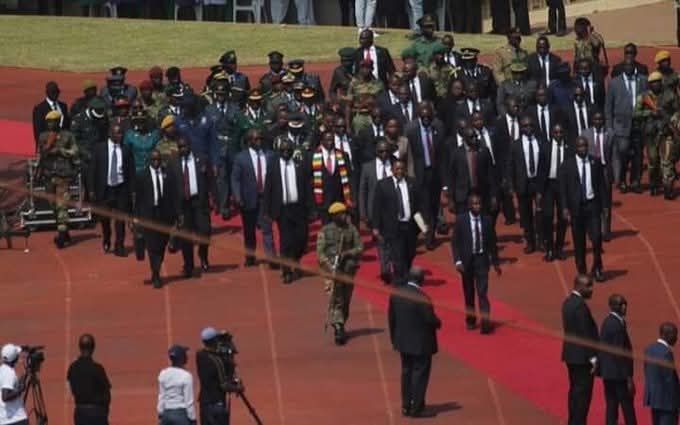
From above, we could see the entire drama unfold — the flashing lights, the blaring sirens, and the long motorcade that announced the arrival of the most powerful man in the land.
To young boys like us, it was both thrilling and bewildering.
Yet, amidst the noise and grandeur, there was something that unsettled me — something that has never left my mind to this day.
For all the spectacle, it was nearly impossible to actually spot Mugabe.
He was engulfed in a sea of men in dark suits, surrounded by heavily armed guards who seemed to swallow him whole.
I remember asking myself, even in my childish innocence: if being president was such a great honor, the pinnacle of prestige, why did he look more like a man under siege than one adored by his people?
If he was so loved, what was there to fear?
That moment etched itself into my young imagination, planting an idea I have carried into adulthood: a president is not truly free — he is, in many ways, a prisoner.
What kind of life is it when one cannot stroll through his own neighborhood, pop into a shop to buy a newspaper, or share a simple meal at the local gathering place?
To me, that is a prison far worse than Chikurubi Maximum Security.
At Chikurubi, prisoners are denied liberty by the state.
But the president, ironically, is denied liberty by the very office that is supposed to symbolize power.
Every aspect of his existence is choreographed, guarded, and shrouded in fear.
Even as a child, I realized that as ordinary citizens we had more freedom than the head of state himself.
That realization has guided my outlook ever since.
Even today, I am struck by the contrast.
A few hours ago, before sitting down to write this piece, I walked to a nearby tuck shop to buy a snack.
On the way, I exchanged greetings with neighbors, stopped for a chat, and enjoyed the fresh air of a simple afternoon.
These small, ordinary pleasures — unnoticed by most — are treasures of life.
Yet they are pleasures entirely beyond the reach of the president.
He can never simply step outside unannounced.
He can never mingle freely without suspicion.
He can never enjoy the spontaneous joy of life that ordinary citizens take for granted.
And yet, men and women fight tooth and nail, sometimes shedding blood and causing suffering, for the so-called privilege of that office.
But what sort of privilege is it to live as a captive?
The irony is glaring.
Leaders cling to power in the name of controlling their countries, but what control do they truly have if they cannot move freely within those borders?
Every trip is choreographed months in advance, every stop screened by security agents, every handshake vetted by intelligence officers.
Even when traveling on the highway, with blaring sirens and outriders clearing the road, I see not a leader in command but a man imprisoned — a man who cannot even stop at “Pa50” near Norton for a braai.
That is not power.
That is captivity.
These thoughts returned forcefully today when I read a report about Advocate Thabani Mpofu condemning the harassment of citizens whose vehicles broke down near State House in Harare.
In one incident, a truck that suffered mechanical failure was forcibly pushed away by soldiers, as though its presence was a calculated threat.
In another, a kombi that accidentally crashed into the State House perimeter saw innocent passengers rounded up by armed guards.
These were ordinary people facing misfortune, yet treated as though they were staging an attack.
As Advocate Mpofu rightly noted, no law allows the state to mistreat people simply because their vehicle failed.
You cannot punish people for bad luck.
Yet this is what fear does: it magnifies the ordinary into the dangerous, the unlucky into the suspicious.
A simple car breakdown becomes a potential assassination attempt.
A minor accident becomes a plot against the state.
But this fear, in reality, reveals the president’s own captivity.
If every car near his home is a possible threat, if every passerby is a potential assassin, then the president is never truly at ease — even in his own house.
His granite walls are not fortifications of comfort but walls of a cell.
This captivity extends even further.
Imagine what it must be like to sleep with one eye open, never fully trusting even those closest to you, always fearing betrayal or a coup.
How suffocating it must be to live in a world where loyalty is transactional and trust is fleeting.
What joy is there in sitting at a banquet table when every smile could mask an enemy?
What rest is there in a mansion when every shadow could hide a threat?
Some may argue that this is the price of power, that the trappings of high office necessarily come with heavy restrictions.
But then, what kind of power is it that denies a man the simple right to walk among his people?
Nelson Mandela, after becoming South Africa’s president, was occasionally seen walking freely in public, mingling with ordinary citizens.
Western leaders are sometimes photographed buying groceries, visiting coffee shops, or jogging in public parks.
While they too have protection, it does not suffocate them to the same degree.
The difference is not in the nature of the presidency but in the relationship between leaders and the people they govern.
Where there is trust and legitimacy, there is less fear.
Where there is repression and alienation, the president lives in a fortress — but a fortress that doubles as a cage.
This is why, from that day atop Palm Court to this very moment, I have never envied the life of the president.
If anything, I pity him.
For while we, the so-called ordinary citizens, move about with the fullness of life, the president lives in a gilded cage — bound not by iron bars, but by fear, suspicion, and isolation.
His power is an illusion, his comfort a façade, and his liberty nonexistent.
And so, I return to the question that has haunted me since childhood: why would anyone lust so desperately for such a life?
Why would men and women fight, deceive, and even kill for an office that strips them of freedom?
Perhaps the allure of power blinds them to the reality of captivity.
Perhaps the illusion of control is more intoxicating than the experience of liberty.
Yet when I weigh the two, I know without hesitation where true freedom lies.
It lies not behind the walls of State House, nor within the blaring motorcade, nor under the suffocating shadow of bodyguards.
It lies in the ordinary life of ordinary citizens, who walk the streets unguarded, who share meals unmonitored, who live without the constant weight of fear.
That, to me, is real power.
And that is why I will never envy a president.
 TENDAI RUBEN MBOFANA - THE UN-OPPRESSED MIND!