Nothing signals grand failure more clearly than the constant making of excuses.
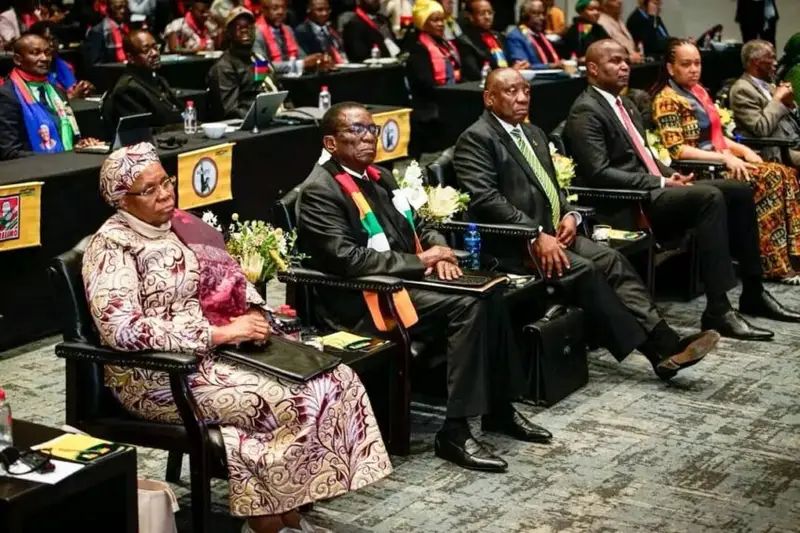
That was never more evident than at the just-ended summit of former Southern African liberation movements, hosted by South Africa’s ANC in Johannesburg.
To directly receive articles from Tendai Ruben Mbofana, please join his WhatsApp Channel on: https://whatsapp.com/channel/0029VaqprWCIyPtRnKpkHe08
The gathering brought together leaders from FRELIMO of Mozambique, SWAPO of Namibia, MPLA of Angola, CCM of Tanzania, and Zimbabwe’s ZANU-PF—once proud movements forged in anti-colonial struggle, now grappling with the demands of post-liberation governance.
The contrast in tone and focus among these parties was impossible to ignore.
While most leaders used the platform to acknowledge the pressing need to adapt, renew, and reconnect with the changing aspirations of their people—especially the youth—ZANU-PF stood out like a relic.
President Emmerson Mnangagwa’s message was anchored not in reform or reflection, but in the familiar script of blaming “neo-imperialists” and “Western-sponsored opposition forces” for Zimbabwe’s national crisis.
It was a striking performance—one that revealed just how far removed ZANU-PF is from reality and from the direction other former liberation movements are now taking.
At the summit, the ANC’s President Cyril Ramaphosa stressed the need for economic transformation, youth empowerment, service delivery, and tackling corruption.
Namibia’s Netumbo Nandi-Ndaitwah spoke about re-earning the people’s trust and modernising party structures.
Even FRELIMO, once as rigid as ZANU-PF in its rhetoric, used the opportunity to call for stronger regional cooperation and a shift towards citizen-focused leadership.
Yet ZANU-PF, through Mnangagwa and Secretary-General Obert Mpofu, chose to double down on the narrative of foreign sabotage—a tired justification that has long ceased to be believable.
What made this position even more embarrassing was how disconnected it was from the constructive tone of the summit.
This was not a gathering designed to pat each other on the back for historic victories.
Rather, it was a sober moment of reckoning.
A recognition that former liberation movements are facing steep decline in popularity and legitimacy across the region—due to growing youth disillusionment, poor governance, and elite entitlement.
This reality has forced many of these movements to confront their weaknesses head-on.
All, it seems, except ZANU-PF.
Nowhere was this call for introspection more powerfully articulated than by former Mozambican president Joaquim Chissano, who delivered a keynote address at the summit’s official gala dinner.
Speaking directly to the assembled delegations, Chissano warned that many liberation movements had deviated from their founding principles and were no longer serving the people who had entrusted them with power.
He urged these movements to recommit to the ideals of dignity, democracy, accountability, and inclusive development—or risk becoming irrelevant.
His message was neither diplomatic nor vague; it was a bold challenge to the very parties gathered before him to embrace renewal or face extinction.
Chissano’s legacy gives his words weight.
He led Mozambique through war and into peace, presided over economic reforms, respected term limits, and stepped down voluntarily—an example of principled leadership in a region where many leaders cling to power despite widespread failures and public frustration.
His record is one of leadership defined by service, not self-preservation.
When Chissano warns that liberation parties have lost their way, he does so from the vantage point of one who chose integrity over entitlement.
In sharp contrast, Zimbabwe today is trapped in a downward spiral of economic collapse, service delivery failure, and state repression.
The ruling party, which once claimed to have liberated the country from Rhodesian rule, has now become the very force responsible for plunging millions into poverty.
With an unemployment rate estimated at over 90 percent, crumbling infrastructure, a near-worthless currency, and a brutal security apparatus, Zimbabwe’s crisis is self-inflicted.
Yet, instead of acknowledging this and engaging in meaningful reform, ZANU-PF finds refuge in imaginary enemies.
This obsession with blaming the West—while entirely ignoring the suffering of ordinary Zimbabweans—has become a political shield for ZANU-PF’s corruption, incompetence, and cruelty. I
n this worldview, every critic is a puppet, every protester an agent of foreign interests, every journalist a saboteur.
There is no space for self-critique, no room for accountability.
And most tragically, there is no interest in listening to the cries of a nation that has endured too much for too long.
Other former liberation movements are at least trying to re-engage with their people.
The ANC, for all its challenges, now faces real electoral consequences and is being forced into coalition-building and policy reform.
SWAPO and FRELIMO have admitted their popularity is waning, and have opened space—however limited—for debate about internal renewal.
The direction is not perfect, but it is evident.
ZANU-PF, by contrast, seems determined to cling to an outdated script in which its liberation war credentials excuse every abuse, every failure, and every broken promise.
The danger in this approach is that it infantilizes citizens.
It tells Zimbabweans that they are too naïve to know who is truly responsible for their misery—that their suffering is simply the result of external manipulation.
But the people know the truth.
They live it every day.
They see their hospitals collapsing, their children learning by candlelight, their currency reduced to worthless paper.
They don’t need the West to tell them who has failed them.
What Zimbabweans need is leadership that listens, reforms, and delivers—not leadership that hides behind ghosts of colonialism while building private mansions and offshore bank accounts.
True sovereignty is not defined by rejecting foreign influence; it is defined by empowering your people to live in dignity.
And true patriotism is not a slogan—it is service.
ZANU-PF’s performance at the Johannesburg summit confirmed what many have long suspected: that the party is more interested in defending its legacy than in securing Zimbabwe’s future.
In clinging to the past, it has lost sight of the present—and certainly has no plan for tomorrow.
That is why it stood isolated even among its peers, who have begun to acknowledge that legitimacy must be earned, not inherited.
Liberation movements must evolve or die.
The summit was a reminder of that truth.
ZANU-PF’s refusal to evolve is not resistance—it is regression.
And it is the people of Zimbabwe who continue to pay the price.
 TENDAI RUBEN MBOFANA - THE UN-OPPRESSED MIND!