As the Shona saying goes, “Nyama inonaka inotaura yega”—truly delicious meat speaks for itself; it doesn’t need anyone to market it.
In any normal, functional democracy, a president serving his final term—typically the second—is often at his most relaxed and least preoccupied with public image management.
To directly receive articles from Tendai Ruben Mbofana, please join his WhatsApp Channel on: https://whatsapp.com/channel/0029VaqprWCIyPtRnKpkHe08
After all, the individual has already secured the necessary mandate to lead and is no longer eligible for re-election.
This final lap is usually a time to implement policies that he genuinely believes in, free from the pressure of public opinion or fear of political backlash.
It is a period of legacy-building, where attention shifts from the theatrics of campaigning to the serious business of governance and delivery.
The president, having already earned the people’s mandate twice, now governs with the confidence and serenity that comes with nearing the end of an era—departing not out of rejection, but as a constitutional imperative.
In such a setting, one would hardly expect a continuation, let alone intensification, of efforts to market and prop up a leader who is not only ineligible for another term, but already on his way out.
It would be viewed as wasteful, unnecessary, and frankly bizarre.
And yet, in Zimbabwe, that is precisely what we are witnessing.
Despite President Emmerson Mnangagwa now serving what is constitutionally supposed to be his second and final term in office, there has been no let-up in efforts to bolster his public image.
If anything, these efforts have grown more feverish, aggressive, and desperate.
Tune in to the state-controlled Zimbabwe Broadcasting Corporation (ZBC) and you could be forgiven for assuming the country was preparing for a presidential election.
Songs glorifying Mnangagwa’s supposed achievements are played with nauseating frequency, creating the illusion of a man on the campaign trail.
News bulletins are a festival of flattery, with ministers, government officials, and ruling ZANU PF supporters queuing to heap praise on the president.
Incredibly, this praise is often for mundane and routine government functions: the drilling of a borehole here, the patching of a pothole there, the distribution of agricultural inputs that are often donor-funded or constitutionally mandated.
Such absurd levels of praise-singing would be ridiculous even in an election year.
That they are taking place now, when the president is supposed to be focused on concluding his term, raises deeply unsettling questions.
Why the obsessive image management?
Why the endless propaganda, the songs, the slogans, the airbrushed portrayals of success that few ordinary citizens can relate to?
The answer, perhaps, lies in a chilling possibility—one that is not only whispered in the corridors of power, but now debated openly in public discourse: the push for a term extension.
It is no secret that there are elements within Mnangagwa’s inner circle agitating for a postponement of the 2028 elections to 2030, which would in effect extend his stay in office.
They may try to sugar-coat it as a “one-time deferral” or cloak it in administrative or national interest arguments, but the implications are the same—undermining the constitution and subverting the will of the people.
And while the president himself has publicly denied having such intentions, the frenzied efforts to maintain his relevance suggest otherwise.
Even within ZANU PF, such manoeuvres have not been met with universal support.
Many within the ruling party are growing increasingly uncomfortable with the idea of tinkering with the constitution for one man’s political survival.
They understand the political risk of pushing an unpopular leader onto a weary and suffering population.
For this is not the Zimbabwe of 1980, nor even 2018.
This is a country where more than 80 percent of the population lives in poverty, where infrastructure is collapsing, and where corruption has reached unprecedented levels under Mnangagwa’s watch.
It is entirely understandable that the ruling elite would be nervous about the prospect of a referendum required for any constitutional amendment.
Zimbabweans are angry.
They are tired.
They are disillusioned.
Extending the term of the very man many blame for their misery would be politically suicidal.
It is in this context that we must view the over-the-top efforts to polish Mnangagwa’s image.
This is not routine public relations.
This is not legacy-building.
This is political damage control on steroids.
It is about rewriting the narrative and manufacturing public consent for a deeply unpopular presidency.
But propaganda can only go so far.
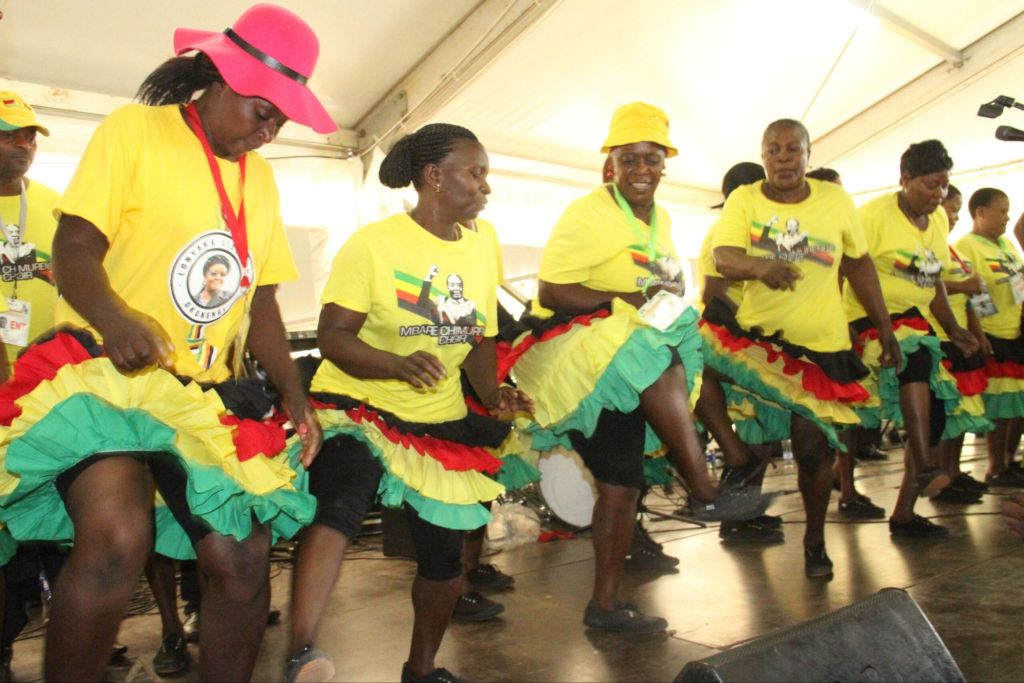
No matter how many times Mbare Chimurenga Choir belts out tunes praising the president, they will never mask the painful reality in Zimbabwean households.
If people’s lives were truly improving, they would not need to be told.
They would see it, feel it, and experience it daily.
They would not need songs and slogans to know their lives are better.
When a man can earn enough to feed his family without begging, when a mother can send her child to school without tears and anxiety, when families can access quality healthcare without mortgaging themselves—then we can talk of progress.
Until then, all the propaganda in the world will ring hollow.
Ordinary Zimbabweans are not interested in the expansion of an airport they will likely never use.
They are not impressed by a shiny new Parliament building gifted by the Chinese.
These are not the things that make life bearable.
What they care about is being able to buy their own cars without relying on shady handouts from controversial benefactors like Wicknell Chivayo.
They care about their dignity, their livelihood, and their children’s future.
If Mnangagwa had truly transformed the country, he would not need to be on television every other minute.
His works would speak for themselves—in classrooms that have books and motivated teachers, in hospitals that save lives, in roads that are passable without destroying one’s vehicle.
That is the real legacy any president should strive for.
Instead, we are witnessing what may go down as the most unpopular presidency in Zimbabwean history.
And this unpopularity is not manufactured.
It is earned.
It is earned in the broken dreams of the youth, whose futures have been squandered.
It is earned in the tears of families who bury loved ones lost to a failing healthcare system.
It is earned in the frustration of civil servants whose salaries can’t buy them even a week’s worth of groceries.
It is earned in the despair of a population stripped of hope, dignity, and voice.
So, is it really a surprise that the ruling elite feels compelled to keep propping up the president, despite the constitutional clock ticking toward his departure?
The louder the propaganda, the more deafening the silence of real transformation.
The more elaborate the praise, the more glaring the absence of substance.
Ultimately, a truly successful president does not need to shout about his achievements.
A great leader is seen and remembered not through songs or speeches, but through the tangible change he brings to the lives of his people.
That is what history remembers—not how loudly you sang your own praises, but how quietly you changed lives.
 TENDAI RUBEN MBOFANA - THE UN-OPPRESSED MIND!