Few things are as dangerous as self-delusion—especially in matters of national importance.
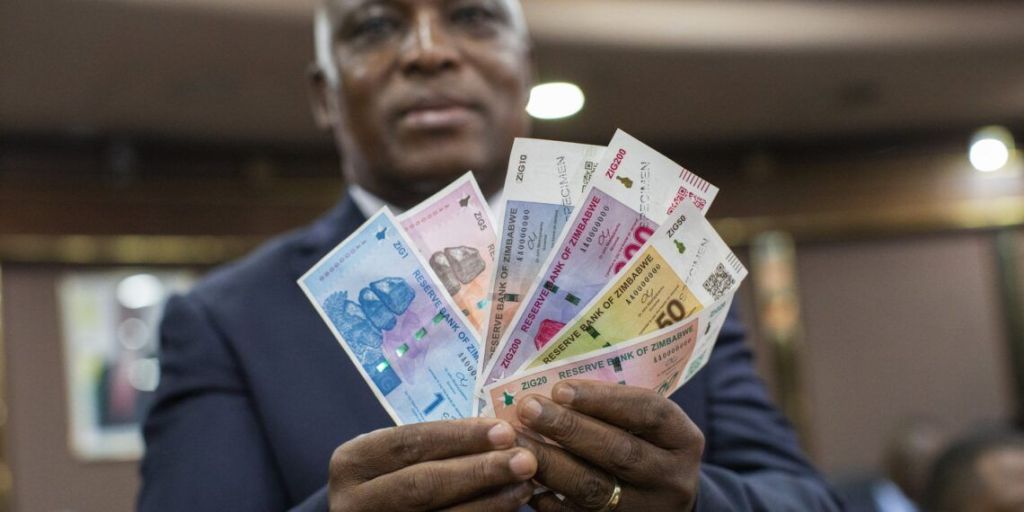
This past week, the Reserve Bank of Zimbabwe (RBZ) sought to allay public concerns about the availability of the Zimbabwe Gold (ZiG) notes, insisting there is “more than enough cash” circulating in the economy—even beyond Harare.
To directly receive articles from Tendai Ruben Mbofana, please join his WhatsApp Channel on: https://whatsapp.com/channel/0029VaqprWCIyPtRnKpkHe08
In a statement issued on June 13, RBZ Governor Dr. John Mushayavanhu expressed satisfaction with what he described as the “significant” improvement in the usage of the ZiG across the economy.
He pointed to data from the National Payment System showing a dramatic increase in local currency transactions: from ZiG7.86 billion (26% of total transactions) in April to ZiG56.8 billion (43%) by May 30.
At face value, these figures may suggest a welcome resurgence in confidence in the local currency.
However, to interpret this rise in transaction volumes as a genuine sign of public trust in the ZiG is both misleading and disingenuous.
Zimbabweans are not embracing the ZiG out of confidence or choice.
They are simply using what they are compelled to accept.
This increase in usage is largely the result of structural coercion.
Salaries for civil servants and many private-sector workers are being paid partially or wholly in ZiG.
Government departments, parastatals, and regulatory agencies are demanding payment in the local currency.
Companies must meet their tax obligations—such as Value Added Tax (VAT), Pay As You Earn (PAYE), and corporate tax—in ZiG.
All of these policies force the currency into circulation, creating the illusion of acceptance.
But beneath that illusion lies a deeply skeptical public that has been burned too many times to believe again.
Zimbabweans have endured decades of currency instability.
Since the turn of the millennium, the country has cycled through no fewer than six versions of a local currency—each one collapsing due to hyperinflation, policy inconsistency, fiscal indiscipline, and lack of public trust.
From the infamous bearer cheques to the bond note and the RTGS dollar, citizens have watched their savings vanish and their purchasing power erode time and again.
It is entirely rational, even expected, for Zimbabweans to approach the ZiG with caution, suspicion, and outright rejection—regardless of what the central bank proclaims.
Dr. Mushayavanhu’s claim that “the RBZ stands ready to support demand” and “defend the ZiG’s value at all costs” is difficult to accept when the fundamentals underpinning the currency remain questionable.
As of June 12, the central bank says there were total deposits of ZiG16 billion in the banking system, with over ZiG207 million in physical cash held by banks.
On paper, this may sound adequate.
But the lived experience on the ground tells a different story.
In many towns outside Harare—particularly in rural areas—cash remains hard to access.
Banks still have limited ATM functionality for ZiG, and many shops continue to operate in a dual pricing system that favors the U.S. dollar.
What we are seeing is not a seamless rollout of a trusted national currency but a restricted, uneven, and tightly controlled system where the ZiG is being artificially kept afloat.
This artificiality extends to the notion of stability.
A currency cannot be said to be stable simply because its exchange rate appears fixed on paper or in official communications.
True stability arises from open market access, convertibility, and confidence.
The ZiG lacks all of these.
It cannot be exchanged freely even within Zimbabwe without encountering difficulties, and it certainly cannot be exchanged abroad.
There is no bank in Johannesburg, London, or Gaborone where one can walk in and convert ZiG to rand, pound, or pula.
That tells us all we need to know about the global view of its credibility.
The core problem is not the denomination of the currency.
It is the trustworthiness of those behind it.
Until Zimbabwe’s economic and political leadership can demonstrate sustained fiscal discipline, reduce corruption, uphold transparency, and create a predictable policy environment, no currency—no matter how cleverly branded or gold-backed—will earn the public’s trust.
What the RBZ characterizes as increased usage is actually a manifestation of Zimbabweans’ survival instincts.
Those who earn part of their salaries or pensions in both USD and ZiG instinctively hold onto the U.S. dollar while quickly spending the ZiG.
This is not driven by convenience but by fear.
The fear that the local currency will lose value overnight, as it has done so many times before, remains deeply ingrained in the Zimbabwean psyche.
Many people still hold on to thousands—if not millions or even billions—of worthless bearer cheques, bond notes, and Zimbabwe dollars that they had once saved with the hope of purchasing something meaningful in the future.
Those hopes were crushed as the value of those currencies evaporated almost overnight, rendering entire life savings useless.
That trauma has not been forgotten.
So today, people offload the ZiG immediately—not out of loyalty to it, but as a survival instinct, to shield themselves from the financial ruin they’ve already lived through.
If Zimbabweans truly believed in the ZiG, they would save in it.
They would invest in it.
They would demand to be paid fully in it.
Instead, they treat it as a hot potato—something to get rid of as quickly as possible.
This is the starkest indicator of public distrust.
And it is why any self-congratulatory statements from the central bank must be met with skepticism.
Confidence is not imposed. It is earned.
It cannot be created through public relations campaigns or inflated usage statistics.
It must be built through consistent, principled, and transparent governance.
The very fact that the ZiG needs constant defense by authorities is evidence of how fragile it truly is.
A real currency, backed by sound economic policies and trusted institutions, does not need to be force-fed to the population.
What Zimbabwe needs is not another monetary rebranding exercise.
What we need is systemic reform.
Until we address the root causes of our currency instability—such as lack of accountability, unsustainable public spending, and politicized economic policy—we will continue to chase shadows.
No amount of spin from the RBZ can change that reality.
Ultimately, the issue at hand is bigger than the ZiG.
It is about trust in those in power.
And unless that trust is rebuilt from the ground up, no currency born under their watch will ever truly belong to the people.
 TENDAI RUBEN MBOFANA - THE UN-OPPRESSED MIND!