The moment a government begins to view the media as an enemy is the moment it begins to lose its legitimacy.
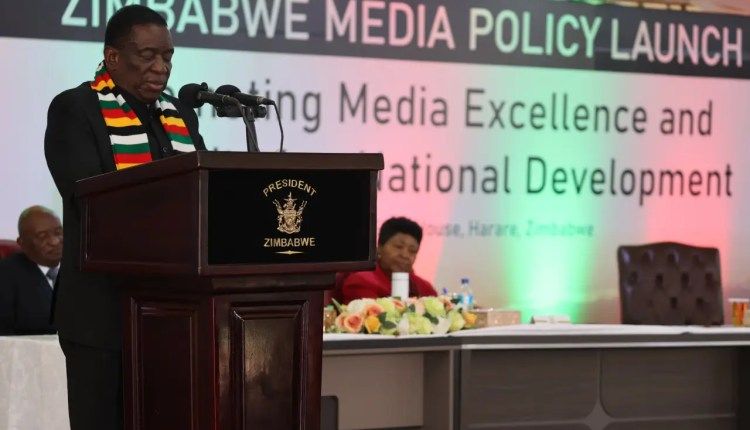
President Emmerson Mnangagwa’s remarks during the launch of the Zimbabwe Media Policy on 28 May 2025 reveal a disturbing tendency by the state to weaponize patriotism against legitimate scrutiny, and to equate dissent with disloyalty.
While the policy’s stated aim of fostering ethical journalism and curbing misinformation sounds reasonable on the surface, the president’s repeated assertions that the media should avoid “tarnishing the image of the country” betray an underlying desire to mute critical voices rather than engage with them.
What makes this underlying intent even more alarming is the president’s own chilling warning during the policy launch: “Anything besides this, chibhakera muziso” — literally, “a punch in the eye.”
Such a threat, coming from the country’s highest office, reveals an inclination toward intimidation rather than dialogue.
It signals that any media coverage deemed insufficiently patriotic risks violent retribution, a dangerous precedent in any democracy.
This is deeply troubling in a constitutional democracy.
To directly receive articles from Tendai Ruben Mbofana, please join his WhatsApp Channel on: https://whatsapp.com/channel/0029VaqprWCIyPtRnKpkHe08
The suggestion that journalists who highlight the daily struggles of ordinary Zimbabweans, expose high-level corruption, or demand accountability from public officials are somehow unpatriotic or agents of foreign interests is not only inaccurate but dangerously misleading.
When President Mnangagwa laments the media’s focus on what he calls “demonising our country,” what he often refers to are well-researched reports on Zimbabwe’s failing public health infrastructure, the crumbling education system, dilapidated roads, chronic unemployment, and grand-scale looting of natural resources by politically connected individuals.
These are not fabrications.
They are verifiable facts experienced by millions of Zimbabweans every day.
To report them is not to attack the nation—it is to defend it from the very forces eroding its foundations.
Independent and private media outlets in Zimbabwe do not operate with a vendetta against anyone.
In fact, many journalists and editors who work tirelessly in this space are among the most patriotic citizens in this country.
We wake up every morning driven by the hope that our work can help shape a better Zimbabwe—a Zimbabwe that works for all its people, not just a privileged political elite.
There is nothing patriotic about silence in the face of injustice.
If anything, real patriotism demands that we speak out, even at great personal risk, because we believe Zimbabwe deserves better.
The president’s insinuation that those who expose wrongdoing are the ones damaging Zimbabwe’s image is deeply ironic.
Is it the journalist who exposes the massive misappropriation of public funds—through shady procurement deals, dubious disposal of state assets, or questionable issuance of Treasury bonds involving top officials—who tarnishes the country’s image? Or is it the corrupt public official who orchestrates these crimes?
Is it the media that reports on hospitals running without essential medicines, or is it the government that underfunds them?
Is it journalists who are jailing themselves for doing their jobs, or is it the state wielding its power to silence them?
Blaming the mirror for the ugliness of the reflection is not only intellectually dishonest, it is an evasion of responsibility.
Zimbabwe’s global image is not shaped by headlines alone; it is shaped by actions—and the world sees what is happening here.
The media should never be reduced to a chorus of praise singers.
That is not our job.
As the Fourth Estate, we are constitutionally mandated to act as watchdogs—holding those in power to account and giving voice to the voiceless.
Our role is not to protect politicians from criticism but to protect the people from abuse.
That is why equating criticism of the ruling elite with criticism of the nation itself is such a dangerous fallacy.
It is a deliberate conflation designed to justify attacks on press freedom and stoke public hostility against the media.
When we criticize those in power, we are not attacking Zimbabwe—we are defending it from those who, through incompetence or corruption, are threatening its future.
What’s even more alarming is the president’s open threat that the “law and justice system will take its course on all those who infringe on the rights of others on media platforms.”
Given the recent track record of journalists being arrested, harassed, or surveilled under vague accusations of undermining state authority or spreading falsehoods, this statement sends a chilling message.
It suggests that the Media Policy is not merely about setting professional standards, but about tightening state control over what can or cannot be said.
It reinforces the perception that government sees an informed citizenry not as a pillar of democracy, but as a threat to its survival.
To be clear, no serious journalist supports disinformation or reckless reporting.
We all have a duty to adhere to professional ethics, verify facts, and respect the rights of others.
But when the government becomes the sole arbiter of what constitutes ethical journalism, the danger arises that only narratives flattering to the state will be deemed acceptable.
That is not democracy; it is propaganda.
What Zimbabwe needs is not a media that covers up problems, but one that uncovers them—so that they can be fixed.
Expecting the country’s image to improve by simply suppressing negative news is like trying to end crime by banning its coverage.
It’s a dangerous illusion.
The true path to restoring Zimbabwe’s reputation lies not in silencing the media, but in confronting and correcting the actions that have led to its tarnishing in the first place.
That means dealing decisively with corruption, restoring public services, respecting the rule of law, and ensuring justice for all citizens, including those in the media.
If President Mnangagwa and his administration are truly concerned about Zimbabwe’s image, they should begin by taking a long, hard look in the mirror.
It is their policies and actions—not the reports of journalists—that shape the world’s perception of our nation.
And should they start charting a new course based on transparency, accountability, and service to the people, we in the media would be the first to report on and celebrate such progress.
There is no greater patriotism than striving to see Zimbabwe become the country it truly can be—prosperous, just, and inclusive.
We will continue to do our job, not out of malice or disloyalty, but out of love for this country and its people.
No amount of intimidation will deter us from this calling.
And no policy, however well-dressed in nationalistic rhetoric, will change that fundamental truth.
 TENDAI RUBEN MBOFANA - THE UN-OPPRESSED MIND!