There’s a peculiar talent nestled within Zimbabwe’s ruling party, ZANU-PF, one that stands out amid its long and tumultuous history: the party is remarkably adept at dismantling the legacies of its own leaders.
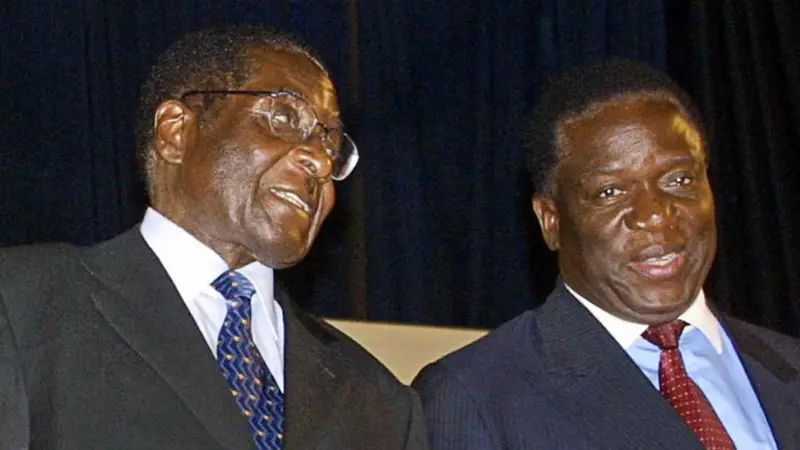
It’s not that these leaders—titans like Robert Mugabe or Emmerson Mnangagwa—leave behind legacies worth celebrating.
Far from it.
Their tenures have been marred by economic ruin, political repression, and a relentless hunger for power that has reduced a once-promising nation to a shadow of its former self.
Yet, you’d think a party so steeped in its own mythology, so insistent on its revolutionary credentials, would at least try to honor its own, no matter how flawed they were.
Instead, ZANU-PF seems to revel in erasing them, turning their names into footnotes and their contributions into inconvenient memories.
To directly receive articles from Tendai Ruben Mbofana, please join his WhatsApp Channel on: https://whatsapp.com/channel/0029VaqprWCIyPtRnKpkHe08
This self-destructive streak fascinates me—not because I honor these leaders, but because it reveals something deeper about the party’s nature, its insecurity, and its inability to reconcile its past with its present.
Let’s begin with the obvious: neither Mugabe nor Mnangagwa has much to offer in the way of a laudable legacy.
When Zimbabwe gained independence in 1980, it was hailed as the “jewel of Africa,” a nation brimming with potential despite 15 years of United Nations sanctions imposed on the Rhodesian regime.
Its agricultural sector was robust, its education system enviable, and its currency held weight.
That was the inheritance Mugabe squandered over 37 years, transforming a breadbasket into a basket case through chaotic economic policies and systemic corruption, and a repressive grip that silenced dissent.
Mnangagwa, his successor, has followed suit, presiding over an economy where inflation soars, unemployment festers, and corruption thrives unchecked.
These are men whose presidencies have left Zimbabweans impoverished, disillusioned, and wondering what cosmic offense they committed to deserve such stewardship.
Their legacies, if you can call them that, are cautionary tales—monuments to hubris and mismanagement.
But my curiosity lies not in their failures—those are well-documented—but in why ZANU-PF, the very machine that elevated them, seems so determined to bury them once they’re gone.
Take Mugabe, for instance.
Today, February 21, 2025, marks another “Robert Gabriel Mugabe National Youth Day,” a public holiday ostensibly tied to his birthday.
It’s a day rooted in the 21st February Movement, a youth initiative Mugabe championed to celebrate those born post-independence, a nod to his vision of a new Zimbabwe.
You’d expect his name to loom large, his image plastered across banners, his speeches replayed with reverence.
Yet, listen closely: the state calls it simply “National Youth Day.”
The full title is a ghost, rarely uttered by officials or party loyalists.
This isn’t a mere linguistic trim for brevity’s sake.
If it were, the day itself would still pulse with Mugabe’s memory—tributes to his liberation struggle, reflections on his decades in power.
Instead, it’s a hollow shell, a platform hijacked by Mnangagwa to laud his own supposed achievements and peddle the fiction that he’s a champion of the youth.
The irony is thick.
Zimbabwe’s youth, the very group this day claims to honor, are drowning in an economic quagmire—unemployment rates hover above 80% by some estimates, and corruption siphons off what little opportunity remains.
Mnangagwa’s speeches ring hollow against the backdrop of a collapsing currency and a diaspora swelling with young Zimbabweans fleeing for greener pastures.
If this day were truly about Mugabe, it might at least nod to his early years, when he invested in education and healthcare, fleeting wins before his descent into tyranny.
But no—his name is a whisper, his legacy scrubbed clean.
It’s as if ZANU-PF fears that invoking him might expose the continuity of failure, the unbroken thread connecting Mugabe’s era to Mnangagwa’s.
Contrast this with South Africa, where Nelson Mandela Day on July 18 remains a vibrant tribute to their founding president.
Across the border, the day brims with purpose—community service projects, reflections on Mandela’s fight against apartheid, and celebrations of his post-1994 reconciliation efforts.
His name isn’t just preserved; it’s exalted, a lodestar for a nation still grappling with its own challenges.
South Africans don’t pretend Mandela was flawless, but they ensure his legacy endures as a touchstone.
In Zimbabwe, Mugabe’s erasure feels deliberate, a calculated act by a party eager to shed the baggage of its past without ever confronting it.
This pattern isn’t new.
It’s baked into ZANU-PF’s DNA, a legacy of internal purges and power grabs that stretch back to its founding in 1963.
Consider Ndabaningi Sithole, the party’s first president.
A key figure in the liberation struggle, Sithole was ousted in 1976 via the Mgagao Declaration, a military-backed maneuver by ZANLA fighters that handed Mugabe the reins.
It was a coup in all but name, and Mugabe wasted no time sidelining Sithole, later hounding him into exile in the United States.
After independence, Sithole’s contributions were downplayed, his hero status denied even in death.
Mugabe didn’t just defeat him; he erased him, setting a precedent for how ZANU-PF handles its own.
Fast forward to 2017, and history rhymed: Mugabe himself was toppled in a military-orchestrated ouster, orchestrated by Mnangagwa and his allies.
The party turned on its patriarch with ruthless efficiency, and the erasure began almost immediately.
Look at the streets of Kwekwe, where Robert Mugabe Road was swiftly renamed ED Mnangagwa Road post-coup.
It’s a petty but telling act—physical evidence of how quickly ZANU-PF discards its icons.
Mugabe’s fall wasn’t just a power shift; it was a symbolic obliteration, a signal that loyalty lasts only as long as utility.
Mnangagwa, now clinging to power, must sense the same fate lurking.
He’s 82, his grip tightening as factionalism within ZANU-PF simmers—Vice President Constantino Chiwenga, a key player in the 2017 coup, is often whispered as a successor eyeing his own moment.
If Mnangagwa exits—whether by ballot, bullet, or biology—I’d wager his name will vanish from the party’s lexicon within two years.
His “Vision 2030” slogans will fade, his roads will be rechristened, and his tenure will be reduced to a cautionary blip.
Why does ZANU-PF do this?
It’s not just pettiness or pragmatism.
It’s a survival instinct, honed over decades of infighting and paranoia.
The party thrives on a myth of unity and invincibility, a narrative that crumbles under scrutiny of its fractured past.
To preserve that myth, each leader must be a blank slate, unburdened by the sins of their predecessor—yet they inherit the same playbook of repression and ruin.
Mugabe’s land grabs begat Mnangagwa’s mining scandals; the Gukurahundi massacres of the 1980s echo in today’s abductions of activists.
By erasing its leaders, ZANU-PF avoids reckoning with this continuity, dodging the mirror that might force it to confront what it’s become.
I’ve never admired Mugabe or Mnangagwa.
As a social justice advocate, I spent years decrying their regimes, their trampling of rights, their hollow promises.
But I can’t help but marvel at this self-inflicted amnesia, this cycle of exaltation and erasure.
It’s a party that builds statues only to topple them, that crowns kings only to guillotine them.
And therein lies its grim genius: by destroying its leaders’ legacies, ZANU-PF ensures its own survival, a hydra regenerating with each severed head.
Yet, for Zimbabweans, it’s a tragedy—a nation trapped under a party that devours its own past, leaving nothing but rubble for the future.
Perhaps one day, the people will write a different story, one that doesn’t end in erasure.
Until then, ZANU-PF’s talent for self-destruction remains its most enduring legacy of all.
 TENDAI RUBEN MBOFANA - THE UN-OPPRESSED MIND!