Watching the Zimbabwe Broadcasting Corporation (ZBC) is torturous on many levels.
The programming is woefully poor and substandard, while the news coverage is unapologetically biased and partisan.
This once-thriving broadcaster, admired across the region, has become a disgraceful propaganda tool for the ruling ZANU-PF party.
Ironically, in its fervent attempt to prop up the government, ZBC inadvertently exposes the extent of Zimbabwe’s decline under ZANU-PF rule.
Every day, viewers are bombarded with reports of communities receiving handouts from government officials or their allies.
These donations are often presented as a fulfillment of President Emmerson Mnangagwa’s mantra of “leaving no one and no place behind.”
Yet, these gestures only highlight how Zimbabwe has been reduced to a nation of beggars, reliant on aid to survive.
Just this morning, ZBC aired two stories that epitomize this narrative.
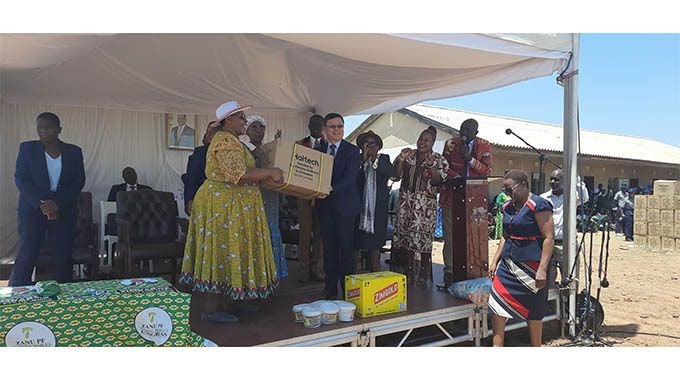
In Bulawayo, elderly residents and children were shown receiving groceries from First Lady Auxillia Mnangagwa.
Simultaneously, ZANU-PF and the Chinese embassy distributed fertilizers, groceries, and solar lights to villagers in Zvimba East.
These spectacles, intended to portray a caring government, instead underscore a grim reality: Zimbabwe, once known as the “jewel of Africa,” has been reduced to a country where handouts are normalized and celebrated.
To directly receive articles from Tendai Ruben Mbofana, please join his WhatsApp Channel on: https://whatsapp.com/channel/0029VaqprWCIyPtRnKpkHe08
In the 1980s, poverty in Zimbabwe was not as widespread as it is today.
Communities were largely self-reliant, and those who needed aid were in the minority.
I remember my childhood in Redcliff, where as a Boy Scout, we supported the few less fortunate families in our community.
Later, at Kwekwe High School, I led a charitable group that raised funds for underprivileged students who needed school frees, uniforms and stationery.
The plight of the poor and oppressed has always been at the core of my heart, and that is why even today, I am still speaking out for the suffering, impoverished and oppressed.
Back then, nonetheless, poverty existed but was not the norm.
Today, however, the situation is starkly different.
Over 70% of Zimbabweans now live below the poverty line, while nearly 50%—around 7 million people—live in extreme poverty, surviving on less than $2.15 per day according to the World Bank, which reflects the minimum income needed to meet basic necessities like food, shelter, and clothing.
This marks a drastic departure from the self-reliant nation of decades past.
Instead of addressing the root causes of this poverty, the government has normalized it.
Officials celebrate the distribution of mealie meal, cooking oil, and agricultural inputs as if it were a mark of success.
This approach is emblematic of a leadership that has failed to create opportunities for self-sufficiency, instead reducing citizens to charity cases.
A significant factor in this decline is unchecked corruption.
Zimbabwe loses an estimated $2.8–$3 billion annually to corruption, with $1.8 billion lost through illicit financial flows and $1 billion through internal corruption.
This amounts to nearly half of the national budget.
Such staggering losses are reflected in Transparency International’s Corruption Perception Index, where Zimbabwe scored a dismal 24 out of 100 in 2023, ranking 149th out of 180 countries globally.
The consequences are felt across all sectors: from healthcare and education to infrastructure and employment opportunities.
With nearly half the budget siphoned off by corruption, it is no surprise that millions of Zimbabweans cannot afford basic necessities.
This systemic failure is compounded by the government’s inability—or unwillingness—to hold perpetrators accountable.
The lack of meaningful action against high-profile corruption cases underscores the complicity of those in power.
Perhaps the most insidious consequence of this governance failure is the normalization of dependency.
Zimbabweans are being conditioned to view handouts as an acceptable way of life.
Public displays of charity by the ruling elite, often accompanied by pomp and ceremony, send a troubling message: that survival depends on the benevolence of those in power.
Even those who are not destitute are not immune to this culture of dependency.
Prominent personalities openly accept and beg for gifts, including luxury vehicles, from individuals with questionable reputations.
We now feel privileged to receive something back from those who stole from us in the first place!
Rather than being seen as exploitative, these transactions are celebrated, perpetuating a cycle where citizens feel indebted to the same elites who have impoverished them.
Zimbabweans must reject this narrative.
We are not a nation of beggars, nor should we accept a system that treats us as such.
The solution lies in demanding accountability and equitable distribution of resources.
The wealth of this nation belongs to its people, not a select few.
Corruption must be rooted out, and those responsible must face justice.
Economic policies should prioritize job creation and empowerment, enabling citizens to regain their independence.
Most importantly, Zimbabweans must refuse to normalize the abnormal.
We must remember the pride and self-reliance that once defined this nation.
It is not too late to reclaim that legacy.
But it will require collective action, courage, and an unwavering commitment to holding those in power accountable.
Only then can we restore Zimbabwe to its rightful place as a land of opportunity and dignity.
This is not a fight for handouts.
It is a fight for justice, fairness, and the right to a better future.
 TENDAI RUBEN MBOFANA - THE UN-OPPRESSED MIND!