Today, as I was contemplating the painful horrid lives we are enduring in Zimbabwe, I wondered what exactly characterized a failed state.
I, as so many other Zimbabweans, have always believed that our country qualified in this ‘hall of shame’, but I just needed to be super sure.
So, I asked Meta AI what constituted a failed state.
I was shocked but not necessarily surprised by what popped up.
A failed state was defined as a country characterized by a collapse or weakness of government institutions.
It had the inability to provide public services, such as security, healthcare, and education.
There was widespread conflict and lawlessness.
A failed state was also known for its economic instability or collapse.
Human rights abuses or absence of rule of law were another prominent hallmark.
There was brain drain and displacement or mass migration of citizens.
Finally, failed states were defined as associated with humanitarian crises, for example, hunger, and a dependence on external aid or intervention.
Does all this not sound eerily familiar?
Surely, does this not aptly describe Zimbabwe?
To directly receive articles from Tendai Ruben Mbofana, please join his WhatsApp Channel on: https://whatsapp.com/channel/0029VaqprWCIyPtRnKpkHe08
So, next time we refer to Zimbabwe as a failed state, we will not be denigrating our own country.
We will only be speaking the truth.
We say it to point out these glaring realities – no matter how embarrassing and even unpalatable to some – in the hope that whatever is being done wrong in the country is corrected.
There is no point – in fact, it’s counterproductive – lying to ourselves, in the name of some misplaced ‘patriotism’, by glossing over the manner in which our once prosperous country has been rundown by those in power.
Genuinely patriotic Zimbabweans want to see a Zimbabwe that reverts to its former glory days of, and even become better than, the ‘jewel of Africa’.
However, the only way to do so is by diagnosing and calling out how we reached this level of failure as a state and offering remedies.
How did we get here?
Decades of misrule, corruption, and economic mismanagement have ravaged the country, leaving its citizens destitute and desperate.
With one of the highest inflation rates in the world – placed at a staggering 880% per year by renowned John Hopkins University economics professor Steve Hanke – Zimbabwe’s failed state status is undeniable.
According to 2023 World Food Program (WFP) Zimbabwe Country Brief over 7.5 million people are facing hunger, and a staggering 90% of the population living below the poverty line (World Bank Poverty and Equity Data).
The government of Zimbabwe had to beg the international community for US$2 billion in food aid.
The ruling ZANU PF party’s stranglehold on power has stifled democracy, suppressed dissent, and perpetuated human rights abuses.
Unsurprisingly, Zimbabwe ranks 129th out of 137 countries in the 2023 Global Peace Index.
In other words, there is no peace in the country, in spite of the ruling elite’s unashamed attempts at glossing over the people’s suffering whilst misrepresenting ‘peace’ as merely the ‘absence of war or civil unrest’.
There is more to peace that such a simplistic characterization.
An impoverished hungry person, with no hope for the future, can surely not be said to living in peace.
The same applies to someone living in fear of one’s own leaders.
The government’s disregard for human rights is exemplified by the disappearance of over 60 activists and opposition members since 2018, based on a 2023 Amnesty International Report.
The August 2023 harmonized elections were roundly condemned by most international elections observers, with the Southern African Development Community (SADC) characterizing them as falling short of regional guidelines and principles governing democratic elections.
Hundreds of opposition supporters and human rights defenders were arrested this year alone on spurious charges, and most are still languishing in pre-trial detention after having been repeatedly denied their constitutional right to bail.
All this reflects negatively on the country’s institutions – such as the electoral commission, judiciary, and law enforcement, amongst others – which have been abused for the political objectives of the ruling party.
Zimbabwe’s economy is in shambles.
Hyperinflation and currency volatility have decimated industry, agriculture, and commerce.
Over 75% of the population relies on informal trading, according to the Zimbabwe National Statistics Agency (ZimStats), which means most Zimbabweans are surviving from hand to mouth without much hope for decent dignified livelihoods.
That is why, in spite of our universities churning out an average 30,000 graduates as year, most of them are without any meaningful economic activity in which to engage.
Some, despite possessing impressive university degrees, are left with no choice but to go for lowly nurse aide training in the hope of migrating to the UK to work as home care workers.
It is estimated that between 4 and 7 million Zimbabweans live outside of Zimbabwe, which is roughly 30 percent of the country’s population.
No wonder our youth have sunken into a life of dejection and despair, characterized by rampant drug and substance abuse, which threatens to destroy an entire generation.
To make matters worse, Zimbabwe has never had a pass rate over 30% in its Ordinary Level examinations in the past 30 years!
The average pass rate has been a paltry and most worrying 19.86% – meaning that amongst the citizenry of Zimbabwe, about two-thirds did not passed their Ordinary Level examinations, leaving them in even worse hopelessness.
Nonetheless, this does not point to these people’s intellectual capacity/intelligence (or lack of), but rather a woefully dysfunctional education system.
Most schools in Zimbabwe – particularly in rural areas, peri-urban settlements, and even high-density urban suburbs – do not have access to adequate learning materials.
Whilst some school children in more privileged communities have access to the latest science and technology education, the less-advantaged (the vast majority) do not even have chairs, desks, and books.
According to statistics released by the Amalgamated Rural Teachers Union of Zimbabwe (ARTUZ, in 2022 alone, 63 percent of rural children dropped out of school.
This has been attributed to various factors, including financial constraints, adolescent pregnancy, and drug abuse.
Recently, primary and secondary education minister Edgar Moyo disclosed that in 2023, more than 4,500 learners in Zimbabwe dropped out of school due to pregnancy, including at least 150 in primary school.
Now, that is staggering!
It becomes even more chilling.
85 percent of rural school children lack reading skills, and 86 percent do not have numeracy skills.
In the same breath, there is a massive shortage of teachers in rural schools – with ARTUZ reporting that there was a shortfall of 20,000.
Poor remuneration and deplorable working conditions (particularly in rural areas) were cited as the main causes of this deficit.
We can also look at the collapsed health care sector where the country’s main public hospitals were built during the colonial era, which means that most infrastructure and equipment are either in a sorry state or non-functional.
In fact, Zimbabwe’s largest hospital only has one functional maternity theatre, which was built in 1977, whilst 2500 pregnant women die every year giving birth.
The vast majority of the country’s public health care facilitates lack basic medications and ambulances with much-needed cancer machines nowhere to be found.
The government of Zimbabwe would rather purchase a presidential jet for a staggering US$54 million, yet a maternity ward reportedly costs only US$37,000 to build.
We could have had 1,459 new maternity theatres constructed instead of buying a luxury jet for the president!
Not only that, but Zimbabwe is a richly-endowed country with over 60 identified precious minerals, which should place us amongst some of the most advanced and developed nations on the planet.
Yet, this is not possible as over US$2 billion of our natural resources, according to the Centre for Natural Resource Governance (CNRG) director Farai Maguwu, are looted each and every year by those close to power who are never brought to book.
The ruling elite in Zimbabwe would rather allow Chinese mining companies to plunder our natural resources – whilst also displacing communities from their ancestral lands, desecrating heritage and sacred sites, and destroying the environment – for zero benefit to the country.
Imagine how our livelihoods could improve if each year this US$2 billion was used for national development.
There is also a crippling power crisis whereby the country experiences load shedding for nearly 18 hours each day, which is prejudicing Zimbabwe an estimated US$80 million every month in lost production (Zimbabwe National Chamber of Commerce).
This is largely attributable to a reliance on antiquated colonial-era power generation equipment, which is a direct result of a lack of political will to invest in this sector, as well as corruption, mismanagement, and poor planning.
Who can forget the US$5 million given to shady businessman Wicknell Chivayo for the construction of a 100 MW Solar Power Plant in Gwanda, which still has not been done since the deal was made in 2015?
Most urban areas have now gone for years without potable, safe, and clean water – where communal boreholes have become the order for the day, thereby posing a real health risk.
This is primarily due to the lack of investment in the construction of sufficient water bodies in the country and the upgrading of water purification and distribution infrastructure.
If the government of Zimbabwe had invested in meaningful water bodies, today no one would be crying over an El Nino-induced drought since we would have simply relied on our dams for water.
In fact, the over-reliance on boreholes now poses a huge risk to underground water supplies as well as a threat to the environment and infrastructure stability due to land subsidence (the gradual settling or sudden sinking of the Earth’s surface owing to subsurface movement of earth materials).
The consequences of Zimbabwe’s failed state are stark.
The figures are simply startling.
Zimbabwe’s instability poses regional and international security risks.
In conclusion, Zimbabwe’s failed state status demands urgent attention.
The people of Zimbabwe deserve better.
It’s time for the people of Zimbabwe to act.
We can not continue living under such unbearable conditions.
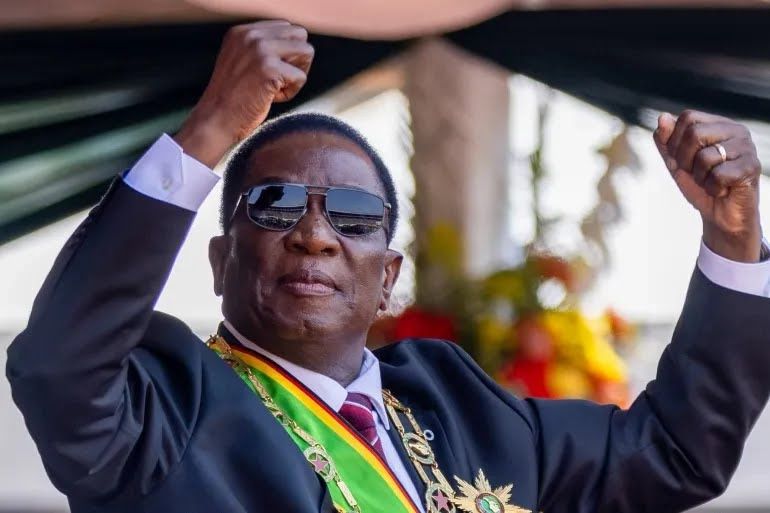
Worse still, the man presiding over this mess actually believes he deserves to remain in office beyond his constitutional term limit ending in 2028!
If this was not a grave issue of the indescribable suffering of the ordinary people of Zimbabwe, I would have declared these moves as a huge joke.
It goes without saying that a president of a failed state is himself a failed president.
 TENDAI RUBEN MBOFANA - THE UN-OPPRESSED MIND!