Last year, we had Jacob Ngarivhume.
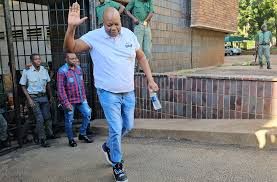
Then today, it is Job Sikhala.
Both of these renowned opposition leaders were found guilty of committing various crimes by Zimbabwe courts.
Ngarivhume was convicted of inciting public violence, and on 28th April 2023, he was given a three-year prison sentence.
Similarly, on 7th February 2024, Sikhala was fined and given a nine-month suspended prison sentence after being found guilty of publishing or communicating falsehoods prejudicial to the State.
Nonetheless, there was something woefully wrong with both these convictions.
For starters, Ngarivhume was tried and found guilty in the absence of any prima facie evidence.
In the same vein, Sikhala was convicted and sentenced on a crime that no longer existed in the country’s laws.
In fact, section 31(a) (iii) of the Criminal Law (Codification and Reform) Act [Chapter 9:23] was struck off the statute books by the Constitution Court in October 2013.
How, on God’s green earth, did a supposedly competent court of law in Zimbabwe ever come to the conclusion that an individual could be guilty either without any prima facie evidence or on a crime that did not exist?
That is why on 11th December 2023, on appeal, the High Court reversed both of Ngarivhume’s conviction and sentence.
However, that was cold comfort as he had already spent eight months behind bars!
We witnessed the same thing happening today when High Court judges Justices Pisirayi Kwenda and Benjamin Chikowero quashed both of Sikhala’s conviction and sentence.
We should not forget that Sikhala spent nearly 600 days in pre-conviction detention after being repeatedly denied his constitutional right to bail.
What I find most troubling is that Ngarivhume and Sikhala were convicted and sentenced by the same person… Chief Magistrate Feresi Chakanyuka.
There is an even more unsettling angle.
Why is it that these courts seem determined to convict and sentence those fiercely and fearlessly opposed to the Mnangagwa administration even when there is ordinarily no case to answer?
In April 2021, High Court Judge Justice Jester Charewa set aside anti-corruption journalist Hopewell Chin’ono’s prosecution on the same charges of publishing or communicating false statements prejudicial to the State.
Chin’ono had been placed on remand by Harare Magistrate Lazin Ncube after being charged on a crime that did not exist in Zimbabwe’s law.
As if this was not already a huge embarrassment on Zimbabwe’s judiciary, in April 2023, opposition official Fadzayi Mahere was found guilty by Harare Regional Magistrate Taurai Manwere on exactly the same charges.
As has become the norm, reprieve only came when a higher court quashed the conviction and sentence on 28th February 2024.
Let us not forget that individuals primarily targeted by this undoubted travesty of justice are those who are loudly opposed to the President Emmerson Dambudzo Mnangagwa regime.
Why would all these magistrates find predominantly opposition figures guilty on charges that are non-existent?
The question then arises: What is wrong with our courts in Zimbabwe?
How do those who are expected to be thoroughly trained and knowledgeable about the law end up coming up with such ‘kangaroo court’ judgements?
Are we now governed by the law of the jungle in Zimbabwe?
Can those who believe that our courts are captured by the ruling establishment then be blamed?
It is undeniable that the magistrate courts have become the weapon of choice by the Mnangagwa regime to persecute and silence voices of dissent.
This is what has come to be known as ‘the weaponization of the law’, or ‘lawfare’.
Even when it is clear that no crime has be committed, opponents of the Mnangagwa administration are arrested on spurious charges, remanded in custody (whilst their trials drag on for what seems an eternity), and then found guilty.
Only after appeal at a higher court may they finally receive some justice.
However, the damage would have already been done.
Not only would these perceived dissenters have had their freedom stolen from them, but they also endured the trauma of being separated from their loved ones.
There is a real possibility that some such as Sikhala could also have even been poisoned, which forced his decision to go overseas for a thorough medical checkup immediately after his release from prison on 30th January 2024.
The torturous experience behind bars – with Sikhala having endured months of solitary confinement – is also designed to break the souls and spirits of these brave men and women.
In addition, the time in prison would have kept them away from standing up against the regime’s oppressive kleptomaniac ways – thereby removing the only genuinely courageous voices for the oppressed and impoverished people of Zimbabwe.
To cap it all off, these convictions are meant to place a criminal record on these activists, meant to tarnish their reputations and even deny them an opportunity to participate in future elections.
In fact, it would appear the Mnangagwa administration somehow endorses this flagrant miscarriage of justice.
What are we to think when a prosecutor such as such Michael Reza is ‘rewarded’ with a high post to head a very important institution as the ZACC (Zimbabwe Anti Corruption Commission)?
This is a man whose career was characterized by his rabid obsession with remanding opposition activists in custody, most of whom that were, nonetheless, later cleared after appeal.
If the judiciary wants to be taken seriously, it needs to rid itself of officials who have brought disrepute to our justice delivery system.
If the Mnangagwa regime wants to be seen as not having captured the judiciary and respects it as an independent institution, then there is an urgent need to appoint credible officials.
All bad apples in our judiciary have to be uprooted, and the justice system cleansed.
No country on the planet can be regarded as a democracy when its judiciary is used as an instrument of repression.
 TENDAI RUBEN MBOFANA - THE UN-OPPRESSED MIND!