Recent utterances by President Emmerson Dambudzo Mnangagwa to his Russian counterpart Vladimir Putin have raised an issue that has bedeviled Zimbabwe for the past few decades.
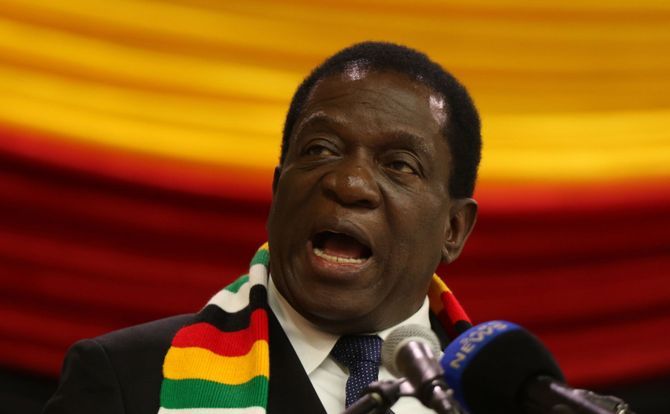
In his wild allegations, Mnangagwa accused the US of ‘consolidating its power’ in neighboring Zambia, in the process leaving ‘us lonely’.
It was undoubted that he was trying to paint an image of a Zimbabwe under an increasing security threat from the US using Zambia as a gateway.
This was all part of the ‘illegal regime change’ narrative driven by the ZANU PF government, particularly over the past two and a half decades, more so after the land reform program of the early 2000s.
In this agenda, Western powers are supposed to be determined to bring down the regime in Zimbabwe and replace it with their puppets.
There may be some truth in those claims.
However, there are even more truths that the Mnangagwa regime does not want the people to know.
As much as the West, particularly the UK and US, was obsessed with getting rid of then leader Robert Gabriel Mugabe – the situation has since changed.
Granted, these Western powers tried every trick in the book to eliminate Mugabe – through sanctions, a failed UN Security Council resolution, the opposition, and even militarily invasion.
However, something there is an important fact that needs to be noted.
Mugabe had been their blue-eyed boy since before Zimbabwe attained its independence – with the British largely believed to have played a covet part in the formation of ZANU as a breakaway from Joshua Mqabuko Nkomo’s ZAPU in August 1963.
The was because, at the time, ZAPU was viewed as ‘dangerous Communists’ due to the backing they received from the Soviet Union.
This was at the height of the Cold War, and colonial Zimbabwe found itself as one of the fighting grounds for global hegemony.
As such, since the ‘winds of change’ were already sweeping across the region, the British had come to terms that Zimbabwe was next to gain its independence.
Therefore, they needed to ensure that whoever took over power had to safeguard their interests.
They found those people in ZANU.
Some may say that ZANU was sponsored by the Chinese.
Indeed, it was – nonetheless, the British has absolutely no problem with that since China in the 1960s and 70s was just an ordinary struggling nation and not a global player at the time.
At the sane time, although Mugabe made all the right noises about ‘Socialism’, the British knew very well that he was really a Capitalist at heart and was merely saying these things to receive Chinese assistance.
In addition, this was a most convenient setup since Britain could not be seen siding with those fighting their kith and kin in Rhodesia.
The British would simply lay low and make sure that their puppets, ZANU, would take over at independence.
That is why in 1980, Lord Soames – who was the UK governor during the transition period – made sure the elections went ZANU’s way, in spite of ZAPU being more popular.
He was to become quite good friends with Mugabe.
According to a reliable source who was privy to the dealings at independence, when Tanzania leader Mwalimu Julius Nyerere questioned the British on how it was possible ZANU won the elections, all the ballot papers were promptly shipped off to the UK where they were burnt.
In fact, that is how ZANU learned the art of rigging as their only way of both attaining and retaining power – since they were fully aware that the party was not genuinely loved by the masses.
It is the same reason, immediately after independence (1883 to 1987), the Mugabe regime embarked on a systematic genocide against the people of the Matebeleland and Midlands provinces.
This was designed to annihilate ZAPU once and for all.
The British turned a blind eye to these atrocities.
There was no condemnation of human rights abuses, let alone sanctions, because these massacres gelled well with their plan to keep out the Soviets.
That is why, as his hands were dripping with the blood of innocent Zimbabweans, Mugabe was knighted by Queen Elizabeth II and accorded numerous awards for his ‘outstanding leadership’.
Only when Mugabe reneged on his mission to protect Western interests at the turn of the millennium – by backing the grabbing of white-owned farms by veterans of Zimbabwe’s independence struggle – did these global powers begin shouting about human rights.
Targeted sanctions on high-ranking officials and some entities were imposed shortly afterward.
This was all meant to both punish Mugabe and his cronies, as well as push them out of power.
The main opposition at the time, Morgan Richard Tsvangirai’s MDC, was funded by these global powers – as the new darlings of the West who would safeguard their interests.
In 2008, these countries even pushed for a UN Security Council resolution imposing tougher economic sanctions on Zimbabwe – which was vetoed by China and Russia.
This was to also serve as a pretext for military invasion either through Zambia or Botswana.
The regime change agenda was in full throttle.
However, all these machinations failed to oust Mugabe – with the opposition having every election victory stolen from them through blatant vote rigging, intimidation, and ruthless violence.
The West needed plan B.
This is where everything gets very interesting.
WikiLeaks’ release of US diplomatic cables at the time tell a very disturbing story.
After realizing that the sanctions, UN resolutions, and opposition route were not working, the US resorted to effecting regime change through the ruling ZANU PF itself.
According to Julian Assange’s WikiLeaks leaked US cables, there were several clandestine meetings between the Americans and high-ranking ZANU PF government officials.
In a cable that followed a meeting with a ZANU PF politburo member, a US diplomatic cable reads, “There appears to be a growing realization among some of those in the ruling party’s senior ranks that Zimbabwe is in a very deep hole and that [President] Mugabe’s departure from the scene is a necessary precondition for the policy changes required for an economic turnaround and a restoration of political stability.”
This set the stage for what was to happen in November 2017 – when Mugabe was forced to resign in a military coup d’état backed by some of his own ZANU PF comrades – ushering in Mnangagwa as the new president.
Immediately upon taking over, the UK Ambassador to Zimbabwe Catriona Laing (a former MI6 secret agent) congratulated Mnangagwa and pledged to work closely with his regime.
It is believed Laing is the one who actually coined the phrase ‘new dispensation’ in reference to Mnangagwa’s administration.
This was clearly intended to create the false impression that this government was totally different from Mugabe’s.
Even today, Mnangagwa always makes sure to distinguish his regime as the ‘Second Republic’.
He entered into an agreement with dispossessed white farmers for multi-billion dollar compensation.
Most targeted sanctions were removed in short order as relations between Zimbabwe and the West gradually improved.
Regime change had finally been achieved!
Nonetheless, the Americans were a bit skeptical of Mnangagwa at first since they regarded him as having been too close to Mugabe and untrustworthy.
They would have preferred anyone else from ZANU PF, but just not Mnangagwa
That is why they kept targeted sanctions in place until only recently, where relations are now warming.
Any continued criticism of the Mnangagwa administration by the West is all part of an act designed to keep up the impression that they (West) are concerned about human rights.
If the West never cared about human rights as the ZANU PF regime massacred thousands of innocent civilians in the 1980s, why would they care today?
Even the support of the opposition of two decades ago is all but gone – no wonder the unending chaos and confusion.
Just as in the 1980s, as long as their interests are protected, then it is business as usual.
As such, all this talk by Mangwana of the West still seeking ‘regime change’ in Zimbabwe is a whole lot of rubbish.
The regime change that Mugabe feared and talked about nearly on a daily basis was accomplished in November 2017.
There are no longer any other ‘regime change’ plans by Western powers on the table.
Mnangagwa is their new puppet and blue-eyed boy – as long as he does not make the same mistake Mugabe made in 2000.
 TENDAI RUBEN MBOFANA - THE UN-OPPRESSED MIND!