So, finance minister Mthuli Ncube, over the past weekend, went around shops in Bulawayo, like a crazed vigilante – demanding small businesses to accept payments in local currency – whilst tearing down tags displaying prices strictly in US dollars!
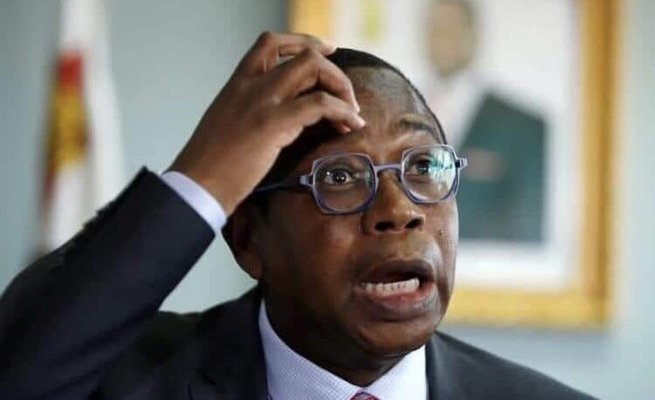
He even berated a hapless lowly branch manager of a renowned chain retail supermarket over prices – strangely appearing to forget that such decisions were made at head office.
I would have assumed that someone in the form of a government minister would have opted to communicate directly with the supermarket’s executives.
Even I, just being an ordinary citizen, am known for directly communicating with head offices – when I feel my grievances have not been satisfactorily addressed at branch level.
So why did Ncube feel that making an embarrassing spectacle of himself at these establishments was the most intellectual thing to do?
All this being done not only by a mathematical finance PhD degree holder from the prestigious Cambridge University in the UK – but also past chief economist and vice president of the AfDB (African Development Bank)!
Surely, how did he expect these laughable theatrics to resolve our seemingly unending recurring economic crisis in Zimbabwe?
Let us also remember that most of those places he ambushed, like a marauding out-of-control lion, were informal enterprises – which the government has dismally failed to regulate and control over the course of years!
I can bet Ncube this – barely two hours after leaving these shops in Bulawayo, new prices tags in US dollars were already up!
Instead of breathing fire and brimstone – whether at individual businesses or the entire sector – the government of Zimbabwe, of which Ncube is representing, should be dealing with the causes of this skyrocketing of prices.
As popular iconic musician, Oliver Mtukudzi, once sang, ‘Wongorora chikonzero chaita musoro uteme’ – in other words, when there is a problem, one needs to deal with the cause, and not simply the symptoms
In fact, it is common knowledge that the main driver is the rabid exchange rate between the local currency and the greenback – which is now at a shocking ZW$2,600 to US$1 at the official RBZ (Reserve Bank of Zimbabwe) auction system.
On the more referenced parallel market – where, most businesses and ordinary citizenry access the scarce hard currency – the US dollar is trading at a staggering ZW$4,500.
As such, it goes without saying that, in the absence of any genuine resolution to these glaringly unsustainable exchange rate volatilities and disparities – both hyperinflation (currently at over 700 per cent), and the rejection of the local currency will be a daily occurrence in Zimbabwe.
Even if Ncube goes around town tearing down price tags, haranguing branch managers, and threatening punitive legal action – the facts on the ground will not change.
As much as this is painful to us consumers, nonetheless, businesses will do whatever it takes to survive in such an unpredictable environment – as they forward price their goods and services (in order to cope with hyperinflation), and the ever-falling exchange rate.
What sense is there in selling one’s goods and services in useless Zimbabwe dollars – when what you earn as a business will not be enough to restock, or may even be rejected by suppliers?
I asked this question in a past article, “If Mnangagwa had a shop how much would he sell a loaf of bread?’
As it turns out, according to his spokesperson, George Charamba, actually he does own one…DCK Bakery in Kwekwe.
Can someone please care to share with me how much an average loaf of bread costs at this establishment!
I bet my last dollar that one will not likely find a loaf going for anything much cheaper than the rest of other bakeries in the country.
The President Emmerson Dambudzo Mnangagwa regime is fully aware what needs to be done, and the action that has to be taken.
First and foremost, the Zimbabwe authorities can do the most obvious thing of fully dollarizing the economy – considering that, already over 75 percent cent of all transactions are in the US dollar – including, those by the government itself, such as taxes, duty, tariffs, passports and more.
As much as Ncube recently ordered state institutions to start charging in the local currency – and only accepting US dollars from willing clients – this is a bit too late.
The fact that even the government had also opted for hard currency, and rejecting our own Zimbabwe dollar, helped erode any little confidence Zimbabweans still had for their money.
All these clearly insincere and reluctantly made moves will not help revive the Zimbabwe dollar – which we all should finally admit, has reached its last days.
A currency loathed and distrusted by its own people can never hope to survive.
If totally doing away with the local currency is not a good idea, then Zimbabwe needs a floating exchange rate – where forces of supply and demand are permitted to operate freely in determining the trading price.
This will, in all likelihood, at least align the two exchange rates (official and parallel) – so that our local businesses have only one rate with which to work.
However, this will never reign in the Zimbabwe dollar’s frightening freefall – as issues of confidence (or lack of) will always haunt this currency.
In so doing, the government also needs to give the central bank a reasonable measure of sovereignty or autonomy – in order to make independent monetary decisions.
It is a well known fact that unwarranted interference by fiscal authorities has been one major reason that the RBZ auction system had been dysfunctional – where the exchange rate has been rigged.
Similarly, these scarce resources have mostly been accessible to selected cartels aligned to the ruling elite – who buy the US dollar at cheaper prices at the central bank, then make a killing on the parallel market – where they resell at exorbitant rates.
Just imagine the maddening profits for someone who buys the greenback at ZW$2,600 from the central bank – then pouring it onto the streets, where it is sold at ZW$4,500?
There are those who blame contractors offered tenders by the government – who are part-paid in the local currency, after which they offload it on the ‘black market’ – for pushing up the rate.
This may be true.
In fact, the government’s propensity to print loads of useless money, in order to pay for all these tenders and other ‘development projects’, has indeed been a major driving force behind the local currency’s spectacular fall.
Nonetheless, the question is, “Where is all that readily-available foreign currency on the streets coming from – most of which is in mint condition?”
Those are the real crooks – who are always getting preference on the RBZ auction system, ahead of the productive sector – who are feeding the parallel market.
At the end, our producers, manufacturers and others are left with no option than to source the desperately needed hard currency on the same ‘black market’ – where politically-aligned cartels poured the US dollars they scandalously obtained from the auction system.
No wonder most of those big sharks behind this so-called ‘black market’ are reportedly now filthy rich – procuring the latest flashy cars, building mansions in leafy suburbs, and holidaying all over the world.
That is the real reason the Mnangagwa regime will never seriously address this economic crisis in Zimbabwe – since doing so would effectively turn off those overflowing financial taps for these cartels.
Instead, they prefer deploying Ncube to perform his drama and theatrics on the streets – all meant for the optics, in trying to fool the public that the government was seized with the matter.
The plan is also to portray the business sector as the real enemies – who derived some perverted pleasure from the people’s misery.
Let me challenge Ncube and his comrade!
When the economy was dollarized between 2009 and 2018 – where were these supposed ‘saboteurs’, as the economy remained stable for a whole decade?
Did the prices of bread, mealie meal, cooling oil, public transport, and other basics not stay the same for years – until Mnangagwa grabbed power in 2017, in a military coup d’état?
Zimbabweans are sick and tired of a government that never owns up to its failures – but, always in search of scapegoats to blame.
The dire situation in Zimbabwe does not require ‘Mukadota-like antics’ – but for Ncube and his colleagues to implement sound policies that strength the economy.
As I have written before, stabilizing the currency is not enough – since what that simply entails is keeping such fundamentals as inflation and the exchange rate at a steady rate.
This can even mean managing to maintain the exchange rate at ZW$4,500 to US$1 and annual inflation at 700 per cent for a couple of months.
That is not tenable – as the prices of goods and services will still be largely out of reach for millions of ordinary Zimbabweans – in spite of remaining unchanged for months.
Let us remember that most employees still earn in the local currency, and their salaries will not likely be increased in order to catch up with the ‘stable’ exchange rate and inflation.
What is urgently needed is for the economy to be strengthened – where prices of most goods and services become affordable for the majority of ordinary citizens – and, remain as such.
The ball is now squarely in the court of Mnangagwa and his team.
They need to make brave decisions that may even go against their friends who are immensely benefiting from these skewed lopsided exchange rate disparities through arbitrage.
If this means fully dollarizing the economy – thereby, immediately shutting down cartels on the streets – so be it!
 TENDAI RUBEN MBOFANA - THE UN-OPPRESSED MIND!